Summary
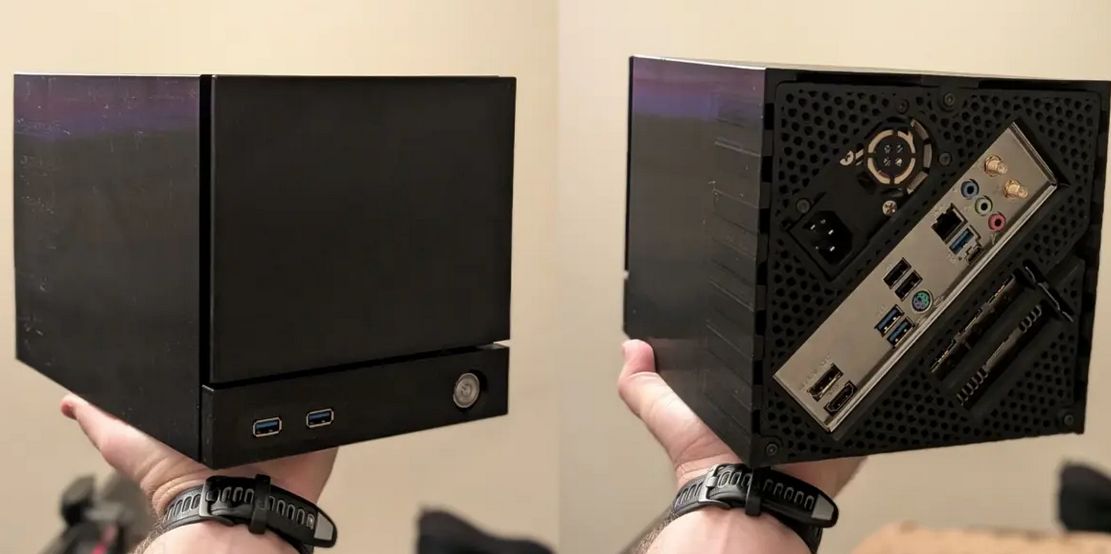
The recently released Valve Steam Machine is somewhat awkward in that it uses a custom, non-standard PCB and non-standard power supply. This fact apparently has irked some people who decided that it makes perfect sense to try and cram a Mini-ITX board, Small Form Factor (SFF) PSU and full-sized discrete GPU into an enclosure of the same size. Cue the SFF Mini-ITX Steam Machine Case project by [3DCatt] over at Printables. This is apparently a project done in cooperation with AMD’s [Jacob Terkelsen], who showed off the 3D printed case stuffed full with the aforementioned parts, which includes a GeForce RTX 5060 GPU. Of note is that the Valve Steam Machine uses a different cooling configuration as it has both the CPU and GPU on the same PCB. These share the same massive heatsink, as can be seen in e.g. the [Gamers Nexus] teardown video. For this angular imitation machine it would have been nice to use a blower-style GPU, to exhaust the hot air rather than dump it all into the case. This is also an issue that was raised by [Jacob], with more ventilation added to mitigate the issue. What the overall performance will be compared to regular compact Mini-ITX cases remains to be seen, but if you really want to live the Steam Machine life and have some parts kicking around along with a 3D printer, it might be worth a shot. I’m curious to see thermals on a machine using this. It seems like the only source of air is from behind, in which case it’d intake backwash and go into thermal runaway. A few thoughts I had while going over the design I love ITX PCs so much This projects looks like its tailor made to be converted into a sheet metal construction design I love ITX PCs so much (did I mention this?) SFF PSUs are darn expensive, I find that HP 1200W server PSUs are slim, but also crazy inexpensive. You can find ATX wiring harness kits for them (or just solder wires on your own) to make/obtain a compact but super powerful PSU This design relies on one single large fan in the front. If it were me doing the design, I would have placed two fans on each sides, or maybe one on one side and the other one on top. Maximising airflow seems like a good idea, especially for ITX builds, and if you’re designing the case anyway, there is no reason why you shouldn’t go overboard. The angular, ‘mounted in air’ construction is a bit alarming to me. I don’t know much about the strength of the plastic they used but I feel its much safer to have PC components mounted on the bottom surface, just in case something breaks and falls down. Heaviest components at the bottom, to make CoG low in case its accidentally pushed. I personally associate ITX cases with travel and moving around in trains/air travel but a 3D printed case does not inspire confidence because of it being made of plastic. I myself own a Cooler Master NR200 case. Its really, really good as far as ITX cases go. All metal construction. But then again, I have no idea how strong 3D printed plastic is (I just print enclosures for my electronics projects, thats all). It may be fine.