Summary
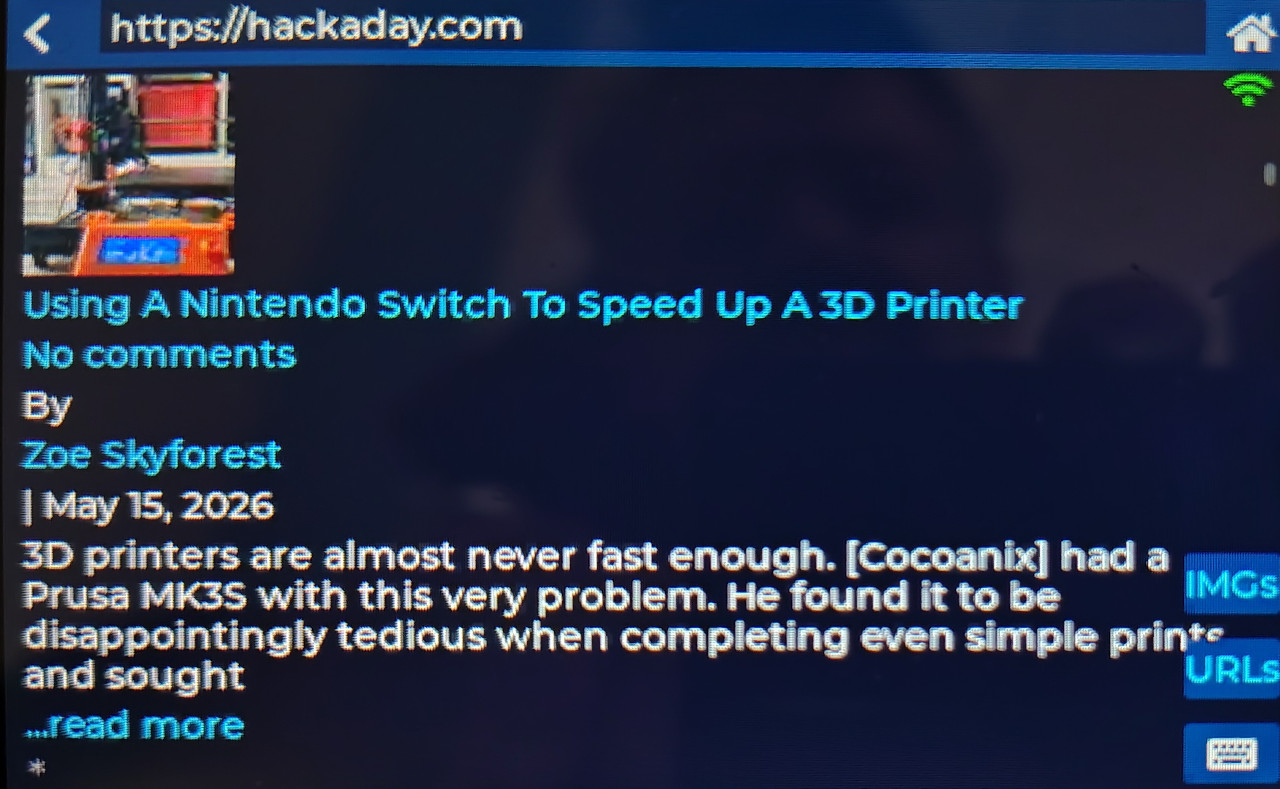
At the Hackaday Europe conference in Italy earlier in the year, we were shown a rather interesting device. The work of [Alun Morris], it was an ESP32-powered Cheap Black Display board, and it was running a web browser. Definitely an achievement. Lest you imagine that it was sporting the latest and greatest in browser technology, we must disappoint you. The browser in question is a very basic text mode device, but it did happily retrieve Hackaday, which should be the only test a browser should need to pass. Under the hood it’s running FreeRTOS, with separate HTML retrieval and tokenizing, and UI processes. It can fetch web pages directly, but there’s also a server-side proxy for difficult sites, and for creating image thumbnails. An ESP32 is a powerful microcontroller, but it’s fair to say it’s not in the league of running a web browser and as far as we can remember this is the first one we’ve seen. We’re sure it’s a field with further progress to be made though, particularly with the more powerful recent chips in the series. This project however is a good start, and more importantly it can be yours for a few dollars on Ali to buy a dev board. What are you waiting for? Maybe a more powerfull ESP32 could make a usable gadget. Like a S31 or P4+C6 Now we know. It’s easier to bring a web browser to a 240MHz ESP32 than an edit button on Hackaday comment’s section (not even a delete button) To be fair, seems pretty consistent with the last time I was browsing the web on an 8MB machine with SVGA level graphics. Hm. I think Netscape Navigator 2.0 in 1996 had more complete HTML support? I mean, PC/GEOS has Skipper/Webmagick browser and runs on an 286 with 640 KB or more RAM (supports swap file, EMS, XMS).. And to what I can see, these barebone www browsers can handle websites with frames, at least. Then there’s Arachne, Dillo and the new MicroWeb 2 for DOS. They all seem to run with 640 KB to 4 MB just fine. Not sure what to make of this ESP32 browser, thus. I hope it will continue to evolve, though. 🙂 Now that I think of it, this browser reminds me of Minuet from 1994! It had similar level of HTML support, but lacked input forms. Minuet ran on dated 4,77 MHz PCs still found in universities, for example. It supported text-mode, as well as Standard VGA and SVGA resolutions/color-depths (via VESA VBE). https://en.wikipedia.org/wiki/Minnesota_Internet_Users_Essential_Tool With PSRAM it should be much more capable. Who remembers Arachne browser? I hope work on a minimal host web client continues. I’ve built embedded UI/HMIs using all sorts of proprietary frameworks, every time wishing I could build a standard HTML/CSS/ES6 UI instead. I think the current minimal web client host starts with a full Unix or Android operating system on an SoC, far in excess of what is required to run the rest of the web stack.