Summary
Although Li-ion cells have become a lot cheaper over the years, if you wish to buy hundreds of high-quality ones for that performance go-kart project, you may feel financially pressured into going for the option of stripping down years-old commercial battery packs instead.
 While this is a financially sound option, you do have to figure out what the condition is of each cell before you happily stuff them into a new battery pack for said go-kart, as [Within Tolerance] recently did.
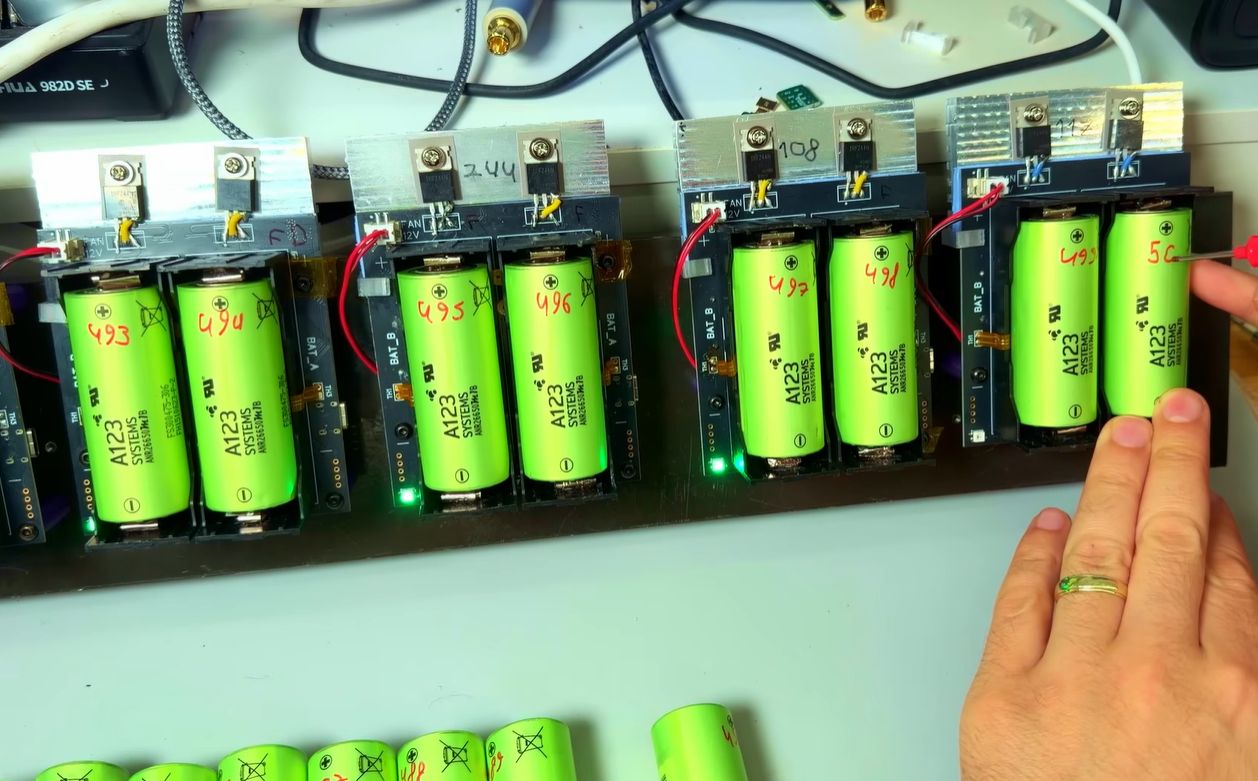
This is something that can be done manually, but for the 768 lithium iron phosphate (LFP) cells that were obtained for this project that’d be quite the tedious task. Hence it was decided to instead spend that time designing a system to automate this process, capable of charging, discharging, measuring and quantifying individual cells.
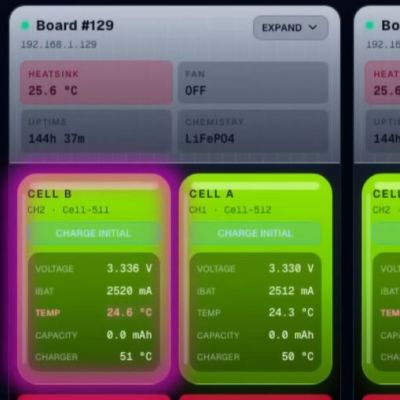
You can find the resulting Cell Goblin battery tester project on GitHub, which entails a custom PCB featuring an ESP32-S2 as the brains and associated software to monitor the process on a connected PC. Fortunately the issues on the PCB that are described in the video are claimed to be fixed in the repository version.
Using five of these dual-cell cell testers it was possible to run through the hundreds of cells with ten cells at a time. An internal resistance meter was also wired into the PC-based software via its UART. As of publication of the video the testing was still in progress, which gives some idea of how long it takes to work through those cells.
Is this darknet diaries voice?
LFP batteries lose around 1-2% capacity per year depending on the average SoC and temperature they’re kept in. Up to 4-5% if you keep it at 100% SoC all the time (e.g. a UPS battery). For a 13 year old battery that has been sitting half-full for 13 years, you can expect about 77 – 87% capacity from original.
Reference:
https://www.sciencedirect.com/science/article/pii/S2352152X23014135
And the data seems to agree. The ANR26650 A123 has a minimum 2500 mAh, typical 2600 mAh capacity when new. These cells seem to have dropped to somewhere between 80-92% of the typical capacity with an average around 86% which lines up well with the theory. Knowing this, the estimated loss has been 1.15% per year and the estimated EOL if the same continues should be around year 19. These cells may have another 5-6 years to go before they’re truly done.
This lines up with the predictions that LFP cells should last up to 20 years when kept well. An electric bus in active use is pretty ideal, since the batteries are constantly drained and the average SoC is kept fairly low.
When the capacity approaches 80%, the aging and wear-out mechanisms accelerate due to the damage that has already accumulated, so you can expect the cells to start failing somewhat sooner. The data also doesn’t reveal whether any individual cell started with more or less capacity, so some of the cells may already be at EOL and would soon start to fail, which is probably why the company ditched these as “junk”. The overall pack performance is limited by the weakest cells and it costs them too much to test and rebuild packs with old cells just to get couple more years out of it.
While this is a financially sound option, you do have to figure out what the condition is of each cell before you happily stuff them into a new battery pack for said go-kart, as [Within Tolerance] recently did.
This is something that can be done manually, but for the 768 lithium iron phosphate (LFP) cells that were obtained for this project that’d be quite the tedious task. Hence it was decided to instead spend that time designing a system to automate this process, capable of charging, discharging, measuring and quantifying individual cells.
You can find the resulting Cell Goblin battery tester project on GitHub, which entails a custom PCB featuring an ESP32-S2 as the brains and associated software to monitor the process on a connected PC. Fortunately the issues on the PCB that are described in the video are claimed to be fixed in the repository version.
Using five of these dual-cell cell testers it was possible to run through the hundreds of cells with ten cells at a time. An internal resistance meter was also wired into the PC-based software via its UART. As of publication of the video the testing was still in progress, which gives some idea of how long it takes to work through those cells.
Is this darknet diaries voice?
LFP batteries lose around 1-2% capacity per year depending on the average SoC and temperature they’re kept in. Up to 4-5% if you keep it at 100% SoC all the time (e.g. a UPS battery). For a 13 year old battery that has been sitting half-full for 13 years, you can expect about 77 – 87% capacity from original.
Reference:
https://www.sciencedirect.com/science/article/pii/S2352152X23014135
And the data seems to agree. The ANR26650 A123 has a minimum 2500 mAh, typical 2600 mAh capacity when new. These cells seem to have dropped to somewhere between 80-92% of the typical capacity with an average around 86% which lines up well with the theory. Knowing this, the estimated loss has been 1.15% per year and the estimated EOL if the same continues should be around year 19. These cells may have another 5-6 years to go before they’re truly done.
This lines up with the predictions that LFP cells should last up to 20 years when kept well. An electric bus in active use is pretty ideal, since the batteries are constantly drained and the average SoC is kept fairly low.
When the capacity approaches 80%, the aging and wear-out mechanisms accelerate due to the damage that has already accumulated, so you can expect the cells to start failing somewhat sooner. The data also doesn’t reveal whether any individual cell started with more or less capacity, so some of the cells may already be at EOL and would soon start to fail, which is probably why the company ditched these as “junk”. The overall pack performance is limited by the weakest cells and it costs them too much to test and rebuild packs with old cells just to get couple more years out of it.