Summary
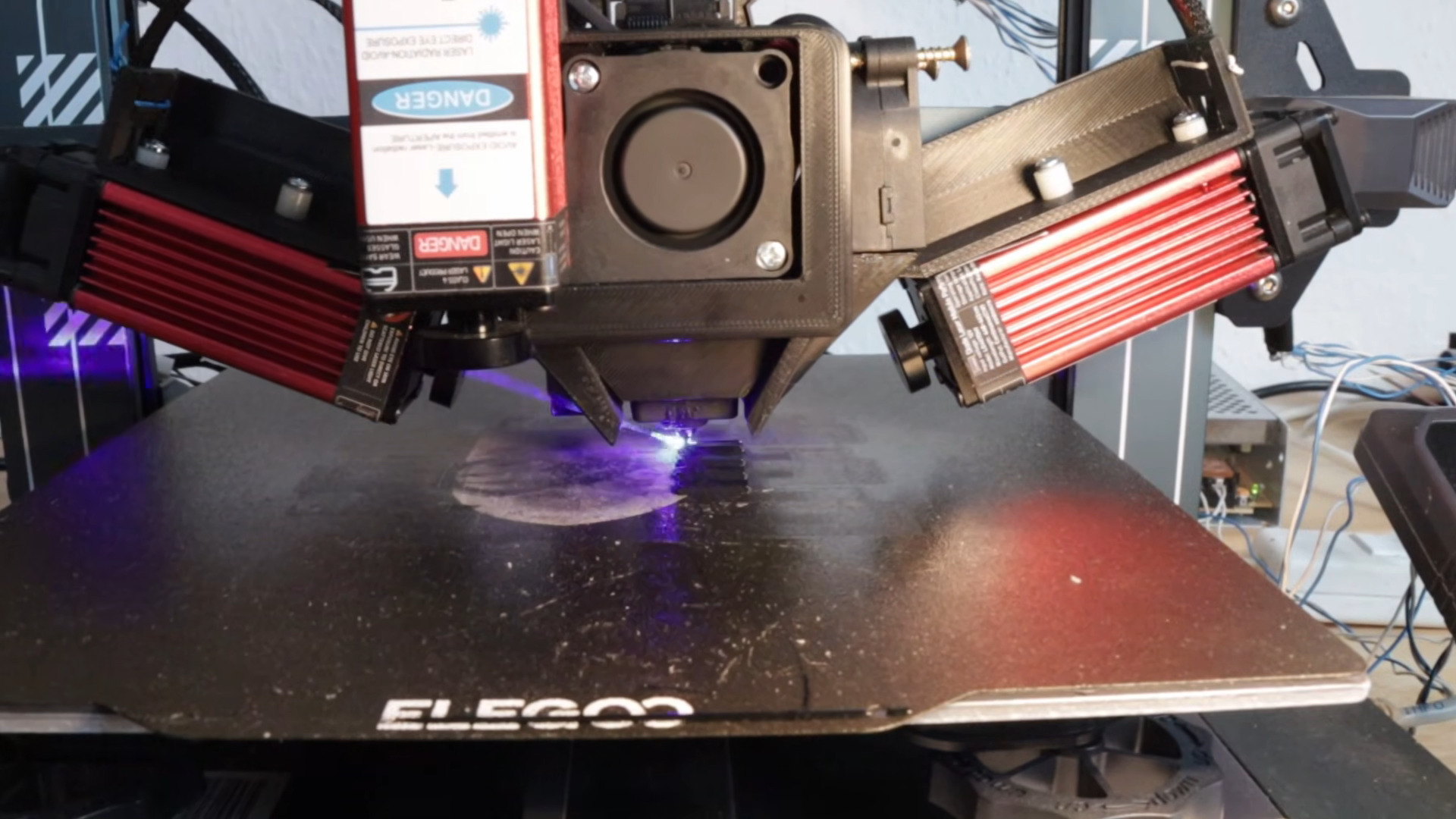
If there’s one defining factor about 3D printing you have to account for when you’re making a design, it’s probably layer adhesion. Sure, there are a lot of factors to consider, but having the z-axis of your part dramatically weaker than x- and y- is a pretty big deal in a whole lot of applications. [I Changed a thing] changed a thing to fix that — namely, he changed his 3D printer by strapping a couple of lasers to it. That’s the kind of hack we like to see! What the lasers are doing is a very simple idea: they’re pre-melting the last-laid-down-layer just under the nozzle so that molten plastic is meeting molten plastic to create a much stronger joint than you get when you extrude onto an already-cold layer. The second layer keeps the hotspot warmer longer, which also helps the bond. The resulting parts are not purely isotropic, but he’s getting breaking strain along the z-axis of ABS that’s up to 94% of what he’s measuring in the x direction, while PLA still rates at 77.9%. That’s compared to 60% and 41%, for un-lasered samples, respectively. If you watch the video, you’ll get all the details for the printing process and can see more test data. These lasers look like a game-changer, but their mass might slow down the fast coreXY printers that are so popular these days. If you don’t want to slow down, remember that changing your layer patterns can boost a print’s strength on its own. Thanks to [Josh Pensel] for the tip! I would like to see a test of these strengths vs. just using a heated chamber. If there are lasers like this the machine will need to be fully enclosed (and likely ventilated). So if the enclosure is required anyways…might as well verify if you even need the lasers. When I tested enclosures I was planning to have heaters/fans for the chamber temp but I realized pretty quickly that the heated bed gets the chamber to temp very quickly. It becomes an issue of needing to remove heat instead of adding it (at least in my tests). Aside from that…the idea of heating the layer with a laser (or hotair) has been kicked around quite a bit in the reprap community for years…good to see someone getting around to testing it. Regarding the issue with their mass, maybe putting the laser module away and putting a fiber as a guide-light between it and the nozzle to carry the light?