Summary
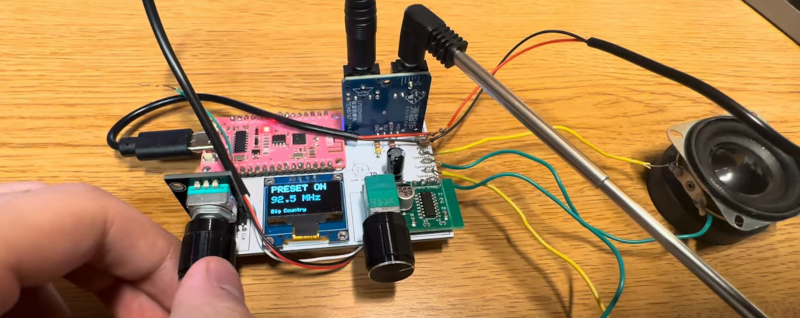
It used to be a rite of passage to build some sort of AM radio receiver. Many people started with a crystal radio, of course, but you’d graduate to maybe a TRF or superhet design. FM radio projects were not as common, because demodulating an FM signal was harder, as was making things work in the 100 MHz range. These days, though, you can get everything on a chip like the TEA5767, and [turtushig22-blip] has an open design that uses that device on a breakout board, a display, a knob, and an external amplifier. An ESP-32 pulls it together. You can see two videos about the project below. Unlike older FM radio designs, the TEA5767 doesn’t require any adjustments. RF goes in, and stereo audio goes out. You can control the device through I2C or a 3-wire serial interface. Software-wise, you send a five-byte control word and the chip sends back five status bytes. You don’t set the frequency directly, but provide a PLL divisor. For example, with a 32 kHz reference crystal, setting 100.1 MHz would be: 4*(100.1 MHz + 0.225 MHz)/0.032768 MHz = (about) 12247. The radio uses a 225 kHz IF and can autonomously seek stations. You can select whether the search is up or down, and the minimum acceptable signal strength. One unusual feature: the TEA5767 can select the positive or negative mixer output, which might be useful for image rejection in some cases. The output is purely analog, and there’s no RDS/RBDS decoder. So don’t expect station information on the OLED display. Still, a nice, easy FM radio build. Naturally, not the first TEA5767 build that we’ve seen. Or even the second. Well OK, but it’s an antique IC that’s been EoL for well over a decade, almost two! Shouldn’t promote old inferior stuff, though most cheap breakouts & modules are probably built with ‘modern’ cheap clones, replacements from 2nd-srces. Instead there are better FM-chips still in active production, e.g. Si473x family. Of which e-g- Si4735 actually seems quite popular also in DIY/”Maker” scene. Also featuring a really decent library for the ‘duino crowd (search “pu2clr/SI4735” on github) So all it is, is just sending some bytes over the I2C. Who cares? Driving HD44780 would’ve been more exciting. Somehow connecting up pre-built hi-tech modules like this doesn’t feel like it has the same magic as building a crystal set, including winding the coil yourself, and hearing your first radio station even though there is no battery. Not dissing this project though, can you even build a functioning crystal set these days? You can but there is little to listen to on AM these days. Also the threshold of kids amazement is higher than ours was ;-) I am not suggesting this is the new crystal radio project. I would think most kids today get a blinking LED Arduino or something over a radio project. So…this gives some kid (kids come in all ages), who knows nothing about electronics, the same—or more—satisfaction than building a crystal radio?