Summary
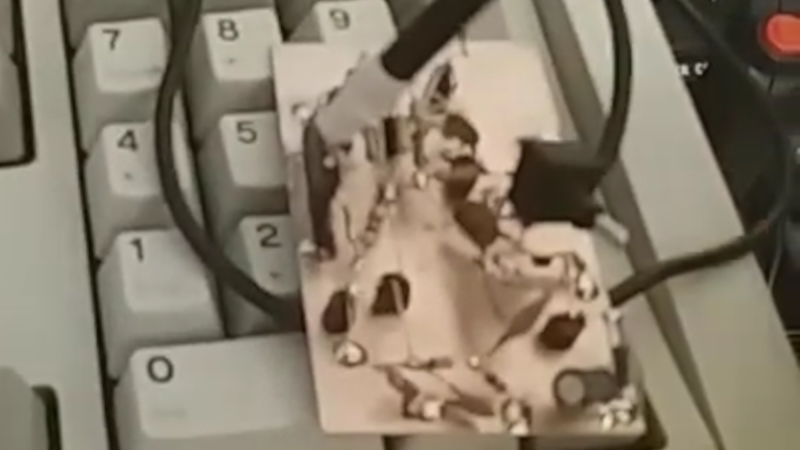
These days, modems are pretty fancy bits of kit, what with to keep up with the speeds of cable, VDSL, and fiber connections. At lower speeds, though, it’s entirely possible to build a modem out of simple discrete components. [sv3ora] did just that, building a simple modem for the CB2 Micro.
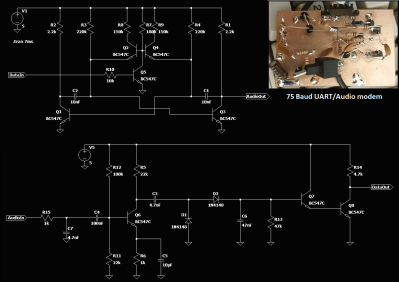 The project takes advantage of the fact that the V1.54 firmware for the CB2 Micro enabled 75 baud serial communication. Thus, it made sense for [sv3ora] to build a 75 baud modem to suit. As was the way in the days of dial-up internet, the modem modulates data into audio, demodulates audio back into data, allowing the CB2 Micro to send and receive data over telephone lines, ham radio links, or to store and retrieve data via mediums like cassette tape.
The device is built out of good old BC547 transistors. along with a smattering of diodes, resistors, and capacitors as supporting hardware. That’s all you need to turn slow serial into audio and back again. [sv3ora] does a great job of demoing the hardware, using it to store a program on tape and retrieve it again later.
We love old school modems around these parts. We’ve even explored ways to build your own dial-up ISP in the past!
Without any chips, this forces me to reconsider what exactly a modem is. In this case, just a circuit that converts serial bus signals to audible sound. Reminds me of an acoustic coupler without any acoustics.
A modem is a MODulator-DEModulator in the simplest sense. It intents to convert digital signals into analogue signals suitable for POTS (plain old telephone system), following the signal levels and frequencies that can be expected to work on that system, or any other system that has more bandwidth with vastly more complex modulation techniques like coax but must adhere to specific bandwidths as to not interfere with other transmissions.
Digital signals usually rely on square waves, which needs lots of harmonics (ie higher frequencies) to propagate properly, a POTS modem usually uses sine waves to limit the bandwidth or make optimum use of the available bandwidth like 56k modems do.
I’m no expert though, so others correct me if I’m wrong :)
Well, sure. That’s a telephone modem, meant for use over a telephone line. It’s really converting that digital signal into any sort of signal that can be sent through some medium where the digital signal alone might not fare so well and to also convert the received signal back to digital.
Instead of a phone line it could be radio waves, light via a fiber optic cable or even light via free space. You could build a modem that actually does use sound, perhaps audible or perhaps ultrasonic. Or maybe you can come up with something weirder than all that.
Yes, but there’s a catch: These audio signals aren’t necessarily “analog”.
I mean, they may if they have a pure sine waveform.
But on other hand, they are pre-defined audio pairs. That makes the, digital (pre-defined; digitus, fingered like a comb).
If they are two absolute digital signals (say, Bell norm or A/FSK in general), they are also binary.
The fax machine has same problem with definition.
It’s often mislabled as analog, but it uses absolute values.
A b/w fax machine is both digital and binary. It uses a black/white bitmap (bright, dark or 0 and 1).
The audio signals used by 2400 or 4800 Baud fax transmissions are simple A/FSK, too, if memory serves.
Well.. you are half right. You just described the “mod” in “modem”. It “mod”ulates the data into sound (or at least some sort of signal that is compatible with the medium you wish to transmit it across). It also has to “dem”oldulate the sound back to digital signal. That’s the “dem”. And yes, that’s all there is to it. Everything else your modern “modem” might do is just some other function crammed into the same box. For example, (a very unfortunate example in my opionion) many “modem”s today also have a router crammed into the box along with them. But that aspect of that box has nothing to do with the concept of a “modem”.
You’re right, I think.
But people have different ideas about this, I’m afraid.
By “a modem”, many modern people think of an Hayes compatible smartmodem with an AT command set.
And an acoustic coupler is a tone decoder/encoder with a micrphone and a speaker.
It’s main purpose was a legal one, a legal “hack”.
Because it wasn’t wired to the telephone line directly, it was no intrusion to the state-owned telcos of the time.
After all, the official telephone was used to dial and everything.
Then there’s amateur radio. There’s the distiction between a simple tone filter (RTTY), a dumb Packet Radio modem (PC-Com/BayCom, Hamcomm; for serial port) and a TNC.
But strictly speaking, a TNC also includes a form of modem (1k2 AFSK, 9k6 FSK).
Many classics such as PK-232 could also use an external modem circuit.
The project takes advantage of the fact that the V1.54 firmware for the CB2 Micro enabled 75 baud serial communication. Thus, it made sense for [sv3ora] to build a 75 baud modem to suit. As was the way in the days of dial-up internet, the modem modulates data into audio, demodulates audio back into data, allowing the CB2 Micro to send and receive data over telephone lines, ham radio links, or to store and retrieve data via mediums like cassette tape.
The device is built out of good old BC547 transistors. along with a smattering of diodes, resistors, and capacitors as supporting hardware. That’s all you need to turn slow serial into audio and back again. [sv3ora] does a great job of demoing the hardware, using it to store a program on tape and retrieve it again later.
We love old school modems around these parts. We’ve even explored ways to build your own dial-up ISP in the past!
Without any chips, this forces me to reconsider what exactly a modem is. In this case, just a circuit that converts serial bus signals to audible sound. Reminds me of an acoustic coupler without any acoustics.
A modem is a MODulator-DEModulator in the simplest sense. It intents to convert digital signals into analogue signals suitable for POTS (plain old telephone system), following the signal levels and frequencies that can be expected to work on that system, or any other system that has more bandwidth with vastly more complex modulation techniques like coax but must adhere to specific bandwidths as to not interfere with other transmissions.
Digital signals usually rely on square waves, which needs lots of harmonics (ie higher frequencies) to propagate properly, a POTS modem usually uses sine waves to limit the bandwidth or make optimum use of the available bandwidth like 56k modems do.
I’m no expert though, so others correct me if I’m wrong :)
Well, sure. That’s a telephone modem, meant for use over a telephone line. It’s really converting that digital signal into any sort of signal that can be sent through some medium where the digital signal alone might not fare so well and to also convert the received signal back to digital.
Instead of a phone line it could be radio waves, light via a fiber optic cable or even light via free space. You could build a modem that actually does use sound, perhaps audible or perhaps ultrasonic. Or maybe you can come up with something weirder than all that.
Yes, but there’s a catch: These audio signals aren’t necessarily “analog”.
I mean, they may if they have a pure sine waveform.
But on other hand, they are pre-defined audio pairs. That makes the, digital (pre-defined; digitus, fingered like a comb).
If they are two absolute digital signals (say, Bell norm or A/FSK in general), they are also binary.
The fax machine has same problem with definition.
It’s often mislabled as analog, but it uses absolute values.
A b/w fax machine is both digital and binary. It uses a black/white bitmap (bright, dark or 0 and 1).
The audio signals used by 2400 or 4800 Baud fax transmissions are simple A/FSK, too, if memory serves.
Well.. you are half right. You just described the “mod” in “modem”. It “mod”ulates the data into sound (or at least some sort of signal that is compatible with the medium you wish to transmit it across). It also has to “dem”oldulate the sound back to digital signal. That’s the “dem”. And yes, that’s all there is to it. Everything else your modern “modem” might do is just some other function crammed into the same box. For example, (a very unfortunate example in my opionion) many “modem”s today also have a router crammed into the box along with them. But that aspect of that box has nothing to do with the concept of a “modem”.
You’re right, I think.
But people have different ideas about this, I’m afraid.
By “a modem”, many modern people think of an Hayes compatible smartmodem with an AT command set.
And an acoustic coupler is a tone decoder/encoder with a micrphone and a speaker.
It’s main purpose was a legal one, a legal “hack”.
Because it wasn’t wired to the telephone line directly, it was no intrusion to the state-owned telcos of the time.
After all, the official telephone was used to dial and everything.
Then there’s amateur radio. There’s the distiction between a simple tone filter (RTTY), a dumb Packet Radio modem (PC-Com/BayCom, Hamcomm; for serial port) and a TNC.
But strictly speaking, a TNC also includes a form of modem (1k2 AFSK, 9k6 FSK).
Many classics such as PK-232 could also use an external modem circuit.