Summary
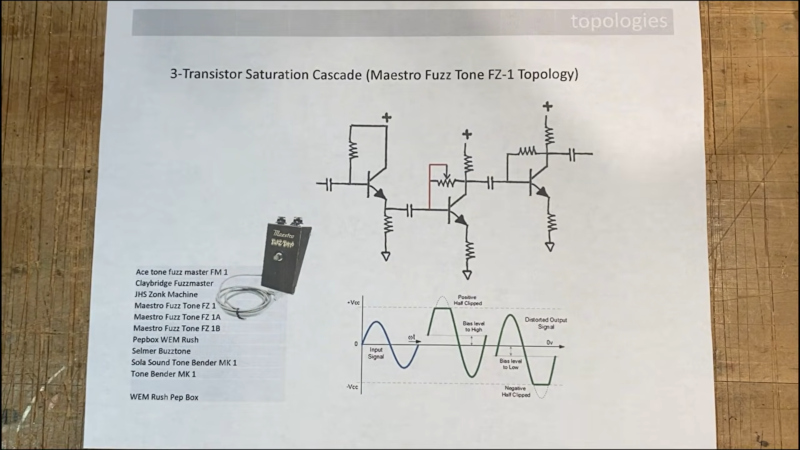
It’s likely that even those of us who have never picked up a guitar in our lives will recognize the sound of an electric guitar with a fuzz box effects pedal. The raspy distorted sound has been at the heart of so many very well known recordings. Behind it is a distortion circuit, or as [Bill Jehle’s Mad Scientist Guitar Lab] is here to tell us, eight different circuit topologies. The result is a fascinating trip through the evolution of rock music through the 1960s, as he examines circuits from simple diode clippers through to frequency doublers and phase shifters. He’s provided a playlist as an accompaniment so you can even have an immediate listen to each sound. It’ll mess up our YouTube recommendations, but worth it for the informative journey. It’s also a window into a lost period in electronics where all they practically had was the transistor, so each device had to put in the maximum work for a living. Designing circuits like these called for intimate knowledge of the device characteristics, and just how they could be safely exceeded. The video is below the break, and well worth a watch. If clever transistor music circuits interest you, you’ll love the flawed devices that gave the Roland 808 its sound. I have an old (Dunlop) Fuzz Face lying in my basement, which was originally bought by my oldest brother back in the mid-sixties. I haven’t played with it since the late 80’s. Chances are it’ll be either discarded or given away after I’m dead and gone (which shouldn’t be all that long). My brother was very much a fan of The Ventures back in the day. I’m not sure if they ever used a fuzz face. They often used the latest effects that were happening back then. You can clearly see two germanium transistors on the main board and a small cluster of resistors and capacitors. Nothing too fancy. It’s hard to believe how guitar distortion came from such humble beginnings.