Summary
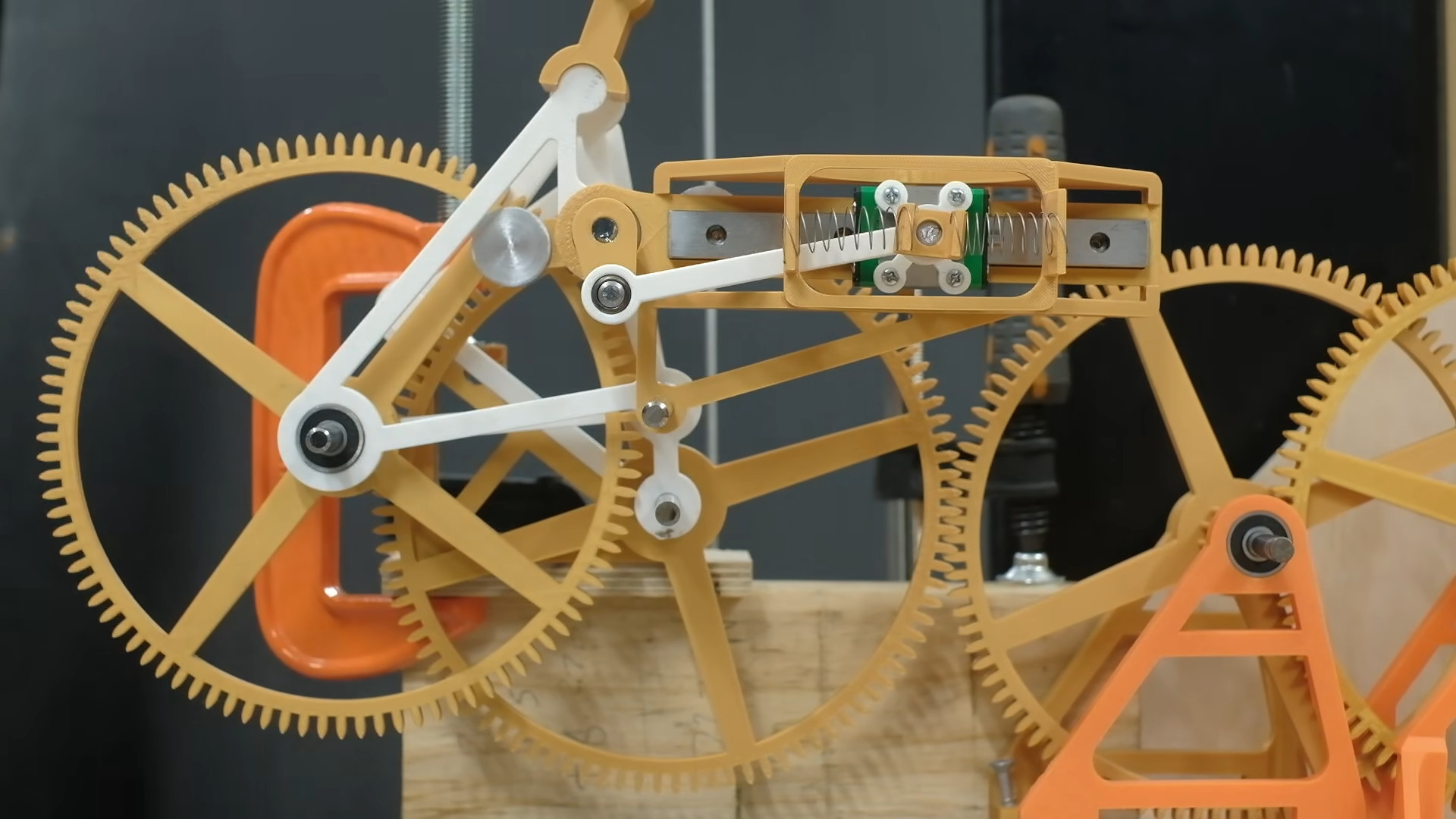
When it comes to clockwork, there is a spectrum — some people love the ticking, and some people hate it, while most fall into the broad middle of indifference. Once upon a time, Pope Alexander VII fell into the “hate it” category, and commissioned a silent timepiece from [Fratelli Campani] in 1656. Three hundred seventy years later, [Many Vices] sought out to re-create the mechanism in extruded plastic thanks to the efforts of watchmaker [Carlo G. Croce], who documented his brass recreation in this PDF file and his own videos. While the archaeology of recreating the mechanism from old photos is interesting, the mechanism itself is the real showpiece. The secret, as you might be able to tell from the photographs, is an eccentric crank escapement that provides continuous movement rather than the traditional anchor escapement whose periodic movements creates the distinctive ‘tick’ and ‘tock’. [Many] tests both in his video so you can hear the difference and see how much power is wasted with the crank escapement, which doesn’t keep going very long. We wonder if carefully tuning the flywheel he’s using to match the frequency of the swinging pendulum would help a little there. Likewise, his linear-rail-based spring pendulum modification — though it does look awesome and we’d love a train-themed clock using it — doesn’t come close to providing the runtime of traditional clockwork. That’s probably why the anchor escapement persisted for centuries, even if some people and Popes couldn’t stand the tick-tock. We’ve featured a lot of different 3D printed clocks, from wholly mechanical to electromechanical digital units to even ones based on D20s , so it’s hard to believe that not much more than a decade back, printing a mechanical clock was considered a challenge. Time marches on whether we can hear it or not. The issue with the slider crank mechanism is that the acceleration of the crank doesn’t match the oscillation of the pendulum or the mass-spring oscillator. It’s not symmetrical so it’s fighting the oscillation by trying to speed up or slow down at the wrong times, and that makes the whole thing bang against its bearings and try to bind up. To make it quiet, you have to have the tolerances bang on, otherwise it will rattle and shake. Someone else suggested a scotch yoke mechanism to at least have a symmetrical swing. A cam and a follower could be tuned to provide the exact acceleration profile. Actually, a scotch yoke does have simple harmonic motion (sinusoidal), so attaching it directly to a spring and a mass should work. The acceleration profiles would match and the whole thing should run smoothly except when the yoke is changing direction. What’s left then is closing the slop in the slot without adding friction. Perhaps, eliminating the slot altogether with a Watt’s linkage? https://en.wikipedia.org/wiki/Watt%27s_linkage Oh, and don’t forget to add a flywheel. Whenever the cam rotation speed and the mass-spring oscillation frequency do not match, you get a torque ripple in the input that is either trying to speed up or slow down the cam. Notice that the system will never run at exactly the resonant frequency of the oscillating mass. If that was the case, the cam would be free-wheeling together with the mass at exactly the same rate and no reaction forces would appear. No reaction forces means any torque on the input will speed the system up or slow it down without resistance – until it starts to react. It means, the more torque you apply to the input, the more the oscillator speeds up past the resonant frequency until it builds up enough reaction torque to resist and the system settles to a new dynamic equilibrium. So to make the clock, the amount of torque you apply must be kept constant or the clock period will drift. Regular clock escapements try to decouple the oscillator from the driving mechanism by only giving it a short kick every cycle, or even letting it swing multiple cycles without touching it. This is the opposite of that: this is a forced oscillator.