Summary
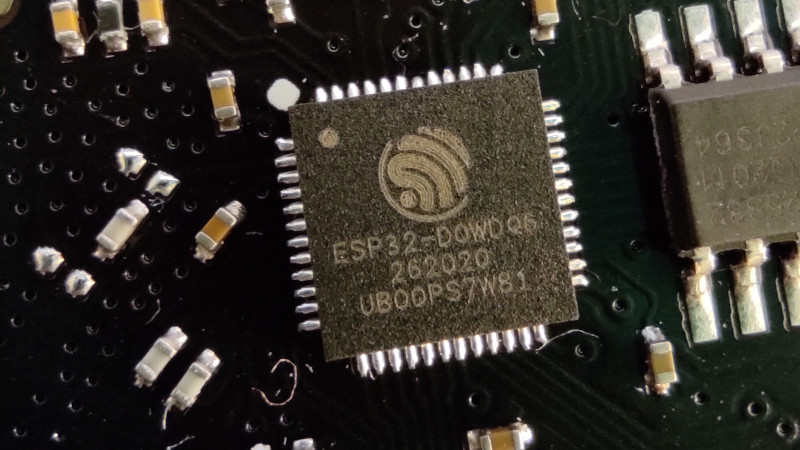
Perhaps the most famous of all the software-defined radio (SDR) receivers is the RTL-SDR, a digital TV receiver on which an undocumented feature was found. Perhaps other radio-enabled chips also have the same undocumented feature? It seems in the case of some members of the ESP32 family, they do. It’s a discovery made independently in two places, by Espargos, and a Reddit user by the name of h0m3us3r. What’s happening is that the undocumented mode taps the I/Q stream off before the WiFi modem, and this can be read and processed by SDR software on an external computer. The undocumented mode can be found on ESP32 chips with the earlier Tensilica hardware onwards, so the low power Bluetooth only chips or the non-radio-equipped P4 won’t work. Sadly it’s also only possible with the receive side, with both 2.4 and 5 GHz bands being supported depending on the microcontroller in question. This isn’t quite the general purpose SDR we got with the RTL-SDR, but there are still plenty of uses to which it can be put. We’re curious as to whether someone can implement the software side of an SDR on the same chip, but we are guessing that might be beyond their capabilities. Either way, we’re looking forward to what the community does with this new-found knowledge. probably just mix the desired signal with a local oscillator and job done? i find it slightly funny to imagine up-converting say hf to an intermediate frequency of 5ghz. Transmit does seem to be possible, according to the Espargos page, just still undocumented. He does not want to share it because of ‘rule3’. I guess there another undocumented register to find! Challenge accepted! But how do we transfer the 2.56 Gbit/s (80Msps, 32 bit/sample) to a computer with more processing power? The 4 bit SDIO interface doesn’t go beyond 50 MHz and the 8 bit PARLIO is spec’ed up to 40 MHz. It would be interesting to see cable modems being used for SDR. They handle an insane amount of spectrum concurrently. Sounds like the dynamic range is very nice. Has me wondering what the ENOB is. Shame about the following sentence: original ESP32, ESP32-C3, ESP32-C5, ESP32-C6, ESP32-C61, ESP32-S2, ESP32-S3, ESP32-S31 all have a maximum SPI throughput of 80 Mbps so at 32 bit I and Q samples that would be a bandwidth of 1.25 MHz. If they drop 24 bits (to 8 bit samples) that could be a bandwidth of 5MHz. And if they drop 31 bits (to 1 bit samples), that could be 40 MHz of bandwidth which may be of interest to people doing radio astronomy either with a RF mixer to look at a different part of the spectrum (or in isolated locations far far from humans activities).