Summary
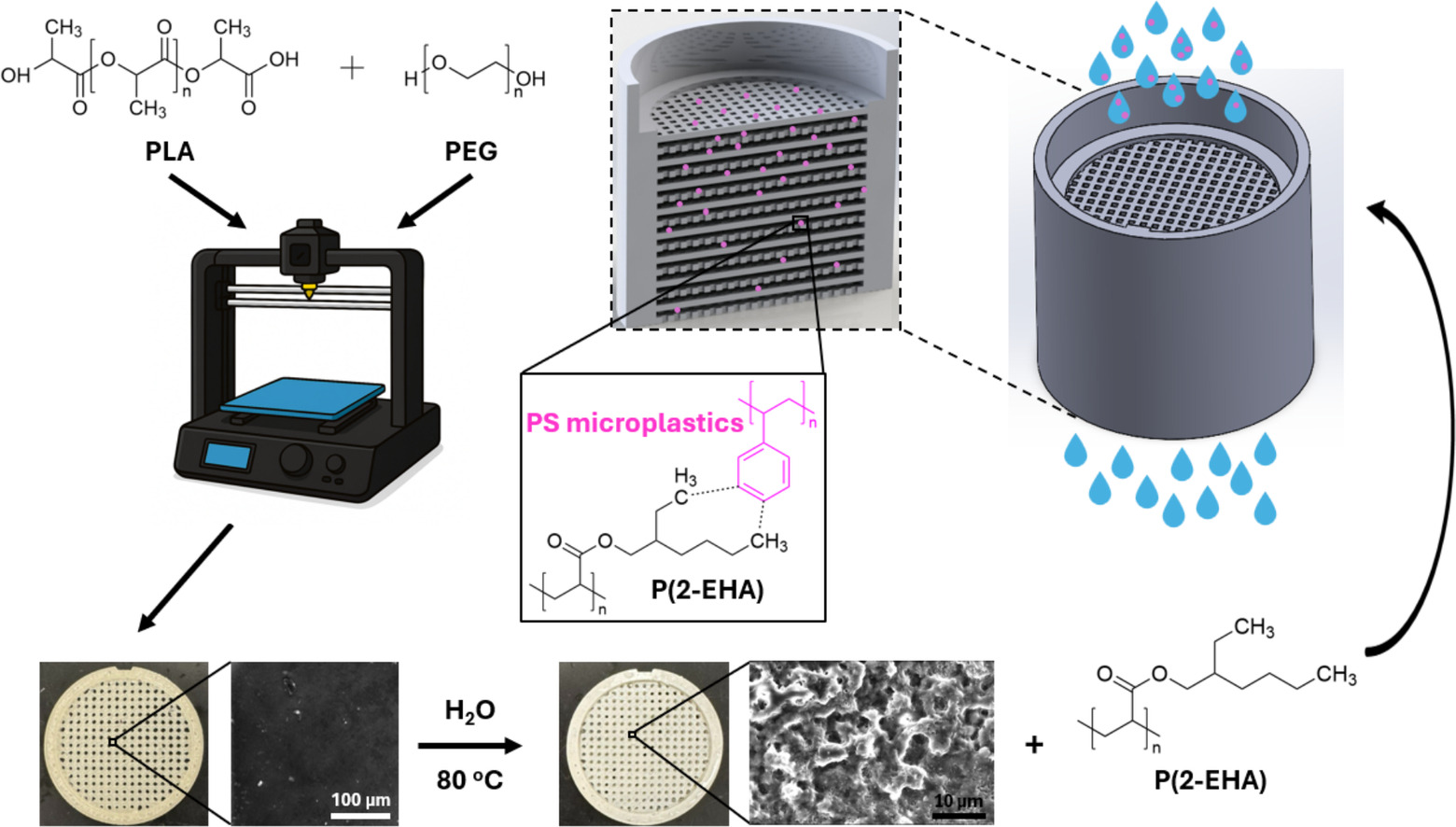
With the rise of synthetic polymers in everywhere from clothing, packaging and beyond, we have also seen a corresponding rise in fragments of these polymers in the environment. These micro- and nanoplastics (MNPs) come in a wide variety of sizes, but have in common that they do not break down very easily, leaving filtration as an important way to keep them out of our potable water sources. A recent paper by [Ethan A. Crawford] et al. in Separation and Purification Technology details a way to use a low-cost, 3D-printed filtration mesh to filter out up to 90% of MNPs using their prototype. This prototype uses a multi-layer filtration system printed in PLA, creating a flow-through system in which polyethylene glycol (PEG) acts as a sacrificial additive to the PLA. Whereas creating the fine pores required for filtration of MNPs is impossible using FDM printing, the spheres of PEG that form inside the printed filter can be subsequently etched away using nothing but hot (80°C) water, leaving behind a porous surface capable of trapping fine particles. These pores are characterized in the paper, with the PLA-PEG10 sample showing the best porous structure while maintaining structural integrity of the PLA material. With 20 layers of these filters a filtration efficiency of 90% was achieved, though as the authors note aspects like improving the system and potential reusability still have to be investigated. We have previously looked at MNPs, including how little we know about how many of them really are inside our bodies right now, and how lab gloves may be contaminating test results. Does the PLA itself not contribute to adding microplastics in the water being biodegradable? Printing plastics (generating micro plastics) to filter micro plastics… Are you serious? The polyethylene glycol (a synthetic man made polymer) is washed “away” but gets a pass because it’s soluble.