
Summary
As Director of the Software Engineering Division at the MIT Instrumentation Laboratory, Margret Hamilton was responsible for the software for the Apollo program. The code she was responsible for ran the lunar lander, and brought multiple missions successfully to the surface of Luna and back to orbital rendezvous. We regret to inform you that she passed on September 30th of 2026, aged 90 years.
 If you call yourself a software engineer, you have her to thank. Hamilton didn’t just help define the field through her efforts, she literally coined the term while at NASA in an effort to get “mere” programming taken more seriously. Suffice to say, that ambition was realized, and few see programmer as a low-status career these days.
After decades of obscurity, known only to those willing to dive deep into the Apollo program to discover her work there, Hamilton found deserved fame late in life. Her likeness eventually found its way to classroom posters and even an official LEGO figure. She also got the Presidential Medal of Freedom, but we don’t see how that could possibly compare to being immortalized in LEGO.
Some have called her a feminist icon, blazing a trail for girls and women. While that’s true enough, it’s also thinking perhaps too small. Like the missions she did so much to make successful, Margret Hamilton blazed a trail for all of humanity.
We wish Margret’s family the best as she blazes a trail we all must someday follow into that one last undiscovered country. Our own biographical tribute is several years old now, but it bares rereading in light of this news.
When I studied dynamical systems, our professor told us that Lorenz discovered chaotic systems because his climate models would produce different values when inputing the initial conditions from printouts, as opposed to when reaching those conditions during simulation.
I leant a decade later that the programmer that made those models run in the computer was Margaret Hamilton!
She has an interesting story, beyond the apollo program.
Oh wow, that’s a cool backstory!
Nowadays it’s hard to imagine that ‘programmer’ could be considered a lowly job title. Especially on something as mission-critical as bringing people safely to the freakin’ moon and back. We all know the necessary bureaucracy that surrounds that kind of work these days. Bravo Margaret for giving it the dignity it deserved.
Alternative Facts
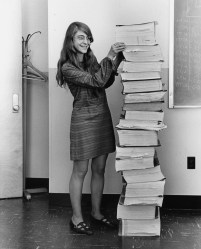
Margaret Hamilton became known to a broad audience primarily through a famous photograph from the Apollo era, in which she stands next to a meter-high stack of printed program code.
In many books and documentaries, it is falsely claimed that Hamilton wrote this code herself. In fact, however, not a single line was written by her. She was the team leader, and the software was developed by the members of her team.
The entire Apollo 11 assembly code is 1,751 pages long. The meter-high stack she is standing next to must therefore be something else—perhaps multiple versions or copies.
But how did Margaret Hamilton actually become the team or project leader for the NASA project in the first place?
She was the partner and later wife of the previous project leader. When he no longer felt like doing the job, she took over the role. At that time, the project was already in its final stage and facing winding down. The good people moved on to new, more exciting projects.
In 2016, Hamilton received the Presidential Medal of Freedom from President Obama with a citation stating that she had “led the team that developed the in-flight software for NASA’s Apollo command and lunar modules.” This claim is misleading, as Hamilton was only given a leading role in the software for the Lunar Module (LM) in early 1970—after the main objective had already been achieved.
If you call yourself a software engineer, you have her to thank. Hamilton didn’t just help define the field through her efforts, she literally coined the term while at NASA in an effort to get “mere” programming taken more seriously. Suffice to say, that ambition was realized, and few see programmer as a low-status career these days.
After decades of obscurity, known only to those willing to dive deep into the Apollo program to discover her work there, Hamilton found deserved fame late in life. Her likeness eventually found its way to classroom posters and even an official LEGO figure. She also got the Presidential Medal of Freedom, but we don’t see how that could possibly compare to being immortalized in LEGO.
Some have called her a feminist icon, blazing a trail for girls and women. While that’s true enough, it’s also thinking perhaps too small. Like the missions she did so much to make successful, Margret Hamilton blazed a trail for all of humanity.
We wish Margret’s family the best as she blazes a trail we all must someday follow into that one last undiscovered country. Our own biographical tribute is several years old now, but it bares rereading in light of this news.
When I studied dynamical systems, our professor told us that Lorenz discovered chaotic systems because his climate models would produce different values when inputing the initial conditions from printouts, as opposed to when reaching those conditions during simulation.
I leant a decade later that the programmer that made those models run in the computer was Margaret Hamilton!
She has an interesting story, beyond the apollo program.
Oh wow, that’s a cool backstory!
Nowadays it’s hard to imagine that ‘programmer’ could be considered a lowly job title. Especially on something as mission-critical as bringing people safely to the freakin’ moon and back. We all know the necessary bureaucracy that surrounds that kind of work these days. Bravo Margaret for giving it the dignity it deserved.
Alternative Facts
Margaret Hamilton became known to a broad audience primarily through a famous photograph from the Apollo era, in which she stands next to a meter-high stack of printed program code.
In many books and documentaries, it is falsely claimed that Hamilton wrote this code herself. In fact, however, not a single line was written by her. She was the team leader, and the software was developed by the members of her team.
The entire Apollo 11 assembly code is 1,751 pages long. The meter-high stack she is standing next to must therefore be something else—perhaps multiple versions or copies.
But how did Margaret Hamilton actually become the team or project leader for the NASA project in the first place?
She was the partner and later wife of the previous project leader. When he no longer felt like doing the job, she took over the role. At that time, the project was already in its final stage and facing winding down. The good people moved on to new, more exciting projects.
In 2016, Hamilton received the Presidential Medal of Freedom from President Obama with a citation stating that she had “led the team that developed the in-flight software for NASA’s Apollo command and lunar modules.” This claim is misleading, as Hamilton was only given a leading role in the software for the Lunar Module (LM) in early 1970—after the main objective had already been achieved.