Summary
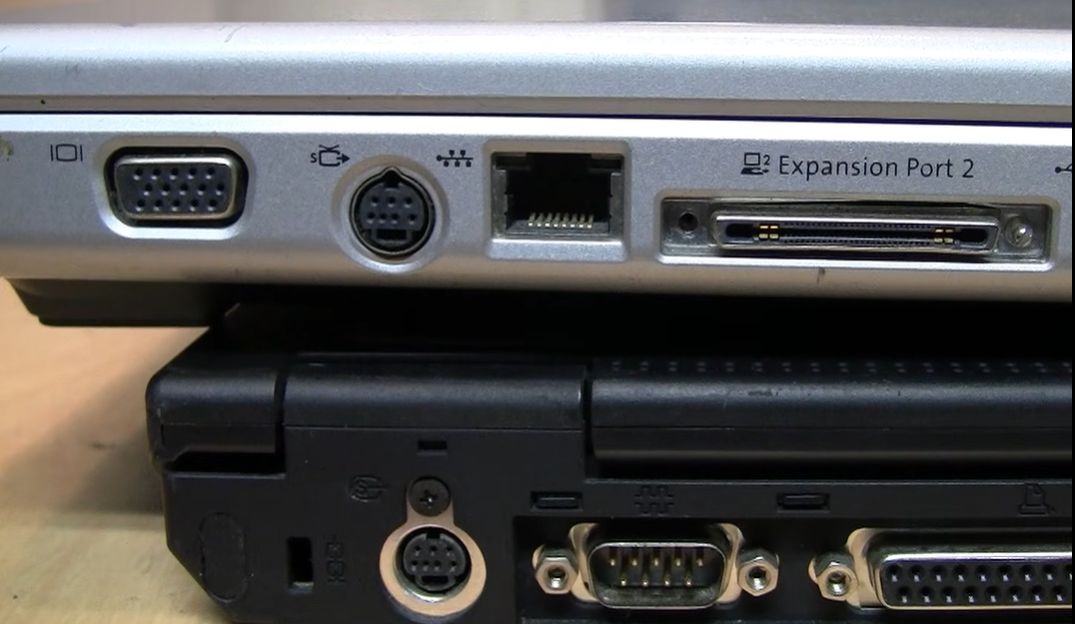
Even though laptops from around the early 2000s came with just about every conceivable port on them, they still would often feature a somewhat unusual combined video output port. While at its core this was just a 4-pin analog S-video output, the three additional pins on the mini-DIN connector provided some more features. Of course, as [VWestlife] found out during his archaeological research, not every manufacturer used the same pinout here.
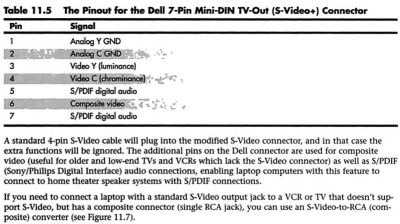 The naming for this specific port differs, with the name ‘S-video+’ appearing regularly, yet many descriptions glossing over the additional pins and only mentioning that it can be used with a 4-pin S-video connector. As it turns out, most manufacturers used roughly the same pinout, matching the shown Dell one. This adds composite output, along with two S/PDIF digital audio pins that could be routed out with an adapter into their full-sized ports.
Of course, the Apple PowerBook G4 had to be that exception again, with it omitting the audio pins and putting the composite signal on pin 5. This left the last two pins completely unused, but serving to completely confuse anyone who thought that they could get more out of the port with an adapter for those uncouth PC systems.
As to the remark at the end about how the transition to ‘just USB ports’ has made everything better, we’d challenge the average person to look at a random USB-C port and tell based on its appearance which standards it actually supports.
It’s the same as the ‘VIVO’ port on desktop GPUs of the time. Everyone had a slightly different pinout and features, so only the adapter that came with the card would work.
That said, I remember slicing up a scart cable and sticking the leads directly into the socket because the adapter was missing, so we could watch Matrix on the TV off of a video CD. The picture was worse than a VHS cassette but at least the TV was bigger than a 14″ monitor.
and dont forget the 8pin version on older mac powerbooks, used as serial ports…
Some early GPU (AGP era mostly) also have multi-out port and you needed breakout cable or adapter to use a TV or record your computer to VCR
I’m not really sure how you would arrange this; but this(along with the various things that ‘serial’ has been bludgeoned into) seems like yet another case where a tiny little bit of industry coordination that wouldn’t really have been against any vendor’s interests could have done a lot of good.
When you’ve got a size-constrained situation the temptation to replace a standard S-Video connector with a mini-DIN that also provides audio or audio and composite is pretty understandable; but would it have killed people to call around and agree on a pinout?(ideally one where a normal S-Video cable would connect as expected; and any additional signals would be exposed on the same pins across vendors)?
Apple. While we’re talking about non-standard pins and being different just to cause trouble(and catastrophic consequences) consider modular and semi-modular ATX power supplies 🔥