Summary
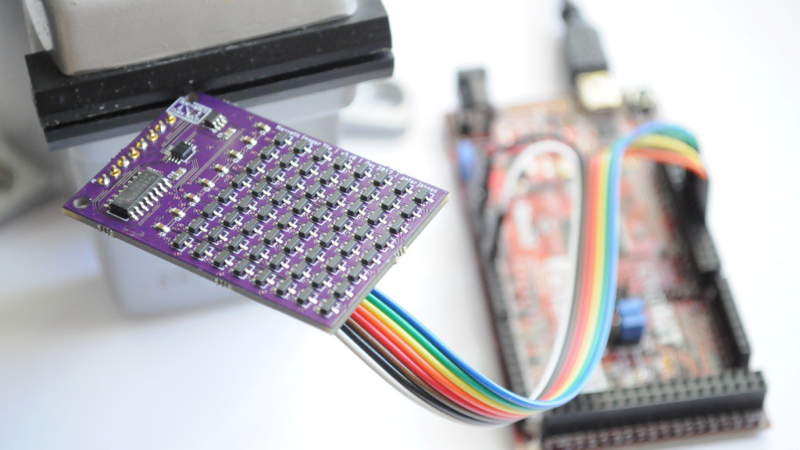
Over on IEEE Spectrum, [Stephen Cass] has a project that would probably have seemed like a magic a few centuries ago. Imagine a box that uses a magnetic device to holds a locking bolt, requiring a magnet to disengage it. The only problem is that any strong magnet can open the box. [Stephen], instead, used an array of 64 Hall-effect sensors developed by [Peter Jansen] to look for a specific magnetic gesture. Inside is a Teensy that can read the 8×8 grid of sensors. A magnetic stylus allows you to draw an unlock pattern. The system lets you train the gesture you want. There are a few problems. The sensor covers a small area, so it is hard to reliably produce the gesture. Putting an obvious mark on the box is a dead giveaway, so [Stephen] put a Celtic knotwork pattern on the box and uses part of it as a reference. The other problem is that if you run out of battery, the box is locked forever. Well, at least until you apply mechanical force and break the box open. Wireless charging would be an option, but we might favor a small jack that would allow you to plug in an external battery. This is a clever use of the sensor. However, we might have preferred a mechanical solution that didn’t require batteries. Or, perhaps, you could use a few normally open and normally closed reed switches to make a kind of magnetic combination lock. It would still need a battery, but it wouldn’t draw current until you connected the switches. Both methods also have drawbacks, of course. Like most things, you just get to pick the drawbacks you can live with. You can see a video of the magnetic imaging tile from [Peter] below. We really want a setup like this for our secret door. We also wonder whether switchable magnets could provide a battery-free solution. I rember in the mid 70’s padlocks that opened using a magnetic key, it was the coolest thing to have in school. But it you lost the key…. Bolt cutters There’s at least one type still being made: https://capitolindustriesinc.com/en/product/padlock-magnetic/ As of today, there are still parkings in my area that operate with a magnetic key. Surely it would be more intelligent to use a couple of compass-type sensors obtaining XYZ https://www.youtube.com/watch?v=SGNVNBl7CJY At my workplace we built an order of cabinets that used an RFID reader lock mechanism inside that would read an access card or smartphone from outside. Neat idea but that whole issue about when batteries run dead was 100% applicable lol The power issue is easily solved by the use of a reed switch to turn the thing on in the first place (assuming a mechanically activated lock) I’d like to see someone make it box of these, to put an object in and get a 3D render of it. It’s nice to be able to slow things down and it beats sticking an inductor to a 3d print head. I wonder what the practical limits of resolution might be, no doubt determined by the amount of data that needs to be dealt with. At least viewing film doesn’t have that limitation. We need something akin to an addressable LED but as a hall sensor, in a tiled array. I’m guessing LED microsurgery isn’t feasible at scale. Perhaps one day AI would be accurate enough to convert the data into a physics simulation of the materials. Apparently there are several options for addressable hall effect sensors. I guess it makes sense that it should exist. Batteries are not an issue if you can access a battery compartment… Does expose you to a few kinds of attacks, and a grumpy person could rip the wires out leaving it locked forever..