Summary
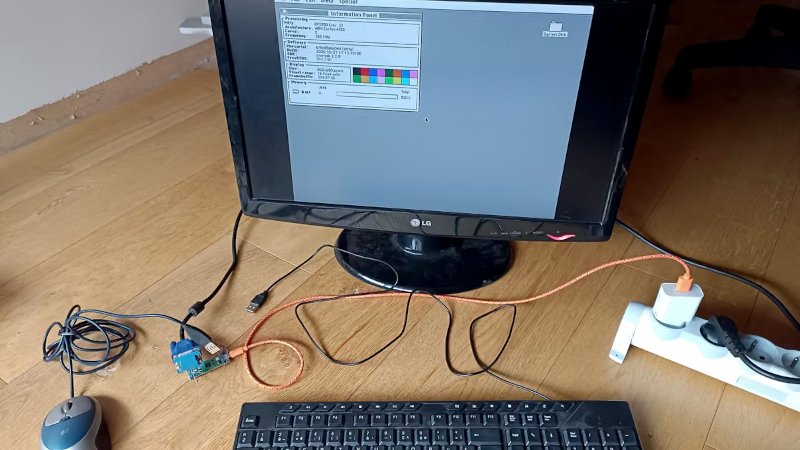
We’re living at an interesting time here in 2026, when microcontrollers are becoming powerful enough to surpass the capabilities of “real” computers from a time when those real computers were starting to become useful. We’ve seen plenty of microcontrollers emulating machines from the 1990s, but what if instead they were giving all their power to the OS? It’s a question [Thomas] is trying to answer with SylphideOS, a general purpose GUI operating system aimed at multiple microcontroller platforms. On the surface it has a GUI that appears to owe a lot to the early Macintosh machines, but underneath it has the FreeRTOS kernel, something that has been around for quite a while. You can argue among yourselves as to whether this make it an OS in its own right or a FreeRTOS distro. Aside from driving a screen through a framebuffer it also has the hardware interfaces you’d expect, for keyboard and storage. There’s support for RP2350 and selected ESP32 platforms so far, as well as an emulator. We have already seen a few operating systems for microcontrollers that provide a user interface for a binary bootloader rather than persisting under whatever programs are running, so this marks an interesting departure. Only time will tell if it becomes a success, but perhaps it’s one to watch. Heretic ! Well, they run DOOM, so Heretic or Quake are in the ballpark. As interesting as this is (and it really is), the words “aimed at multiple microcontroller platforms” made me think one uC would be handling the display, keyboard, storage and network, and parceling out jobs to other uC’s in the same box. That would be fascinating. We could call it… Amiga I’ve seen it before so many times. It’s always 5 minutes of excitement because you can write files to FAT32 SD card, followed by 50 hours of struggle to independently discover problems described in Silberschatz’s book. Finally you realize microcontroller is good for doing HMI or motor control but it sucks ass when you try to make it into a personal computer. And the project becomes a forever TODO/FIXME zombie. +1 Back in the day, it was other way round. An Z80, 8080, 8085 or 8086 processor was used as single board computer (once refered to as EMUF in German). Such a processor served on SCSI controllers as the heart of an on-board computer, for example. The 6502 CPU and the 8051 MCU were similarily used. Sound Blaster had used an 8051 as a “DSP” chip, for example. Thr 68000 was used in some intelligent wavetable sound cards (Turtlebeach cards?).