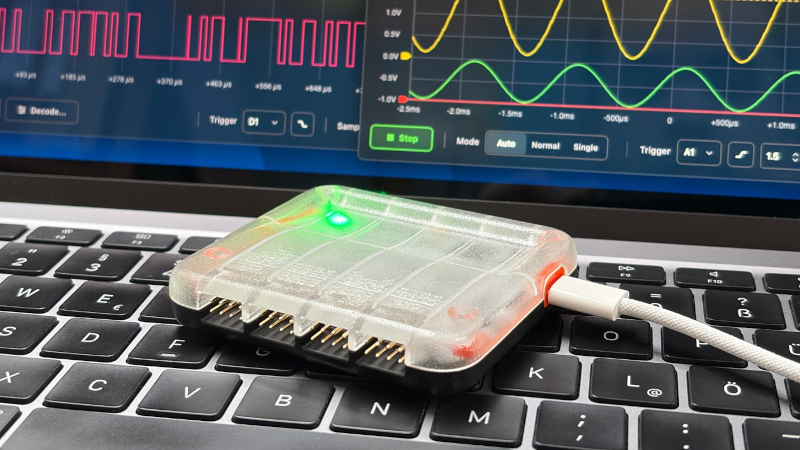
Summary
When working on an electronic project it’s likely you will find yourself working with a variety of different instruments, be they logic analysers, oscilloscopes, or whatever. These can take up a lot of space, not to mention cost a bundle of cash. [Max.K] came up with PicoLab as a solution, it’s an all-in-one box containing a four-channel oscilloscope, eight-channel logic analyser, GPIOs, a data logger, and serial, SPI, and i2C interfaces. There’s even an adjustable power supply! Behind it all is an RP2350, in its larger package with more pins, coupled to some custom interface and protection circuitry. Perhaps the cleverest part is its interface, which it serves as a web site on the network card it exposes through the USB port. Any OS that supports a web browser and USB networking can thus use this thing. You can find all the code in a GitHub repository, should you wish to have a go at building one yourself. We like this idea. Unfortunately I keep banging my head into the need for far more than 8 channels. If only it wasn’t far more expensive to ship an old HP unit to me than to actually buy it! You can get 27 channels with a RP2350/Pico2 board including RLE-compression with this project: https://github.com/rabbitholecomputing/RP2350_Logic_Sniffer I need even more than that :D The trick is to use that other pico-based project which supports ganging up multiple boards. Which requires me to go pay for that pcbway order that’s been sitting at the quote stage for over a month, whoops… My other frustration is that they didn’t add USB 2.0 so you can’t do realtime capture at full speed and are limited by the RAM available on the pico. I really would like to be able to make long, faster captures on tons of pins without breaking the bank. I have a device that uses a semi-unique video output signal and want to be able to simulate an FPGA working with it but a full frame needs much more than what the pico can do. I can’t say these devices are that rare anymore, but i can appreciate the simplicity of the hardware. It is an army of bi-directional transceivers along with a I2C voltage regulator, some current measuring amps and the RP2350B hardware. It is simple, yet effective and i am definitely checking out that MP28167-A I2C Regulator. Firmware is a bit of a mess though as everything is crammed into a single C file of ~2900 lines. It definitely could benefit from getting split up by functionality so that it is easier to maintain or for others to re-use. I guess messy code is just going to be a recurring theme in this AI-powered era. The faster people produce code, the messier it is. LLMs allow people to produce code hundreds of times faster. A skilled developer will use some of that saved time to ask the agent to refactor the codebase before making it public. Firmware and Ui entirely Ai generated ….. yeah i man … thats just how it is today. I have a very very similar project. And while it took me several weeks to programm an older version, Claude did it in 20 minutes and all it got was the hackaday.io page of the old stuff and the new netlist. I really dont know where this will eventually lead to…… scary times At this point it is not about about it being made by the AI, but about the control you have as a human. The level of use gets no credit for me, and mostly as it also looks like slop. It can still be useful in rare cases, but why wouldn’t anyone already into LLM build their own version? I’m more afraid for when the Piper shows up to collect their dues. These AI are incredibly powerful, but also incredibly expensive and we are essentially getting access at an incredibly low teaser rate. It is the biggest reason why i haven’t “gotten with the program” yet. That whole profitability thing is ever present like a sword of Damocles and i don’t want to be around should it drop. PLUS i know that i still have much to learn about coding, refactoring and how to make it so it is feasible to maintain or re-use parts of it and that can only be done by suffering through it. I also do not want to end up like one of those obnoxious vibe coders on social media that boast about their projects only for a real expert to dunk on them from orbit. I want to be the expert! Can we get a few analog channels and power measurement capabilities too? My ideal device would be logic analyzer + oscilloscope + blackmagicprobe + something like nrf ppk2 + analog discovery Sorry but not sorry for being greedy This uses the available analog channels on the Rasbperry Pi Pico for an oscilloscope and for current measurement. So you get a logic analyzer + oscilloscope + PPK2. The only thing missing is JTAG. Analog discovery features are missing as well But then again, this is more than enough for all the digital IoT/low power BLE gizmo development. Didn’t realise you were the creator! Amazing work. This device will serve you well Thank you! What features of the Analog Discovery do you find most useful? The waveform generator seems cool.