Summary
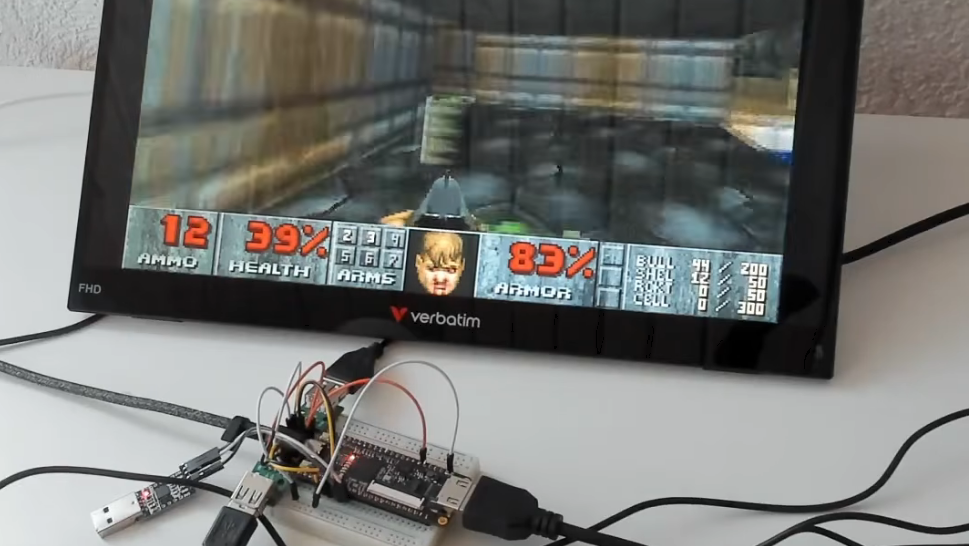
The Tang Nano 9K is a cheap FPGA development board that can usually be acquired for around $15 or so. [ThePartsBin] has been experimenting with this hardware and figured out how to set it up as a retro-style computer. The board is based around the Gowin GW1NR-9C FPGA which only has 8,640 LUTs. However, that’s enough to spin up a 36 MHz RISC-V CPU, and there’s 8 MB of RAM on tap, along with HDMI, 48 kHz stereo audio output, two USB ports, and an SD card reader. Combine all that together, and you’ve got a machine capable of playing a whole raft of classic 1990s games. [ThePartsBin] ported Doom, Tyrian, System Shock and Ultima VII, all of which run at a playable speed at a tasty 720 x 480 resolution. The writeup does a great job of explaining what it took to actually implement these classic games on the platform. Tons of compromises were made along the way, but that’s the engineering challenge, isn’t it? If you’re looking to play retro games, this is not really the fastest or cheapest way to do it. You could probably just emulate them on the machine you’re using to read this very website. If you’re trying to get to grips with a new FPGA board for the first time, though, projects like this can be a very useful learning experience indeed. A better question is, can you set one of these up as an Amiga 68k accelerator? For the ones actually interested in “which exact RISC-V” (due to the simple fact that RISC-V doesn’t mean anything specific), here are few more info pieces: — The CPU is VexiiRiscv, configured as in-order RV32IM + some extensions (Zba, Zicbom, Zicbop, Zicboz). I’m curious about what is the DMIPS/MHz performance of this configuration, just for comparison. — There’s no MMU, so physical addresses FTW! (I guess no LUTs were left for a Sv32-compatible page walker and 2x TLBs) I personally am not a fan of the Gowin FPGAs (for entirely subjective personal reasons), but this project definitely deserves respect especially considering the fact that the complete SoC seems quite balanced and efficient for what it’s doing with so few resources. Great work! PS: Looking at the architecture diagram of this project, I can’t help myself but thinking: “This looks like the RISC-V DOS pc of the 21th century, haha!”