Summary
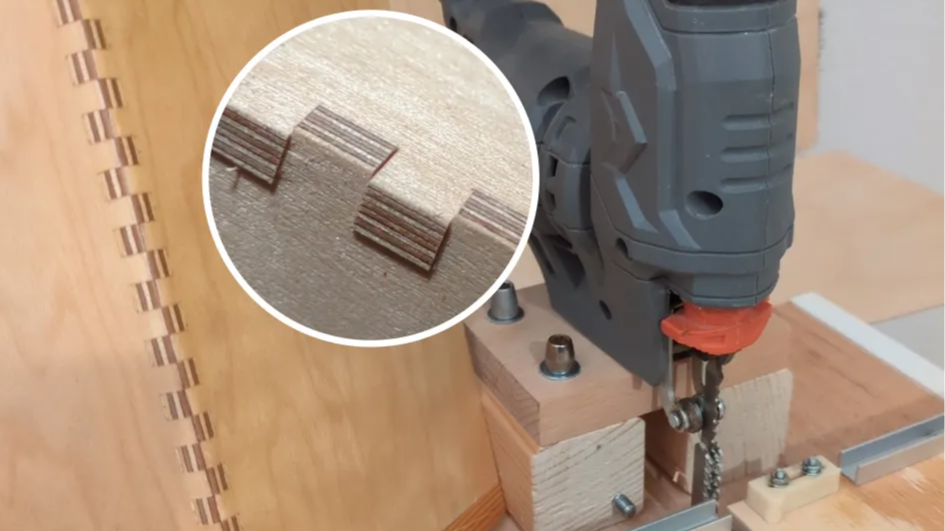
Around these parts, finger joints (or box joints) are usually the product of laser cutting. [bluesyann] shows us a method of using a stationary jigsaw, a custom blade, and 3D-printed jig to create a DIY box joint cutter whose results look impressive. What’s appealing is not just the end result, but the fact that the whole system is made from little more than an inexpensive tool, scrap wood, and common hardware.
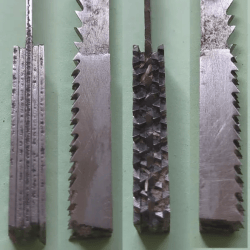 In [bluesyann]’s system, the jigsaw is fixed in place to make a stationary cutter. The saw itself is nothing special; it’s the wide blade that makes the difference. It cuts a notch in a single go, and it’s made by epoxying together multiple blades to make a single extra-wide one. Jigsaw blades are not expensive, and they’re easy to snap into pieces. By using a total of three blades (snapping two of them into pieces) one can create the wide version shown here.
With a stationary jigsaw sporting an extra-wide blade that cuts the same notch every time, all that remains is a way to get the spacing right. The solution there is a 3D-printed jig that each freshly-cut notch fits onto as the next one is cut.
There are a few other details, but those are the important bits. One does have to do a bit of trial and error to get things dialed in, but once they are, it’s off to the races.
If one prefers a less hands-on method of cutting box joints, check out this robotic table saw which automates the process.
Well….i guess it’s technically a hack so yea, and I guess it’s safer than the table saw or router. Just the idea though of snapping good blades…
I would prefer the table saw, or the router table. With the appropriate jig, it is faster and safer than this ( no dubious glued blades )
THAT BLADE IS AWESOME
There is always something new, but a portable/budget miter saw or a table saw with simple rig accomplishes this (and plenty other things) after some strategic thinking. It gets even simpler with the miter saw, as that’s what they are kind of sort of built for.
Though, decades ago, I’ve tried this exact thing (cutting finger joint) with ordinary budget cutter and custom-made rig with mostly okay results, as it is quite tricky to get everything right that way. Kudos for those who figured out a better way : ]
Usually I don’t bother and go the quick and easy route of pre-drilled holes and long screws. Seem to work for me, the numerous shelves, benches, etc (one kitchen table, too) I’ve built over the years don’t seem to budge, but of course, these joints don’t experience much flexing, and most are not visible. The finger joint is much tougher, since it interlocks and can handle flexing, whilst screws-coupled joints eventually pry themselves loose from repeated stress (but then again, that’s why you suppose to reinforce those with strategically placed metal brackets).
I’d probably advise against doing anything to the blade, as it is already flexing under load quite a great deal. While it is not as dangerous as, say, breaking router bits (you really DO NOT want to test router bits for breaking – don’t I have a story about a cheap router bit going rogue), it is still quite easy to break off at the time the least expected.
Having rambled all that, I’ve seen people doing amazing things (not me, sadly) with a table saw. I’d still vouch for using a table saw (sadly, I never owned miter saw), but that’s just me.
I bet once the jig is set up right, it’s great for a few cuts like an occasional drawer corner. This would be great for someone who already owns a jigsaw, with limited shop space and budget. I could have used this when I was young and the table saw and router were off limits for safety reasons.
But I’ve found that jig saw cuts are kinda inherently sloppy, even with a steady hand, good tool, blade, and a straightedge. You’d also likely have to cut pretty slowly so the blades can eject the wood chips and not fill up.
Much better than drawing out each one with a square and multiple passes with a single jigsaw blade though!
can’t believe no one here wants to brag about knowing the word ‘dado’
i hate it but there’s no denying that making a dado set out of a reciprocating saw is a hack!