Summary
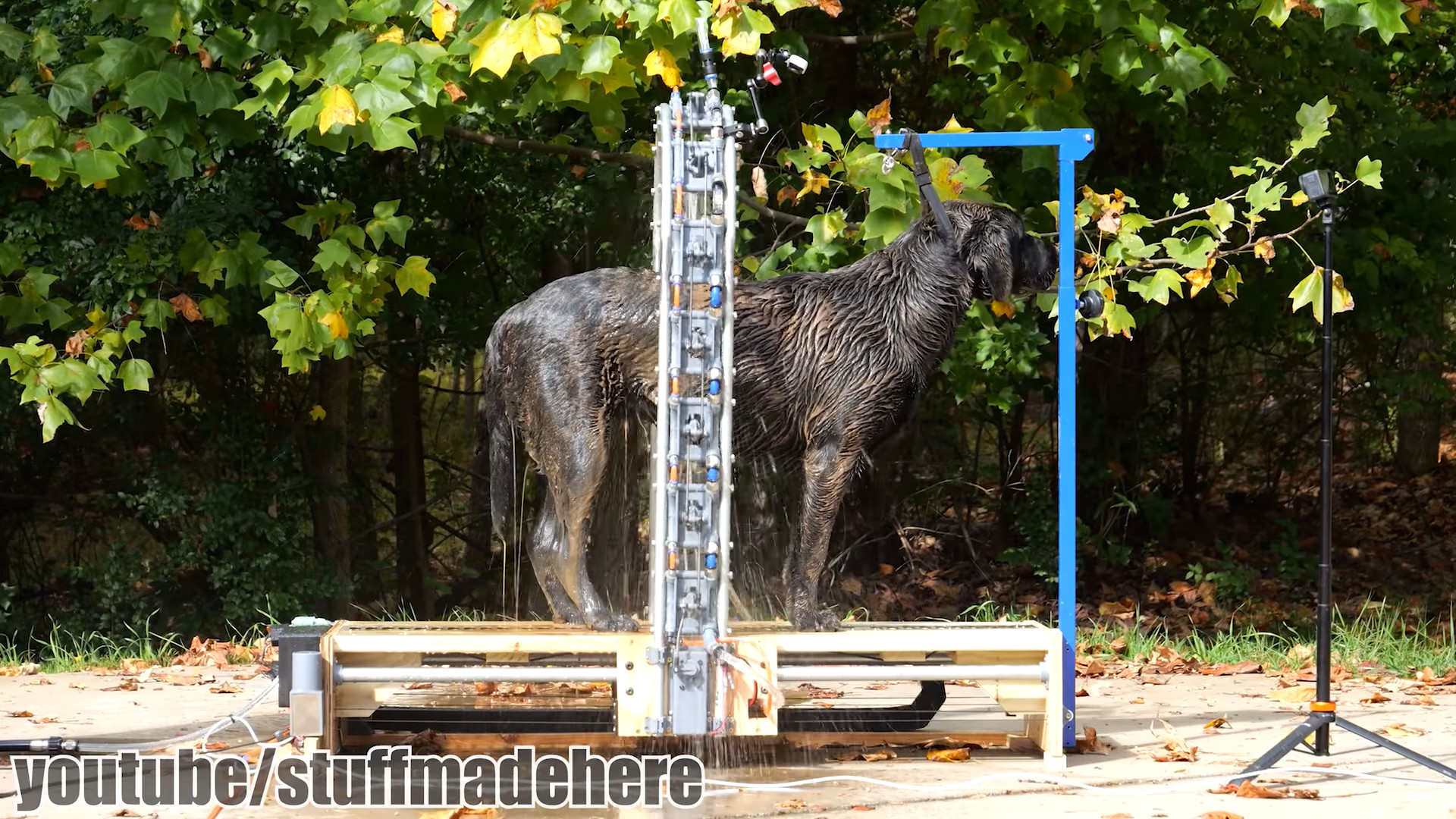
[Stuff Made Here] got fed up with the hassle of washing their dog, and in traditional engineer fashion, decided that automating the process would solve the problem. However, as science fiction writers love to warn us, automation and living things don’t always mix. The concept, much like a car wash, is to have an arch-like structure spray the dog with oscillating nozzles. A secondary nozzle provides a simple air drying function on each of the pods. An “undercarriage” nozzle of similar design runs in a channel below the dog to ensure all mud has been removed. The nozzles move along linear rails, driven by a DC motor. All the electronics are water proofed with the AC power source a distance away to provide additional electrical protection. Unlike other projects of the past, [Stuff Made Here] set out to make this project without fancy metal working tools. Fortunately, it’s a project well suited to SLA 3D printing. While probably printable on an FDM printer, the parts need to withstand water back pressure. While there are better ways of doing this, the nozzles are mounted on an arch made of two bent conduits with legs welded on. The nozzles are mechanically connected with linkages to control the spraying direction. However, [Stuff Made Here] couldn’t resist the urge to use a new CNC lathe when it arrived, so the quest to avoid fancy tools was lost to the desire to play with new fancy tools. Also, a grate under the under-carriage nozzle would have taken too long to source, so instead a plasma cutter made short work of some sheet metal. Granted, the parts could easily be 3D printed and/or sourced online. Besides the fact that the dog is terrified of the machine and won’t use it, it works brilliantly! Sound off in the comments if you think [Stuff Made Here]’s attempt at making a project without fancy tools was successful. I don’t give a f*ck about SlopTube and its content creators. Thank you for sharing that with us. Although I have no idea what I’m going to do with this info. Sir, I am in receipt of your recent communication, the contents of which have occasioned in me a degree of perplexity quite equal to the agitation that evidently dictated your pen. Permit me to observe, with all due gentleness, that your impassioned admonitions and fevered warnings appear entirely untethered from any tangible circumstance. The horizon remains remarkably tranquil, the heavens are disposed in their customary order, and no calamity has befallen our quiet corner of the shire that might justify so tempestuous a flurry of ink. Pray, compose yourself. I would earnestly recommend a brisk constitutional in the fresh morning air, followed by a quiet hour in the library with a volume of steady philosophy—or, should the humors persist, perhaps a draught of calming chamomile administered in the porcelain teapot. Until such time as your spirits are restored to their accustomed equilibrium, I remain. I’ll second his wife awarding that anemic sprinkler gadget a 0/10. Do watch some [Girl With The Dogs] as a palate cleanser ( e.g. https://www.youtube.com/watch?v=dPlgEvXxg3o ) though – she does a great job explaining how dogs are about baths (oh, and about putting the well-being of the dog first). Perhaps someone should tip Shane off about how dogs love jumping into pools when you ask them to come back inside. We’ll survive one episode that’s sponsored by Tsurumi instead of Formlabs… The best dog washing technique was invented by the Scots comedian and actor Billy Connolly when he lived by a lake in Drymen:
- Throw stick in lake.
- Wet dog brings stick back. Put shampoo on dog.
- Throw stick in lake again. I am volunteer at (and part-owner of) a vineyard. At harvest, we put the grapes in plastic crates for transport to the “chai”, where they are processed. The crates are thereafter very sticky with sugary raising juice. The first few years this required a brush and a garden hose to clean, which was usually very wet and cold work. After a few years someone made a “cratewash” from an old IBC, a few pieces of white PVC tubing and nozzles like those. The crates are pushed through and get thoroughly washed, with no complicated moving parts other than the nozzles and a high pressure pump recycling the water from the bottom of the IBC. Similar to this thing but much simpler in construction and maintnance, and it can be carried by two people, useful for something that gets used only a few weeks a year. I think there was some kind of total immersion dip vats where several sheep go under the surface at once. Probably a German invention… Bruce here teaches classical philosophy, Bruce there teaches Haegelian philosophy, and Bruce here teaches logical positivism, and is also in charge of the sheep dip.