Summary
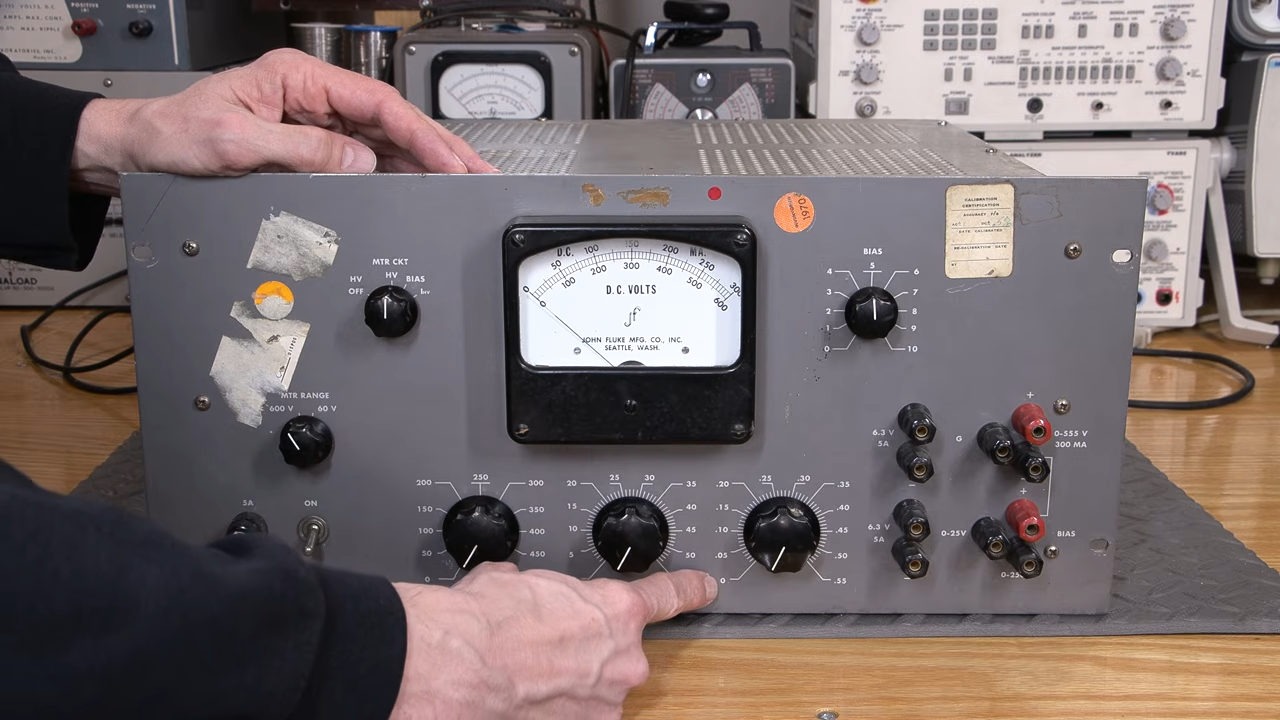
[Mr Carlson’s Lab] saves a Fluke Model 407 high-voltage power supply from the scrap heap, and demonstrates carefully troubleshooting the vintage device to track the cause of the bad output down to a single capacitor. In the process, we get a close look at what is inside as well as insights on how to meaningfully service a device like this.
Firing up old electronics should always be done with care. Some electronic components don’t age well, and some faults aren’t always visible. Applying full power to an vintage device could cause considerable (and avoidable) damage. [Mr Carlson] powers up the device using an isolated transformer and a current-limited variac, but another classic approach would be to use a dim-bulb tester, which most folks could cobble together from spare parts.
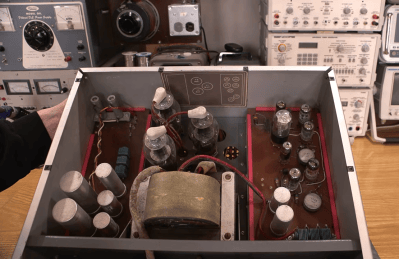 While destined for the junk heap, this Fluke Model 407 actually looks to be in pretty good condition. There’s no obvious damage or failure in its vacuum-tube-and-circuit-board internals, and it powers up but the main output doesn’t act right.
[Mr Carlson] walks through the entire process of tracking down the fault, demonstrating everything from safe power-up and basic inspections to signal and component checking. This process is aided by having access to the original schematics, and the problem is ultimately narrowed down to a faulty capacitor in a feedback signal responsible for keeping the output voltage constant.
It’s not a full restoration, but rather a clear demonstration of diagnosing a hardware error thanks to a careful and informed approach that keeps the specific challenges of vintage electronics in mind. Watch the whole thing in the video, embedded below.
One of those power supplies – or one that looked very much like the one in the photo – almost killed me once. Or rather, I almost killed myself while using it.
In my first job out of electronics school I did contract repair work for the Canadian DND. I was working on a transmitter pre-amp with a 400-volt power supply to provide plate voltage to the output tubes. They were lighthouse tubes – high-frequency vacuum tubes with coaxial connections for plate, grid, and heater, and aluminum heat radiating fins on the plates.
I needed to swap one of those tubes, so I put my left hand flat on the bare aluminum chassis, before reaching in with my right hand to grab the tube. (They needed quite a grip to pull them out, and the fins were the only place to grip). I quickly realized that I’d forgotten to turn the B+ off first.
Hand to hand, right through my heart, I took the current generated by a voltage not too much lower than 400 volts. I put my head down on my bench and rested for a few minutes after that. Fortunately, there were no long term effects that I’m aware of. I consider myself lucky to be alive. If it had been AC, I likely wouldn’t be here to write this.