Summary
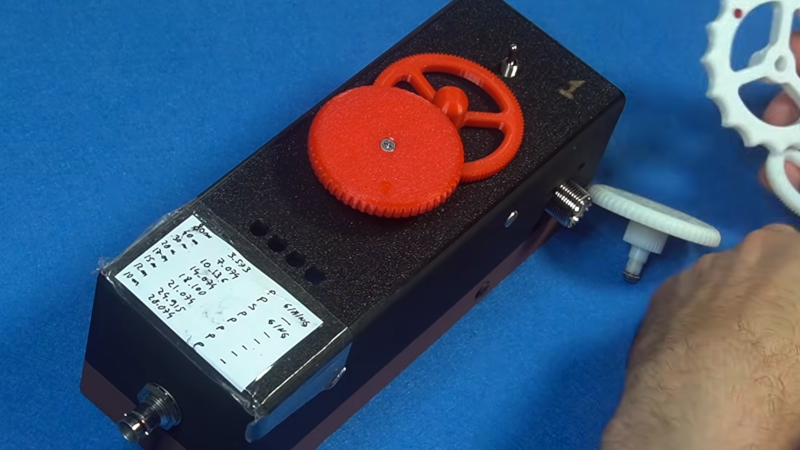
Loop antennas are becoming increasingly popular as more radio fans find they can’t erect elaborate outdoor antennas. Like most things, of course, there are trade-offs. But, most often, loop antennas are for receiving. Only a few can handle transmitting, and [FesZ] wanted to build some that could handle transmit power. You can find out what he discovered in the video below. Loop antennas are very sensitive, and a standard variable capacitor just rotates less than a single rotation. High-precision devices would often have gear reductions, but those are hard to find today. But with a 3D printer, it is reasonably easy to make gear reductions for a variable capacitor, and that’s what [FesZ] did. In addition, [FesZ] replaced one non-critical capacitor with a bank of fixed capacitors and switches. This isn’t just a build video. There are Spice simulations and even a thermal camera deployed. A lot to learn. If you build some cool loop antennas, let us know. If you want to look at some commercial receive antennas — including one that is — sort of — infinitely long, we’ve tried a few. I guess it would depend on what you’re feeding it. 50W would probably be fine without any cap arcing. 1500W…… not so much. Solution: Bigger air-cap and spacing between the windings of the radiating element. This worked in the nascent radio technology days before regenerative transmitters with separate linear stages that had to be fine-tuned to frequency and is still seen in some commercial setups transmitting today. I use a loop antenna at ~5-10 watts; it exceeds the 600v trim capacitors specifications but hasn’t blown up yet. signal has been received in Australia, from central Canada, so I suppose it works.