Summary
Customers expect a consistent experience whether they interact with a business through a mobile app, website, tablet, or self-service kiosk. Delivering that experience requires more than an attractive interface. It depends on an architecture that keeps data synchronized, responds quickly, and supports multiple channels without duplicating business logic.
For companies planning to hire Flutter developer talent, pairing Flutter’s fast and responsive UI with a Python backend offers a practical way to build scalable omni-channel platforms. Python handles complex business logic and integrations, while Flutter delivers a consistent user experience across mobile, web, and desktop applications.
What Makes an Omni-channel Platform Different?
An omni-channel platform goes beyond simply supporting multiple devices. Every channel should access the same core business data while providing an experience optimized for its users.
For example, a customer might browse products on a mobile app, continue shopping on a website, and complete the purchase through another device without losing their cart or preferences. Achieving this level of consistency requires centralized business logic and API-driven communication between frontend applications and backend services. Modern API-first and Backend-for-Frontend (BFF) architectures are commonly used to simplify frontend integrations and reduce the need for each client to orchestrate multiple backend services directly.
Why Python and Flutter Work Well Together
Python has become one of the most popular backend technologies because of its mature ecosystem, scalability, and support for frameworks such as FastAPI and Django. It is well suited for building APIs, handling authentication, processing business logic, and integrating with third-party services.
Flutter complements this by allowing developers to build responsive applications for multiple platforms from a single codebase. Instead of maintaining separate Android, iOS, web, and desktop applications, development teams can reuse much of their UI while connecting every client to the same backend services.
This separation allows both layers to evolve independently. Backend teams can improve APIs without redesigning the interface, while frontend teams can introduce new experiences without changing the underlying business logic.
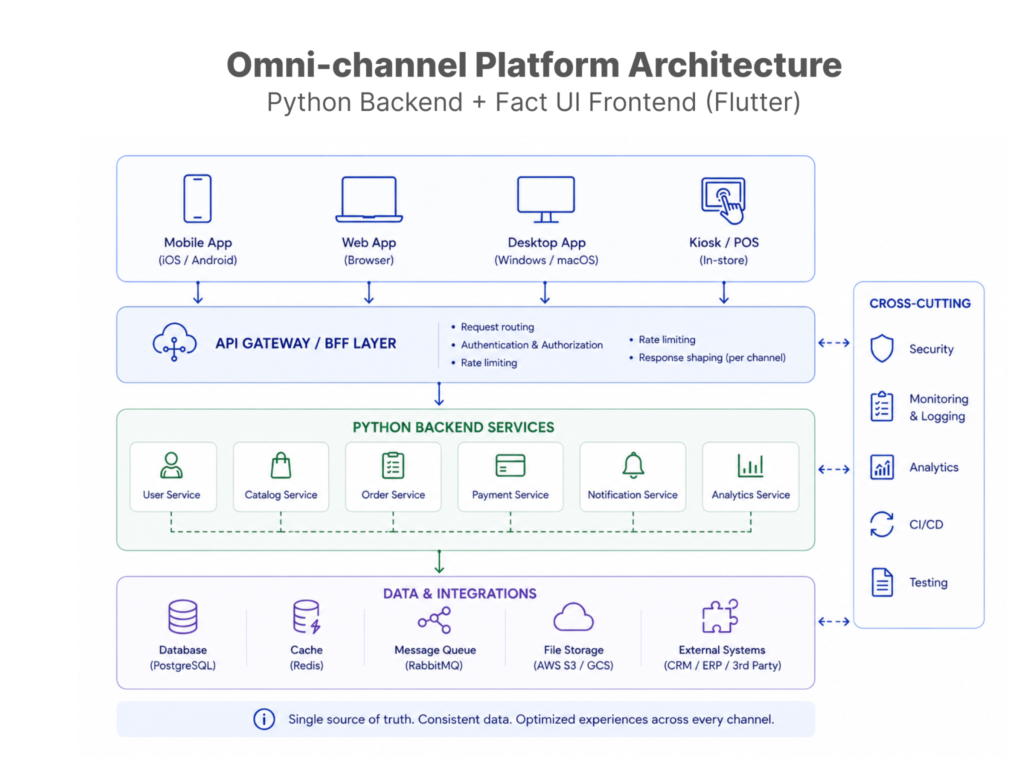 This architecture reduces duplication, simplifies maintenance, and makes it easier to introduce new digital channels as business needs evolve.
Designing for Performance and Scalability
A successful omni-channel platform depends on more than selecting the right technologies. The way those technologies are connected has an equally significant impact.
Experienced development teams typically focus on:
This architecture reduces duplication, simplifies maintenance, and makes it easier to introduce new digital channels as business needs evolve.
Designing for Performance and Scalability
A successful omni-channel platform depends on more than selecting the right technologies. The way those technologies are connected has an equally significant impact.
Experienced development teams typically focus on:
- API-first architecture
- Modular backend services
- Consistent data models
- Efficient caching strategies
- Secure authentication and authorization Another common pattern is the Backend-for-Frontend (BFF), where each frontend communicates with a backend layer tailored to its specific needs. This reduces unnecessary API calls, simplifies frontend development, and allows each interface to receive only the data it requires. These architectural decisions improve scalability while keeping the user experience responsive as new features and integrations are added. Build for Growth, Not Just Launch Many products begin with a single mobile application but later expand to include customer portals, administrative dashboards, partner platforms, or additional devices. Building an API-driven architecture from the beginning makes this expansion much easier. Instead of rebuilding business logic for every new channel, organizations can reuse existing backend services while developing new frontend experiences on top of them. For businesses planning to hire Flutter developer professionals, this approach helps reduce development effort, accelerate delivery, and create digital platforms that can continue evolving alongside changing customer expectations. Conclusion Modern omni-channel platforms succeed because they combine centralized business logic with flexible user experiences. Python provides a reliable foundation for scalable backend services, while Flutter enables fast, consistent interfaces across multiple platforms. Together, they allow organizations to build connected digital ecosystems that are easier to maintain, integrate, and expand over time. By investing in clean architecture and API-first design from the outset, businesses can create omni-channel solutions that deliver both excellent performance today and the flexibility to support tomorrow’s growth.