Summary
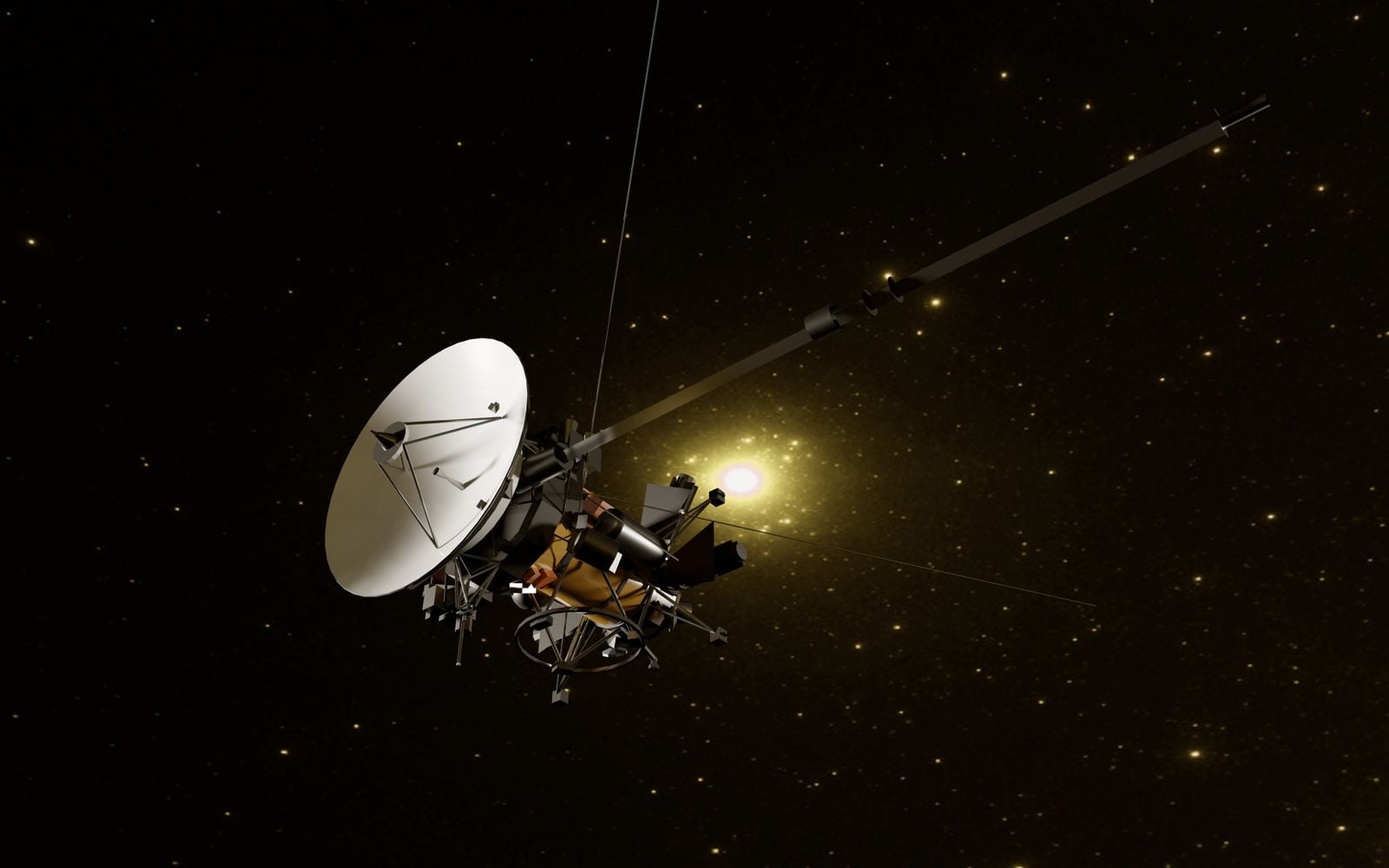
On 5 September 1977, a Titan IIIE/Centaur rocket lifted off from Cape Canaveral carrying Voyager 1 toward Jupiter and Saturn. NASA’s Voyager FAQ gives the spacecraft’s launch mass, including hydrazine, as 815 kilograms. Forty-nine years later, the probe is still transmitting from interstellar space. NASA’s current mission-status page says Voyager 1 will reach one light-day from Earth, 16,094,799,096 miles, on 18 November 2026. At that distance, radio signals need nearly a full day to travel one way between Earth and the spacecraft. A command-and-response cycle therefore stretches across almost two days. What an RTG actually is A radioisotope thermoelectric generator is not a fission reactor with control rods or a chain reaction. NASA’s Radioisotope Power Systems FAQ explains that an RTG converts heat from the natural radioactive decay of plutonium-238 into electricity through thermocouples and the Seebeck effect. Voyager uses the older Multi-Hundred Watt RTG, or MHW-RTG, design. NASA lists each Voyager MHW-RTG at 158 watts of electrical output at the beginning of the mission, giving three units a combined beginning-of-mission output of roughly 474 watts. The generators have no turbine, piston, or other moving power-conversion machinery, which is one reason they can work for decades. NASA’s Voyager spacecraft description confirms that three RTGs supply electrical power and that loads have to be switched off as their output declines. Why the power keeps falling The plutonium does not suddenly stop producing heat when it reaches some expiration date. Its radioactive decay produces a slow decline, while the spacecraft has less and less electrical power available to distribute among instruments, heaters, communications, and other systems. The operational number is remarkably small but relentless. NASA says each Voyager’s RTG puts out about four watts less electrical power every year. Four watts is trivial in a house, but it is significant on a spacecraft whose available power has already fallen to well under half its beginning-of-mission level. Every remaining load therefore competes for a shrinking electrical budget. Turning off the lights, one instrument at a time Voyager’s prime-mission science payload consisted of 10 instruments, representing 11 investigations when radio science is counted. Many were shut down after the planetary encounters, including the imaging system in 1990 after Voyager 1 completed its final family portrait of the solar system. The process has continued as the power margin has tightened. In NASA’s April 17, 2026 mission update, engineers shut down Voyager 1’s low-energy charged particle experiment, leaving the plasma wave subsystem and magnetometer as its two operating science instruments. Engineers have also looked for power outside the science instruments themselves. In 2023, NASA described a strategy that tapped a small reserve of RTG power previously held for a voltage-regulation safety circuit, allowing Voyager 2 to postpone another science-instrument shutdown. The conservation work is still evolving. In an August 2026 update, NASA said engineers had freed additional power on Voyager 2 through a group of changes nicknamed the “Big Bang,” and that the mission planned to perform the same swap on Voyager 1. The fuel supply problem back on Earth Plutonium-238 for space power systems has to be manufactured deliberately rather than mined as a ready-to-use fuel. Oak Ridge National Laboratory reported in 2015 that its process starts with neptunium-237, which is irradiated before the resulting plutonium is chemically separated and converted into oxide. That 2015 run produced 50 grams of Pu-238 and restored a U.S. production capability that had been dormant for nearly 30 years after production at the Savannah River Plant ended in the late 1980s. The milestone mattered because radioisotope-powered missions consume fuel on a kilogram scale, not a gram scale. For comparison, NASA says Perseverance’s Multi-Mission RTG uses 4.8 kilograms of plutonium dioxide as its heat source. That rover uses a newer RTG design, but the quantity shows why producing space-qualified radioisotope fuel is a substantial undertaking. What the record actually shows about the end Voyager 1 is not approaching a moment when its plutonium suddenly runs out. The practical limit arrives when the declining electrical output is no longer enough to operate the remaining spacecraft systems and science instruments. NASA has been careful not to give that moment a guaranteed date. In JPL’s 2025 power-conservation update, engineers said the two Voyagers could retain enough electricity for at least one science instrument into the 2030s, while warning that unexpected spacecraft problems could shorten that timeline. Whenever the final transmission comes, Voyager 1 will continue moving through the galaxy. NASA’s 2026 trajectory update says the probe is heading toward AC +79 3888, better known as Gliese 445, and should pass within about 1.7 light-years of the star in roughly 40,000 years. It will still carry the Golden Record, the gold-plated phonograph disc containing sounds, images, music, and greetings from Earth. Long after its transmitter falls silent, the spacecraft itself will keep going. Four watts a year sounds almost insignificant. For Voyager 1, that slow loss is now the unit by which engineers trade electrical power for a little more time in interstellar space.