Summary
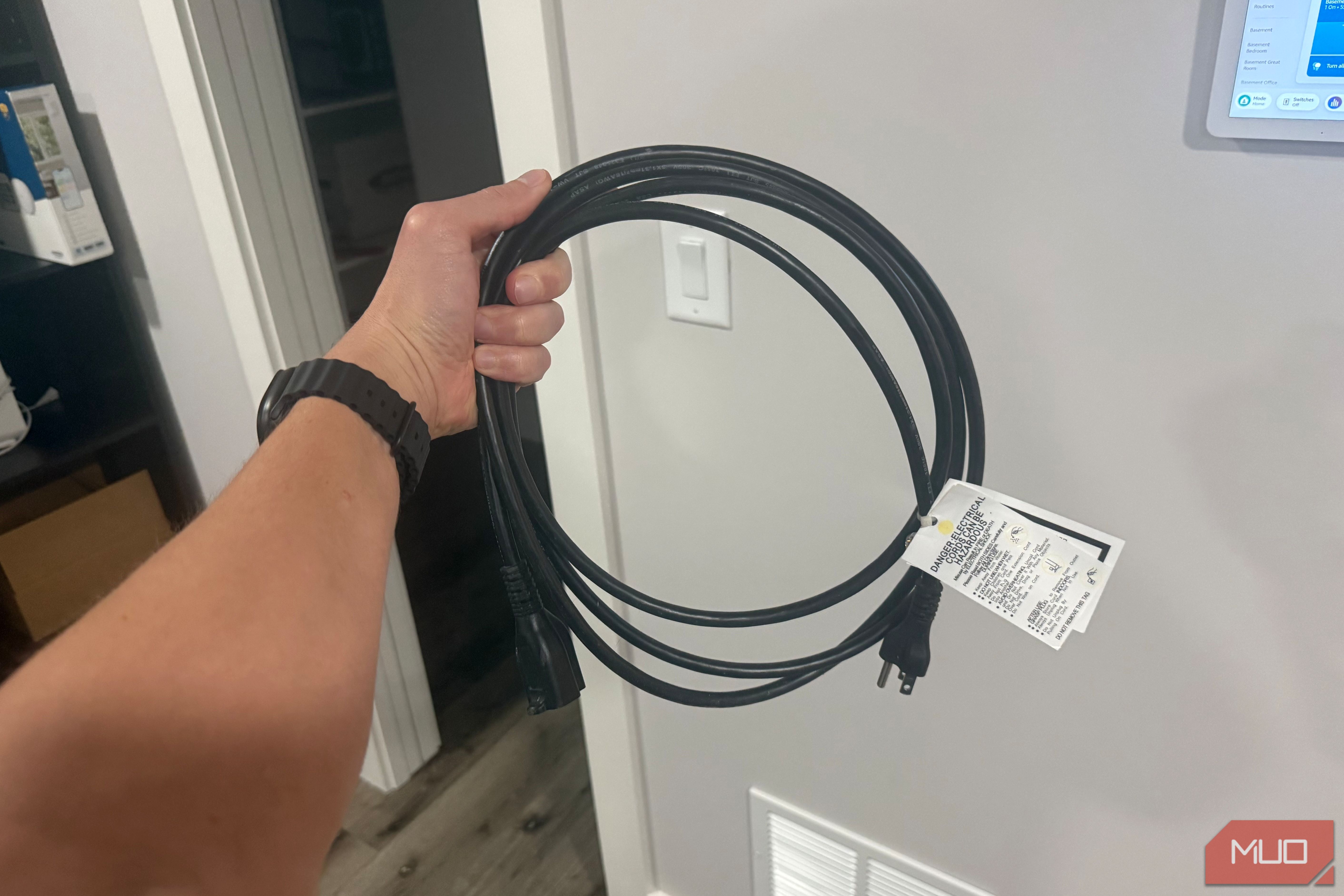
The surge protector in my garage kept tripping. I had a portable AC (Honeywell) and a dehumidifier (which I forgot to turn off) plugged into it. Both units have compressors and were plugged into the same Anker power strip. If the AC unit and dehumidifier turned on at the same time, they’d pull more amps than the strip was rated for. Thankfully, nothing broke, but now I always plug my AC, Ryobi pressure washer, and Shop-Vac directly into the wall. And now I pay closer attention to the extension cords I use. Because the printing on them tells you all you need to know about what they can be used for. Every extension cord carries a spec sheet on its jacket Decoding the print on a $10 cord When held up to light, I can see that the jacket of a 10-foot Amazon Basics extension cord I own is printed with “SJT VW-1 105°C 300V 3x1.31mm² (16AWG)“. That single line of text contains a lot of information. The 16AWG refers to the gauge of wire that is used. The lower the number, the thicker the copper wire used. The 3x1.31mm² refers to the fact that there are 3 conductors (hot, neutral, and ground), and that each is 1.31 square millimeters in size. The S in SJT stands for service cord, the J stands for junior duty (insulation rated for 300 volts), and the T stands for thermoplastic jacket. The 105°C refers to the temperature rating of the insulation, and VW-1 refers to a flame test by UL. The UL and CSA codes are the certification file numbers. By the absence of the W, you can also tell that this extension cord is not rated for outdoor use. The tag tells you the real limit 13 amps, 1,625 watts, and nothing extra The tag on my extension cord is very clear that you should not connect more than a total of 1,625 watts to this cord. It’s listed as 13 amps at 125 volts, which is the same thing. The second tag on my extension cord also warns not to use the extension cord when wet, and to always store the cord inside. This is also telling you the same thing as the absence of the W. A standard space heater uses around 1,500 watts, which is about 92% of the rating of this extension cord on its own. There’s not much room for anything else. That’s why I never plug my heater into an extension cord. My pressure washer fails this cord twice Amps first, then the missing W According to the manual, my Ryobi RY142012 pressure washer requires 13 amps at 120 volts, which is the same as my 16-gauge extension cord. I’d be running a motor at the limit of what my extension cord is rated to handle, with no margin for error. Ryobi recommends using an extension cord that is at least 14 AWG and rated at least as well as the pressure washer. The second issue I have is with the jacket on the extension cord. The manual instructs us to use an extension cord designed for outdoor use with a W-A jacket designation, such as SJTW-A, that is plugged into a Class A GFCI. My indoor extension cord with SJT won’t work, so I plug the washer into my outdoor GFCI on the side of my house. Longer cords need thicker wire Length eats into the rating When you’re looking at extension cords, gauge and length are related. The University of Texas has a nice, simple chart that shows that for up to 13 amps, 16-gauge is OK at 25 or 50 feet. For 14 or 15 amps, you need 14-gauge. For tools such as shop vacs, air compressors, and saws that draw 16 to 20 amps, you need 12- or 10-gauge. The 10-gauge is required for 100 feet for the higher amps. The longer the extension cord, the more resistance and voltage drop that will occur. That also means more heat and more current draw from the motors as they try to compensate. This is why my Shop-Vac, one of the tools I’d never switch to cordless, is plugged directly into the wall, and also why there’s a warning label on my extension cord that says to fully extend the cord before use and not to use an extension cord with another extension cord. My portable AC taught me power strips have limits Two compressors, one surge protector Both my portable 10,000 BTU air conditioner and my dehumidifier have compressors, which means they pull a surge of current when they start. Whenever I used both of them on my surge protector from Anker, they would trip the surge protector. It was doing its job. The manufacturers of portable air conditioners don’t like us using extension cords or power strips. The manual for my portable AC, for example, specifically says not to use an extension cord and not to plug other appliances into the same outlet. Now my portable AC has a dedicated outlet. Read the jacket before you plug anything in For any extension cord, look at the gauge, amp/watt rating, and the presence of the W. Then compare it to the nameplate on the tool you want to use. If they’re close, then it’s best to use a heavier gauge, a shorter extension cord, or just plug directly into the wall. An outlet tester will help you determine whether the outlet you’re plugging into is wired correctly.