Summary
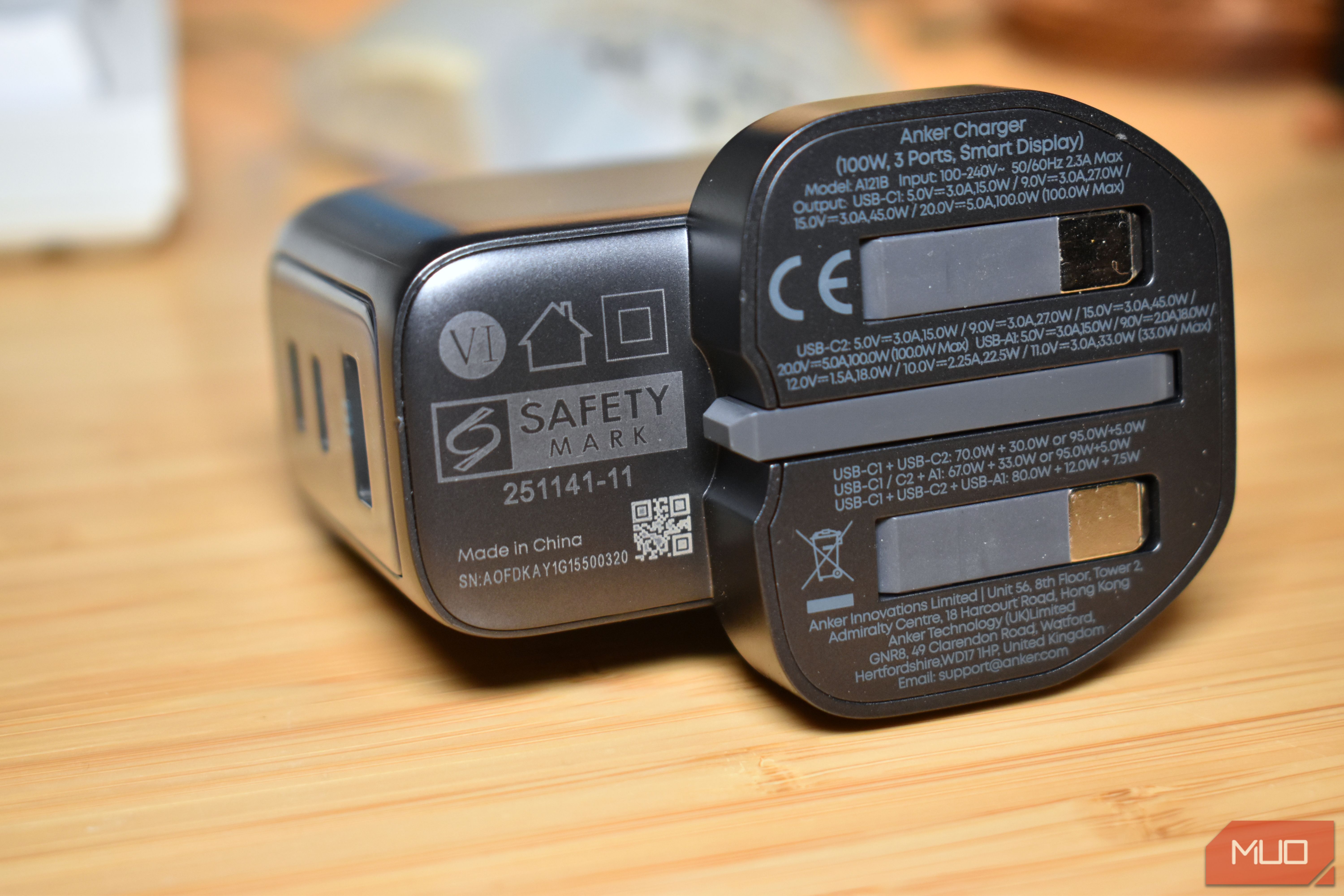
I have a drawer full of chargers, and like most people, I don’t always have the best ones on the market. At last count, at least 20 were sitting around my house, some for products that long ago found their way into the recycling bin. Last week, I put them all in a pile to decide which ones were worth keeping, and I noticed something I’d never seen before. The fine print on almost every charger included a single Roman numeral. Naturally, I got curious about what these characters meant, and I found something very interesting. That character shows an efficiency grade for how much power the charger draws from the outlet when nothing is attached, yet I’ve never seen this mentioned anywhere in all my years of writing about and buying tech. What the Roman numeral on your charger means It’s an efficiency grade most people walk right past The interesting mark comes from something called the International Efficiency Marking Protocol. The U.S. EPA developed it, and the Department of Energy now maintains it. Each numeral identifies two minimums: efficiency and no-load power. The former indicates how much power turns into heat instead of reaching your device, while the latter indicates the charger’s draw when it’s plugged into the wall with nothing attached. Currently, the scale runs from I to VII, with higher numbers indicating stricter criteria. For example, anything with an “I” rating doesn’t meet any of the higher requirements. Occasionally, you might also see two numerals on a single charger, each with a tiny 115 or 230 beside it. These numbers indicate different wall voltages. A supply can hit Level VI on 115V U.S. power and only Level V at 230V. How to find the efficiency rating on your charger Look near the certification logos, and bring good light Finding this Roman numeral isn’t easy, both because the text stays small and, in many cases, the font color is faint. For example, look at any Apple plug, and you’ll typically find the text on the side or bottom of the charger. The text typically includes the model number, output ratings, and a row showing certification logos. Look for the numeral around those logos. The current protocol calls for the text to be written in Times Roman or another plain serif font, which is part of why it’s so easy to mistake it for a stray letter. It would make sense if manufacturers printed “EFFICIENCY LEVEL” in the same location, which they’re allowed to do. Unfortunately, because they don’t have to, most do not, such as Apple. The iPhone Duo maker puts this information near a square inside another square, which is a symbol for double-insulated electronics. On my laptop’s charging block, the two run across the top of the label, with a circled N between them, so they’re a little less likely to be missed. The 35W charger, unfortunately, tells a different story entirely. The square on this charger sits right on top of the VI in a short column on the same side as its prongs. It’s squeezed much too tightly between Japanese and Mexican certification logos. Gray printing on white plastic makes it worse. I needed to hold the charger under a lamp and tilt it to make out the characters. Charger efficiency levels IV, V, VI, and VII explained Most of the chargers in your drawer land in the middle of the scale Most chargers you’ll find around your home are rated IV, V, or VI. Before 2016, the U.S. and Canada required Level IV, while the EU required Level V.
- Level IV: This is the mark you’re most likely to see on older chargers. A small Level IV charger could draw about five times the no-load power allowed under Level VI.
- Level V: This level aligns with California’s Tier 3 and the EU’s phase 2 rules. It caps small chargers at 0.3W with nothing attached and adds a power factor requirement.
- Level VI: This level is required in the U.S. for external power supplies manufactured after Feb. 10, 2016. Here, the no-load cap drops to just 0.1W. For bigger bricks, such as ones in the 49W to 250W range, like many laptop chargers, better than 88% efficiency is required. My MacBook Air charger falls in this range.
- Level VII: The “best” protocol to date also isn’t required in the U.S. The DOE proposed these tighter standards in 2023, but the Trump administration never finalized them.
Most modern chargers are rated at VI, but you’ll have to check each charger you own (or buy) to be sure.
How much electricity an old charger wastes
One charger costs pennies, but every brick in the wall adds up
I ran the numbers on an older charger. A Level IV phone charger can pull around 0.5W with nothing attached. Leave it plugged in all year, and that’s about 4.4 kWh. Pennsylvania’s average residential rate was 21.77 cents per kWh in August 2026, so that charger would cost me roughly 95 cents a year to do nothing. A Level VI charger tops out at 0.1W, which works out to under 0.9 kWh, or about 19 cents. At the national average of 18.16 cents, those numbers drop to about 80 cents and 16 cents.
One charger won’t change your electric bill. The total adds up when you count every power brick that never leaves the wall.
Idle draw is only part of it. Older chargers also lose more energy as heat while they’re working. In the early 1990s, external power supplies could be as little as 50% efficient. That wasted energy has to go somewhere, and it comes out as heat, which is why older chargers tend to run hotter.
Charger efficiency standards could be rolled back
Level VI is still required, for now
For now, Level VI is still the law for chargers sold in the U.S. A DOE rule from April 2026 didn’t change any existing efficiency standard.
That could change. In May 2025, the DOE proposed rescinding the Level VI standards it adopted in 2014, saying it had tentatively found they weren’t economically justified. It was one of 47 deregulatory actions the department announced under an April 2025 executive order called “Zero-Based Regulation to Unleash American Energy.”
The proposal wouldn’t leave chargers unregulated. The legal minimum would drop back to the standards Congress set in 2007, which line up with Level IV. Under this plan, manufacturers could keep building to Level VI, but they wouldn’t have to.
As you can see, a lot of factors go into these ratings, and it seems changes are made alongside administrations in Washington. As such, “standards” sometimes change from one year to the next, which can make the process confusing.
What I did with my charger drawer
It wasn’t an exact science, but in the end, I threw away all the chargers that didn’t seem to have a product mate and any others that looked old. That left about 10 chargers remaining in my household. If you’re clearing out your own pile, take the extras to an electronics recycling drop-off instead of the trash. Many big-box electronics stores accept them.
If you only check a few chargers, start with the ones that stay plugged in around the clock. Anything below VI that lives in the wall is the first one I’d retire, or at least unplug when it’s not in use.
 Anker Charger (140W) With Display
- Brand
- Anker
- Output Power
- 140W
- Color
- Silver or dark gray The Anker 140W charger can provide power for up to four devices simultaneously Along with three USB-C ports, the charger also had a USB-A plug. Two of the USB-C ports are designed for up to 140W of power and can charger a 15-inch MacBook Air to 50 percent in 30 minutes. All of the ports are on the bottom of the charger, helping to keep it plugged in. A screen of the front shows updated charging status and more.
- Cable included
- Yes
- Charging Ports
- 3 USB-C, 1 USB-A
- Weight
- 9.7oz