Summary
I’ve read hundreds of self-help books. I’ve also forgotten most of them within a month. The ideas from the books lit a spark at the moment. But without the follow-up of action, they just stay highlighted or bookmarked as digital junk. So, when I finished my latest (Tiny Experiments by Anne-Laure Le Cunff), I thought
.Inspired by a Reddit thread, I fed it to Claude and turned it into a text-based RPG. My goal was to slow down and not jump onto the next book without trying out the ideas in the practical world, or, as RPG gamers say, “IRL (In the Real World).”
The Claude setup takes less than five minutes
Your book becomes a game world instantly
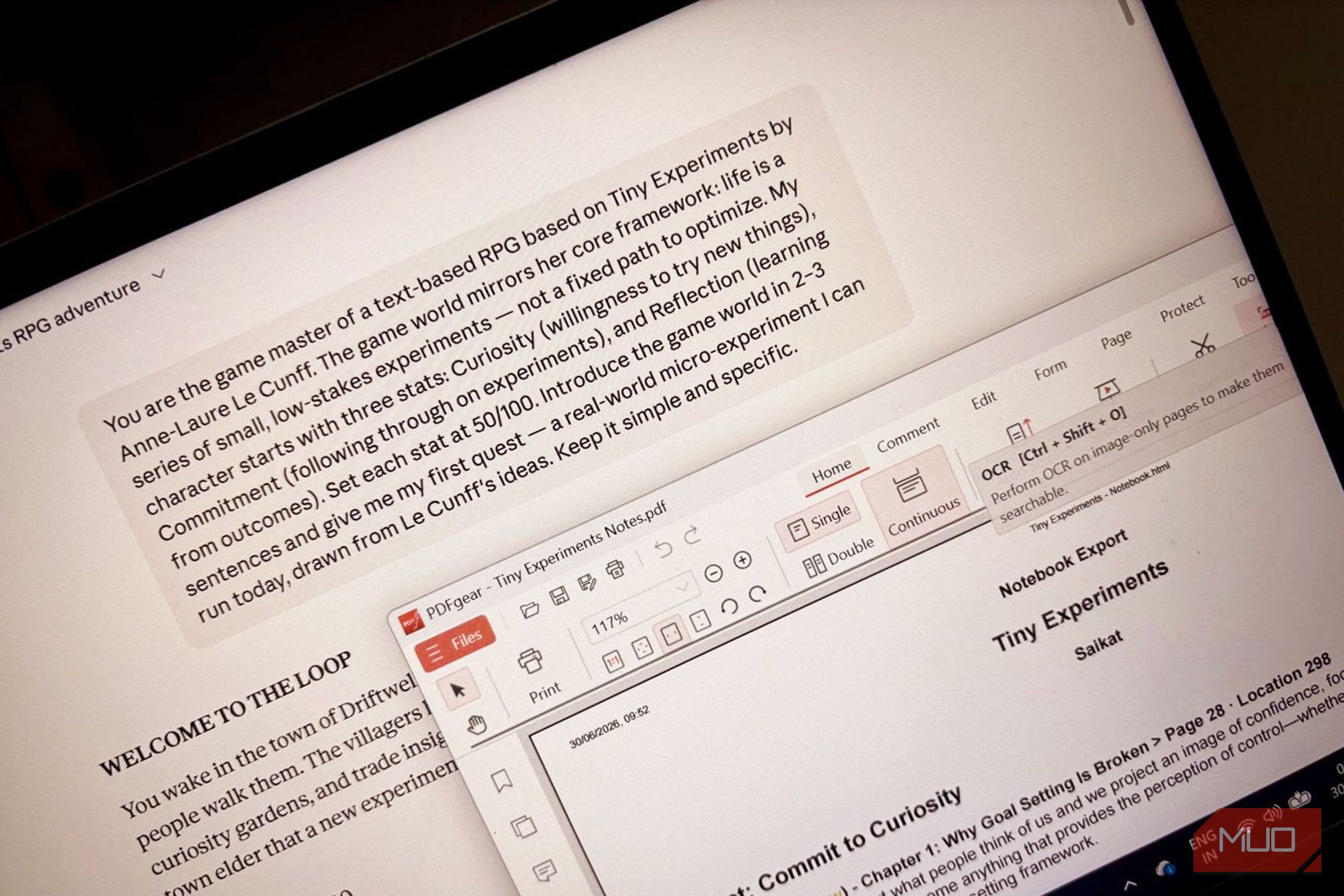
I started with a Claude Project that contained the book highlights in a PDF doc. Then, I designed the first world-building prompt to set the stage for the game to follow. Claude set up the world from there.
You are the game master of a text-based RPG based on Tiny Experiments by Anne-Laure Le Cunff. The game world mirrors her core framework: life is a series of small, low-stakes experiments — not a fixed path to optimize. My character starts with three stats: Curiosity (willingness to try new things), Commitment (following through on experiments), and Reflection (learning from outcomes). Set each stat at 50/100. Introduce the game world in 2–3 sentences and give me my first quest — a real-world micro-experiment I can run today, drawn from Le Cunff’s ideas. Keep it simple and specific.
I was stumped while writing the first prompt. The prompts will depend on the book you are reading, so use Claude to design effective prompts if required.
Yes, this does feel a bit gimmicky. But it’s a gamification experiment worth a shot. Here, the stats aren’t the point. Even looking at a “Reflection: 50/100” score on screen can make you pause and think about what you read.
The quests force real-world action
Claude sends you into your actual life
This is where the RPG earns its keep. After each in-game prompt, Claude assigns a micro-experiment pulled from the book’s framework. Mine included: write one sentence in a journal, or do one set of stretches. Another asked me to read one page of something unfamiliar.
You can invent these on your own, too. But allowing a machine to throw it at you is the novelty.
The IRL triggers are the critical part of the whole book to RPG system. You can’t progress in the game without attempting the quest. This is the accountability hurdle we always skip when reading for pleasure.
An old habit of mine made me uncomfortable about doing the tasks at first. When I actually sat down to write one sentence in my journal, I filled two pages with freewriting. Le Cunff’s framework of collecting data with too-small-to-fail experiments made a lot more sense.
Failure is built into the rules
The game treats setbacks as data, not defeats
This follow-up prompt is the next stage of the RPG game, where Claude can score you:
I completed the quest. Here’s what happened: [describe what you actually did and how it went]. Based on my outcome, update my stats and tell me what Le Cunff’s framework says about this result. Then give me the next quest.
I thought I had completed the quest. But Claude told me that I had missed the Reflection exercise. It gave me a gentle reminder and didn’t add to my score on that metric. It reframed my reason as a data point and adjusted my stats. It didn’t give me a smaller version of the same quest as I expected, but it did follow the author’s ideas and told me to keep the bar low going forward.
This mirrors one of the book’s central ideas: experiments give you the confidence to get started because there is no bad result or wrong choice. You just need to show up.
A self-help book is always filled with a lot of fluff and theory. Having a game master cut through the noise and focus on practical advice was harder to dismiss as the quests continued, and the lessons were drilled into my head. It might be a good idea to turn this book-to-game idea into a Claude Skill later.
The reflection checkpoint changes how you read
Pause the game to check your real patterns
After a few quests, I ran a reflection prompt. I asked Claude to step back and summarize my experiment log:
Pause the game. Based on everything so far, summarize my experiment log: what I tried, what I learned, and what pattern is emerging about how I work. Use the author’s language where it fits naturally. Then ask me one question she might ask.
The book talks about noticing patterns across experiments. The RPG creates enough structured repetition that those patterns actually show up.
I could have journaled my way to the same insight. Maybe. But journaling for a long time can become automatic. The game format created just enough distance to force a new insight.
Any book can become a game like this
The prompts can work for any book
The prompts I used aren’t specific to Tiny Experiments. The three-stat system, the quest structure, the failure reframe, and the reflection checkpoint can work with any book that has a practical framework. It can work with any other AI chatbot, too.
You can tweak them at will to make your own feedback system. For instance, Atomic Habits might use Identity, Consistency, and Environment. The logic will hopefully travel well from one book to the next. I noticed that you can make a quick version without uploading any highlights or the book if it’s a popular title.
Ultimately, all this isn’t about making reading more fun. It’s about making it harder to stay passive. The RPG format won’t suit everyone, especially if you don’t like games. Some readers process ideas best by sitting with them quietly or writing about them in the margins.
When you run through all the quests, you can ask Claude:
As the game master, tell me honestly: is this RPG format actually helping me engage with the book’s ideas more actively — or is it just making the experience more entertaining? What’s the difference, and does it matter?
But make sure the AI chatbot can also play the Devil’s advocate and not just glad-hand you.
 Claude
- Developer
- Anthropic PBC
- Price model
- Free, subscription available Claude is an advanced artificial intelligence assistant developed by Anthropic. Built on Constitutional AI principles, it excels at complex reasoning, sophisticated writing, and professional-grade coding assistance. Try one chapter before the whole book Pick a chapter that challenges you most. Build one prompt around its core idea, assign yourself a single quest, and report back to Claude with what actually happened. You don’t need to build the whole game at once. One experiment is enough to find out whether this works for you.