Summary
Buying an ESP32 board seems simple until you realize there are dozens of variants floating around the internet, and not all of them are the same. Get the wrong one, and your project will hit a snag when you least expect it. The plain old ESP32 does a lot, but it’s not the default you should be reaching for every project.
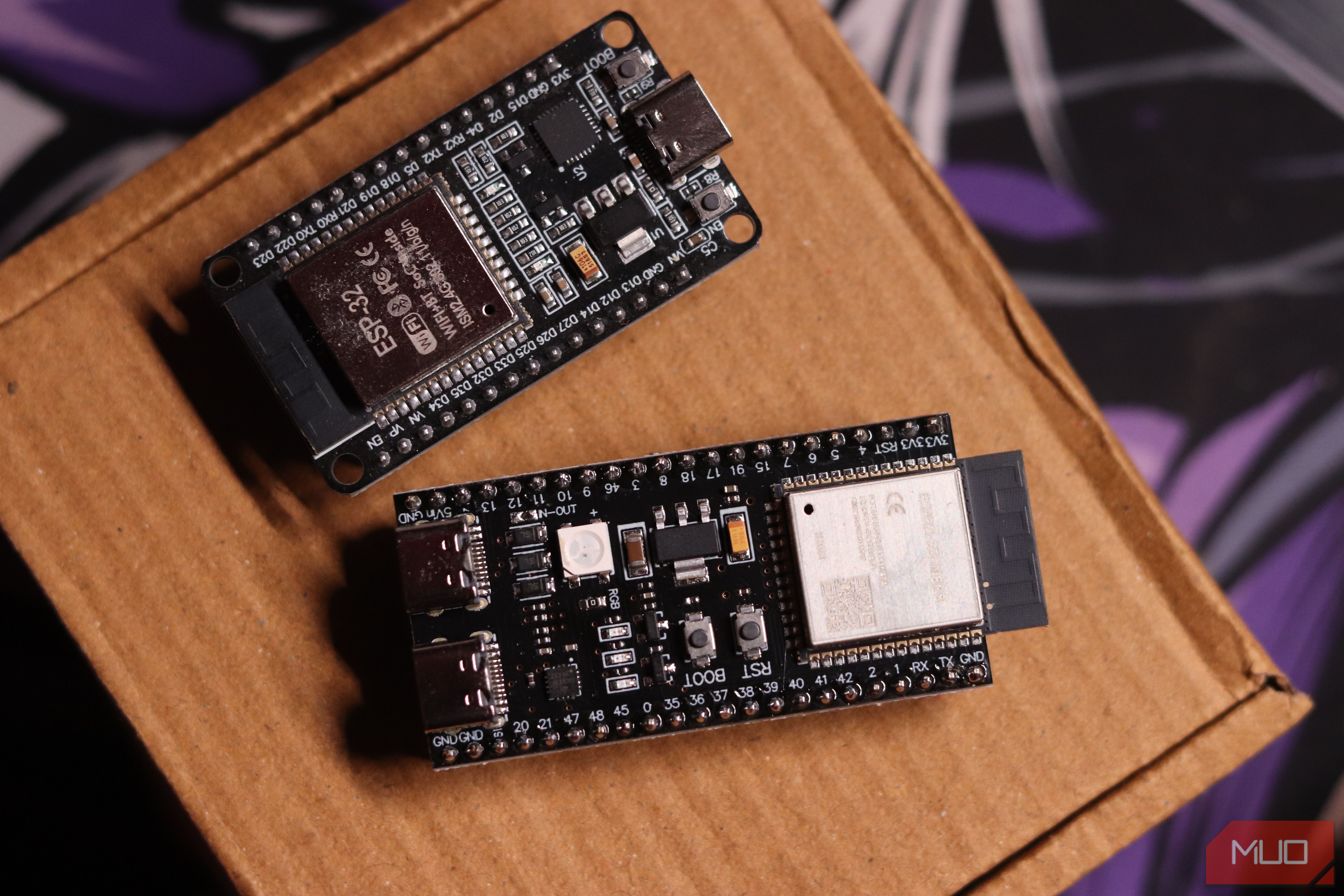
For most people starting a new project today, the ESP32-S3 has quietly become the default choice. That old ESP32 you’ve got sitting in a drawer somewhere is now the niche option, not the other way around.
The S3 quietly became the default choice
Vector instructions the original chip never had
The original ESP32 launched a decade ago in 2016, and has been the backbone of the maker scene ever since. However, Espressif’s newer ESP32-S3 uses a dual-core Xtensa LX7 processor instead of the older LX6 cores. So while the clock speed is technically the same at 240 MHz on paper, the LX7 architecture handles instructions more efficiently and adds vector extensions that were never part of the original chip.
These vector instructions allow the S3 to run lightweight machine learning workloads, like wake-word detection or basic image classification, directly on the chip using Espressif’s ESP-DL and ESP-SR libraries. The original ESP32 has nothing comparable.
Apart from raw compute, the S3 also adds native USB OTG support, meaning it can identify as a USB HID device. This opens up avenues like using it as a hardware security key, keyboard, mass storage device, or serial port without any extra hardware. It also adds a dedicated camera interface for parallel DVP sensors, more GPIO pins at 45 compared to the original ESP32’s 34, and Bluetooth 5.0 over the aging 4.2 spec.
For just about any hobbyist project you can think of today, the ESP32-S3 gives more headroom for less money than it used to cost. And that’s exactly why it makes sense as the default pick.
What the original ESP32 still does better
Classic Bluetooth didn’t survive the upgrade
None of this means your older ESP32 boards are obsolete. It still supports classic Bluetooth alongside BLE, which the S3 dropped entirely. This single detail matters a lot if you’re building anything around Bluetooth audio streaming, like an A2DP speaker or a headset bridge. The S3 traded that legacy protocol support to modernize around BLE 5.0, so if your project depends on pairing with older Bluetooth audio gear or using profiles like AVRCP and HFP, the original chip is still the only sensible option in the ESP32 family.
The original ESP32 is also much more accessible, and at times significantly cheaper than its S3 variant. It has been around for a decade, so nearly every tutorial, Arduino library, and ESP-IDF example was written with it in mind. If you’re doing something conventional like a basic Wi-Fi repeater, or a simple relay controller, and don’t need the AI acceleration or USB device functionality, the original ESP32 will do just fine.
Then there’s the board built for tiny spaces
Tiny, RISC-V, and built to run off a battery
As mentioned before, there are tons of ESP32 variants circling the internet. One particular board you should keep in mind however, is the ESP32-C3 Supermini, which solves a completely different problem than either the original or the S3. It swaps the dual-core Xtensa design for a single-core RISC-V chip running at up to 160 MHz, which sounds like a downgrade until you realize this board only measures roughly 18 by 22 millimeters, a fraction of the footprint of a standard ESP32 or S3 dev board. Some C3 variants like the Seeed Studio XIAO ESP32C3 are built to run directly off a 3.7-volt lithium battery without extra regulation circuitry.
That combination of tiny size and native battery support makes the C3 Supermini the obvious choice for anything wearable, or any project where board size is a real factor. It still gets Wi-Fi and Bluetooth 5.0, so you’re not sacrificing connectivity, just raw processing power and pin count. Generic C3 Supermini boards typically expose around 13 GPIO pins, though battery-ready variants like the XIAO trim that down to 11 to make room for the onboard charging circuitry.
There’s no single right answer, just a constraint
Budget, features, or size — pick your constraint
There is not a single candidate for the best ESP32 board anymore. It depends entirely on what constraint you’re designing around. If you want a general-purpose board with room to experiment with AI features, cameras, or USB gadgets, the S3 is the board to buy.
However, if you’re on a tight budget or need classic Bluetooth, the original ESP32 is still the better choice. And if size or battery life is a constraint, the C3 Supermini is built exactly for the job.
 ESP32-S3
- Brand
- Espressif ESP32-S3 is a low-cost ESP32 variant with built-in Wi-Fi, Bluetooth LE, USB support, and AI/vector acceleration designed for IoT, embedded, and edge AI projects.