Summary
Summary
- Duck.ai now offers GPT-5.6 Luna as its default free model, with no account or login required.
- DuckDuckGo anonymizes prompts and lets users switch between models including Claude Haiku 4.5, Mistral Small 4, and Gemma 4.
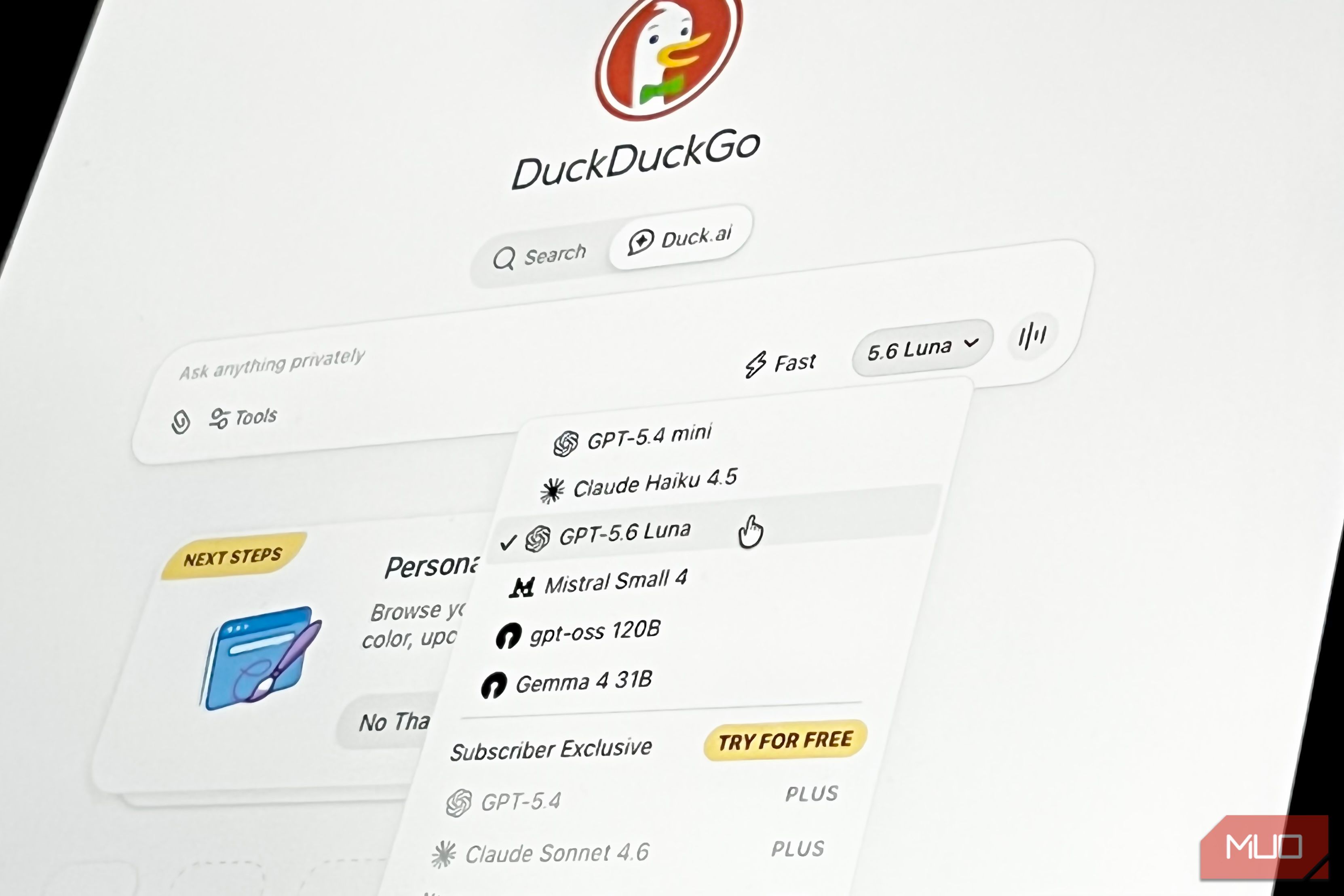
- Duck.ai offers greater model variety than privacy-focused rivals, although Lumo or Confer may be safer for highly sensitive conversations. Using a big-name AI model normally means creating another account and trusting its developer with whatever you type. Duck.ai has offered a convenient way around that for a while, but its older free models made privacy come with a fairly noticeable performance compromise. Thankfully, that compromise is now easier to accept. DuckDuckGo has added OpenAI’s GPT-5.6 Luna to Duck.ai and made it the default LLM for free users, giving you access to one of OpenAI’s latest models without having to create an account or sign in. Duck.ai now offers several major AI models anonymously GPT-5.6 Luna is the new default for free chats, but there’s more DuckDuckGo hasn’t formally announced the change, but opening the official Duck.ai model selector now presents GPT-5.6 Luna as the recommended option for everyday use. The free selection also includes Claude Haiku 4.5, Mistral Small 4, GPT-5.4 mini, gpt-oss-120b, and Gemma-4-31B. OpenAI’s GPT-5.6 has different models, and Luna is the smallest and most cost-efficient member of that family. Therefore, it shouldn’t be confused with the more powerful Sol model that went shoulder to shoulder with Fable 5 in our test. DuckDuckGo also hasn’t disclosed how much reasoning time Luna receives, so I wouldn’t assume it matches the deeper reasoning configurations available elsewhere. Still, it should be more than capable enough for everyday questions and lightweight research. The important part is how Duck.ai handles your prompts. As we found when using DuckDuckGo’s Windows browser, DuckDuckGo acts as an intermediary between you and the AI provider. It removes identifying metadata such as your IP address, making requests appear to come from DuckDuckGo instead of you. You don’t need an account, DuckDuckGo doesn’t store your chats on its servers by default, and its agreements prohibit providers from training their LLMS on your conversations. (I would like to believe that Johnny Silverhand from Cyberpunk 2077 would also use DuckDuckGo for everyday searches and inquieries.) In some cases, that gives Duck.ai a considerable advantage over visiting ChatGPT or Claude directly. More importantly, it lets you switch between models inside the same conversation. If Luna struggles with a writing prompt, for example, you can hand the conversation to Claude Haiku without copying everything into another chatbot. Can Duck.ai beat the competition? For highly sensitive conversations, Proton’s Lumo is arguably the best option out there, which can also be considered as Duck.ai’s closest competitor. It offers guest access, keeps no logs, and uses zero-access encryption for saved chats (which does require a free Proton account). The downside is that Lumo relies on open-source models hosted by Proton. It doesn’t let you jump between OpenAI and Anthropic models. Therefore, if a balance of privacy and answer quality is what you’re looking for, Duck.ai can be a more versatile option. Confer is another compelling alternative. It protects conversations with end-to-end encryption and confidential computing. It also supports useful features such as web search, image generation, and memory. But again, it is designed around its own models rather than a menu of recognizable third-party LLMs. It’s also recommended for people who don’t want to deal with ads in ChatGPT. Duck.ai is a compelling private AI sampler, but it isn’t a vault Duck.ai now occupies an appealing middle ground: it is anonymous enough for ordinary questions, requires no account, and offers more model choice than its privacy-focused rivals. However, anonymity doesn’t erase personal details that you include inside a prompt. For confidential documents or genuinely sensitive conversations, Lumo’s encryption or a completely local model remains safer. For everything else, getting Luna and Claude in the same private interface is tough to beat.