Summary
DeWalt’s yellow battery packs look like variations on a single product until you check the tags. A standard 5Ah pack works out to around 219 list price for the same capacity, and nothing on the outside of either pack explains where that money goes. Three different cell constructions hang on that peg. The expensive ones are built to push current out faster, which is a different promise than running longer. My garage is mostly green Ryobi tools rather than yellow Dewalts, and years of figuring out which packs on a platform earn their price taught me to ignore the badge and look at the cells. Enough friends and family run DeWalt that the question keeps finding me anyway.
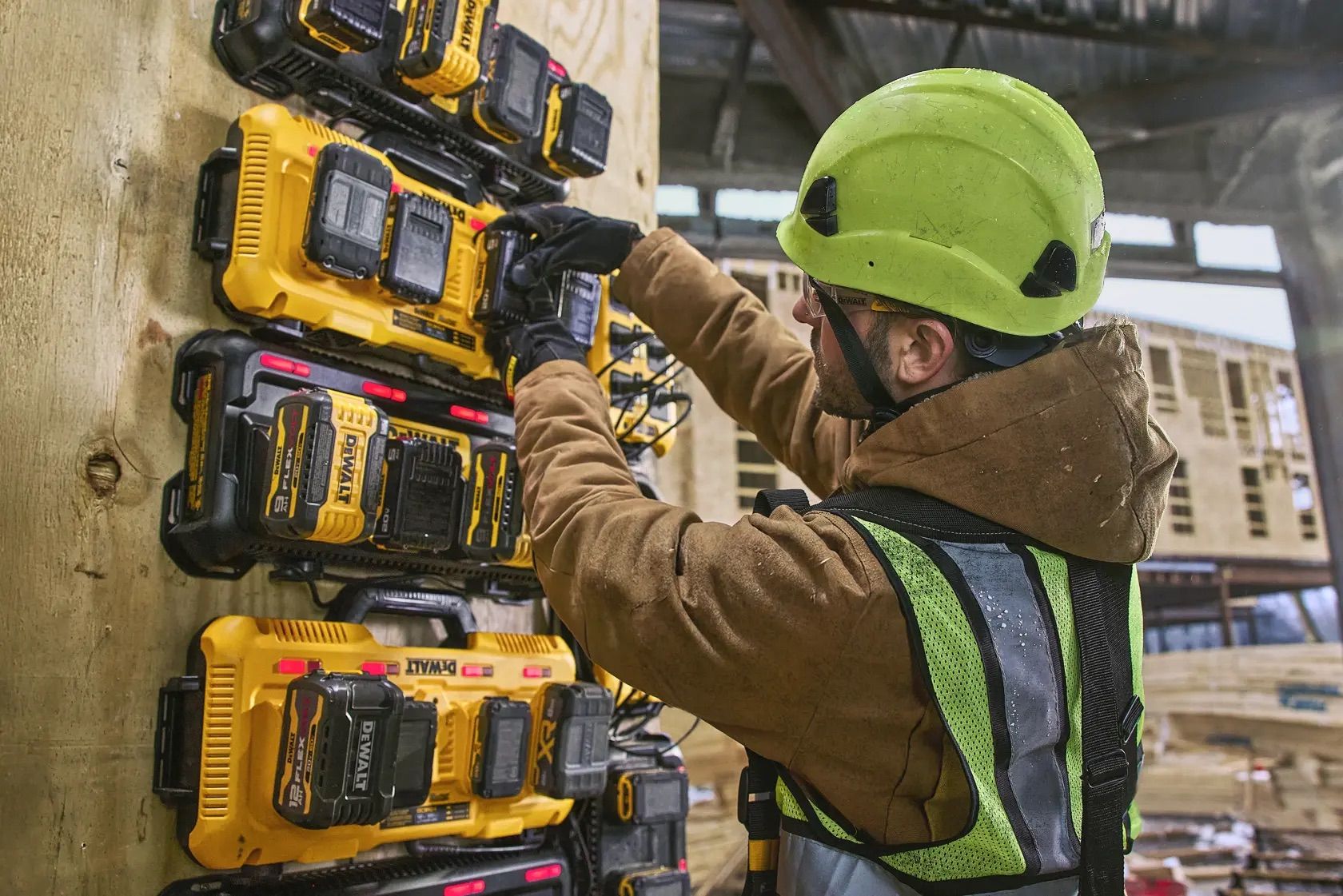
The three cell types inside DeWalt’s yellow packs
Standard cylindrical, tabless cylindrical, and pouch
The base packs use tabbed 18650 cells, the same cylindrical format that has powered cordless tools for well over a decade. These wear no XR badge. The DCB205 5Ah and its smaller siblings sell in volume and go on sale constantly.
Above them sit two different premium designs that DeWalt now markets under one label. Tabless cylindrical cells collect current along the entire edge of the electrode instead of routing it through a single welded tab. Less resistance, less waste heat. Those cells live in the 4Ah and 8Ah packs that carried PowerPack branding until this spring.
The third design skips cylinders entirely. Pouch packs stack five flat lithium-polymer cells, a format DeWalt has sold under the PowerStack name since 2022.
In April 2026, both sub-brand names came off the packaging. A pouch pack and a tabless pack now read the same on the shelf: XR. Cell type still appears in DeWalt’s online product descriptions, which is the only place a buyer can check without opening the housing.
What the premium cells actually buy
Peak current, not extra runtime
Amp-hours describe the size of the tank. Cell construction decides how fast fuel can leave it. A 5Ah pack holds 5Ah no matter what’s inside, and on a work light or a jobsite radio, all three versions run for roughly the same stretch.
The gap opens under sustained load. Every cell has internal resistance, and resistance under heavy draw turns into heat instead of work. A standard pack asked to feed an angle grinder or a 7-1/4-inch circular saw warms up, sags, and eventually trips its own protection circuit. Tabless and pouch construction cut that resistance, so more of the stored energy reaches the motor, and less of it cooks the pack.
I spent 12 years working with HVAC and electrical contractors, and the tools that found a battery’s ceiling were always the same ones: hole saws through joists, cut-off wheels on strut, anything that stayed in the material for minutes at a time. Heat is also what quietly shortens a pack’s usable life, so running cooler pays off twice.
Homeowner tools rarely reach that ceiling
Where the standard pack is still the right answer
Most home projects never ask a battery for any of that. Driving deck screws, boring pilot holes, running a tire inflator, hanging a TV mount: the load arrives in bursts of a few seconds and then stops. A standard pack handles all of it without approaching its limit.
Price makes the case harder to argue with. A two-pack of DCB205s recently ran 249. The pouch 5Ah has sold for 219. Same capacity, half the batteries. Owning a second pack means one is always charging while you work, which beats owning one pack that empties slightly slower.
The premium tier does earn its money in one place. The compact 1.7Ah pouch pack delivers real output in a body small enough to change how a tool balances overhead or inside a cabinet. Nobody bought the 5Ah pouch for its size, though. Batteries deserve more of your budget than tools do, which is exactly why that money belongs on the right ones.
FLEXVOLT is a voltage system, not a cell upgrade
It only pays off if you own 60V tools
FLEXVOLT belongs in a separate conversation. The cells inside are cylindrical, same as the standard packs. What differs is the wiring. The pack reads the tool it’s clipped into and reconfigures itself, running at 20V in a drill and 60V in a FLEXVOLT saw.
That flexibility is genuinely useful, and it’s also the entire reason to buy one. Drop a 9Ah FLEXVOLT into a 20V drill, and you get a heavy, expensive battery with a lot of capacity. The tool doesn’t get faster. It gets front-heavy.
Buy FLEXVOLT when a 60V MAX tool forces the decision, not to chase performance in a 20V one. That’s the same reasoning I use when choosing between two voltage platforms in my own garage. One more note for anyone on the fence: a tabless 12Ah FLEXVOLT pack is on the way, so there’s a reason to wait before spending on the current version.
 DeWalt Atomic 20V Max 2-Tool Kit
- What’s Included
- Drill, impact driver and charger
- Tool Type
- 20V The pack DeWalt is quietly walking away from In August 2026, DeWalt introduced an XR 5Ah battery built with tabless cells, model DCB2105, and confirmed it replaces the 5Ah pouch pack. Company representatives have indicated the replacement will cost less than the battery it retires. The 1.7Ah and 3.5Ah pouch packs stay in the lineup, which fits the pattern: pouch construction shines when a pack needs to be small. So the shopping list is short. Buy standard packs in pairs, keep one compact pouch pack for overhead work, and buy FLEXVOLT the day a 60V tool lands in your cart. The yellow aisle gets a lot friendlier once you know which three things you’re choosing between.