Summary
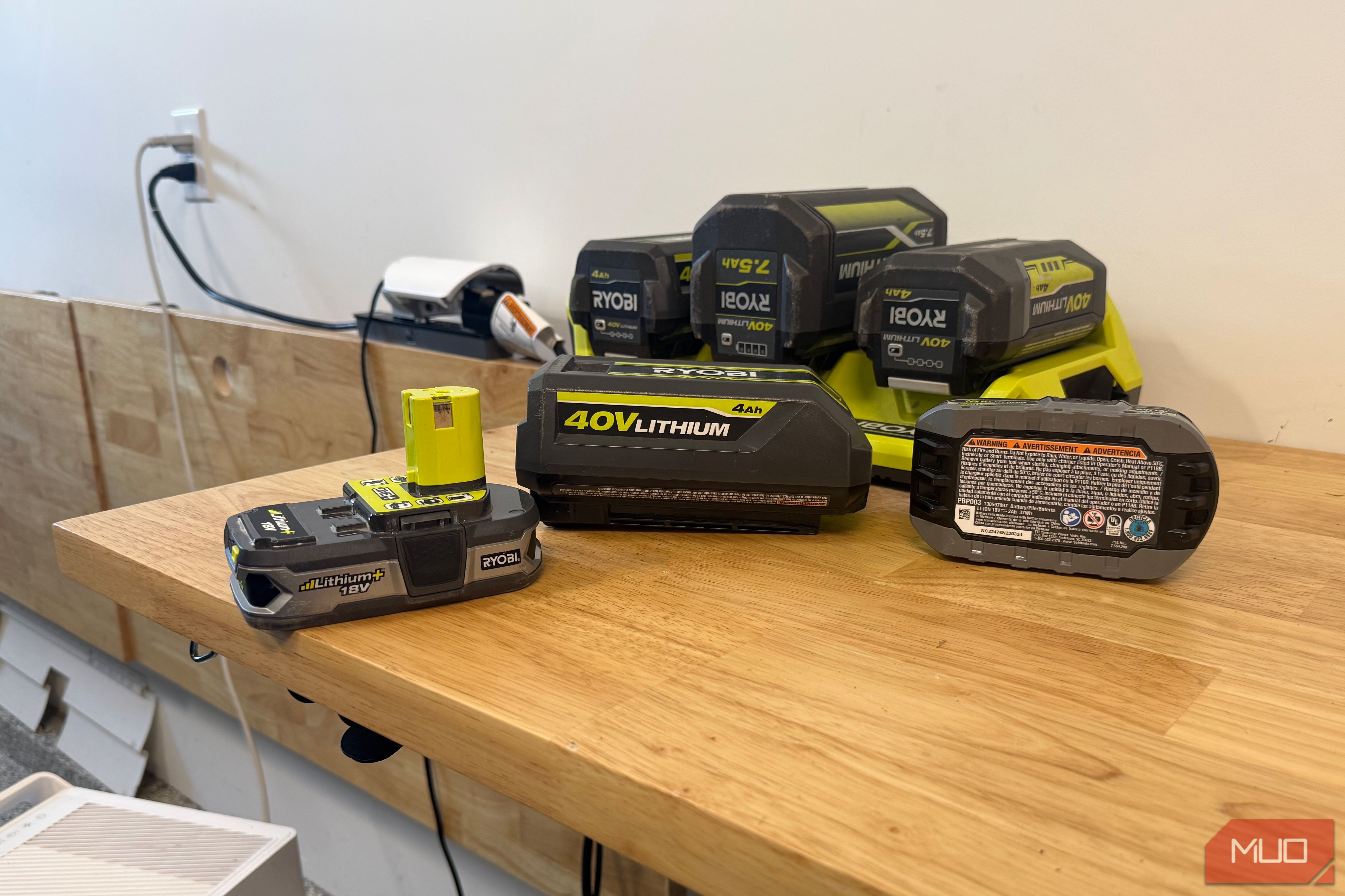
Every 1.5Ah and 2.0Ah pack in my garage arrived the same way, bundled inside a kit box with a tool I actually wanted. For years they sat in a bin while the 4.0Ah batteries did the work. Sorting through which ONE+ packs are worth buying is what finally changed my mind about them. A compact ONE+ battery holds a single row of five lithium-ion cells. The high-capacity version stacks a second row underneath, which raises the current ceiling and adds close to half a pound under your grip. On tools that never approach that ceiling, those extra cells do nothing except make the tool longer and heavier. Four tools in my collection run better with a compact clipped on.
The compact brushless impact driver
Torque comes from the anvil, not the pack
An impact driver works in bursts. You pull the trigger, the fastener seats in a second or two, and you let off. Current spikes at the start, then the hammer and anvil take over once the screw meets resistance, which spares the motor the sustained grind a circular saw puts it through. Runtime almost never decides anything on this tool. Size does. Ryobi’s compact brushless impact driver measures 5.3 inches nose to tail, roughly 26% shorter and over 23% lighter than the brushed version it replaced, and that engineering exists so the tool fits inside a base cabinet or between studs. A tall 4.0Ah pack hands part of that clearance right back. Ryobi builds to the same logic in its own kits, pairing the compact impact driver with two 1.5Ah batteries and reserving the 4.0Ah for the drill. The brushless motor is worth paying for on a tool like this. The bigger battery is not.
The brushless oscillating multi-tool
Clearance matters more than runtime
Cuts from a Ryobi oscillating multi-tool run a few seconds each, with longer pauses while you reposition and check your line. That pattern leaves the battery idle most of the time, so capacity rarely ends a job. Physical shape does. Flush-cutting a door casing means laying the blade flat against the subfloor and dropping the tool body as low as it goes, and a 4.0Ah pack is 10 cells in two rows, so it sits noticeably deeper than a compact. That extra depth is what catches the floor, the joist, or the wall behind you. A 2.0Ah pack lowers the whole profile and takes weight off your wrist while you hold the tool at an angle. Both matter more once you start working through the attachments, since scraping and detail sanding keep you locked in one awkward position for minutes at a stretch.
The 5-inch random orbit sander
Sandpaper quits long before the battery
A 5-inch pad turning at up to 10,000 orbits per minute across a flat panel is one of the lightest jobs in the ONE+ lineup. The motor coasts through it. What ends a sanding session is paper that has clogged and glazed over, and you will burn through several discs before a 2.0Ah pack fades. Weight is the variable that actually changes your day. The Ryobi random orbit sander lives in one hand, frequently pressed against a vertical door or cabinet face, and every ounce hanging beneath your palm compounds across 40 minutes of work. Half a pound reads like nothing on a spec sheet. It feels like considerably more by the third drawer front. This is one of the ONE+ tools I would buy first if I started over, and the compact pack is what keeps it comfortable.
The VORTEX telescoping power scrubber
Weight at the end of a pole gets multiplied
Extend the shaft on the VORTEX telescoping scrubber and the battery ends up at the far end of a lever, arms overhead, brush pressed into shower tile. Weight at that distance works against your shoulders continuously, not in bursts. Swapping to a compact pulls roughly half a pound off the end of that lever, which decides whether you finish a shower surround in one go or stop partway to shake out your arms. Plus, you can’t close the watertight battery compartment with a larger battery anyway.
The motor load stays light throughout, since bristles spinning across grout ask far less of a battery than cutting or drilling does. The tool is water resistant, so it stays in the wet zone with you, and less battery mass hanging over slick tile is its own small advantage. It ended up on my list of tools I did not expect to use this often.
 Ryobi ONE+ 18V Battery
- Battery Type(s)
- Lithium-Ion
- What’s Included
- 2 Batteries Sort your packs by what the tool pulls Five cells have a hard ceiling, and it shows up the second you ask for serious current. Circular saws, pressure washers, and string trimmers all sag on a compact, and patience will not fix that. The sorting rule is short enough to run in the store aisle: if the tool works in bursts or rides flat under light pressure, a compact pack is the better fit. Charging follows the same math. Ryobi lists 80 minutes for a 4.0Ah battery, so two compacts in rotation keep a light tool running without a gap. Match the pack to the draw and the batteries you have been ignoring become the ones you reach for most.