Summary
The tool aisle makes batteries look easy. A bigger amp-hour number should mean a stronger pack, and for years that held close enough to true. Ryobi, DeWalt, and Milwaukee have each broken that logic recently. Every one of them added a second spec, printed quietly or not printed at all, that decides how much power a battery actually hands to the tool. The number on the front now measures runtime more than raw strength. That gap is where people overpay, because on all three platforms the real money goes into the battery rather than the tool. I have wasted cash on Ryobi packs figuring this out. Here is the game each brand runs, and the single habit that keeps me from paying for power my tools will never touch.
Ryobi sells the same 4.0Ah pack at two prices
The green pack and the teal pack are not the same battery
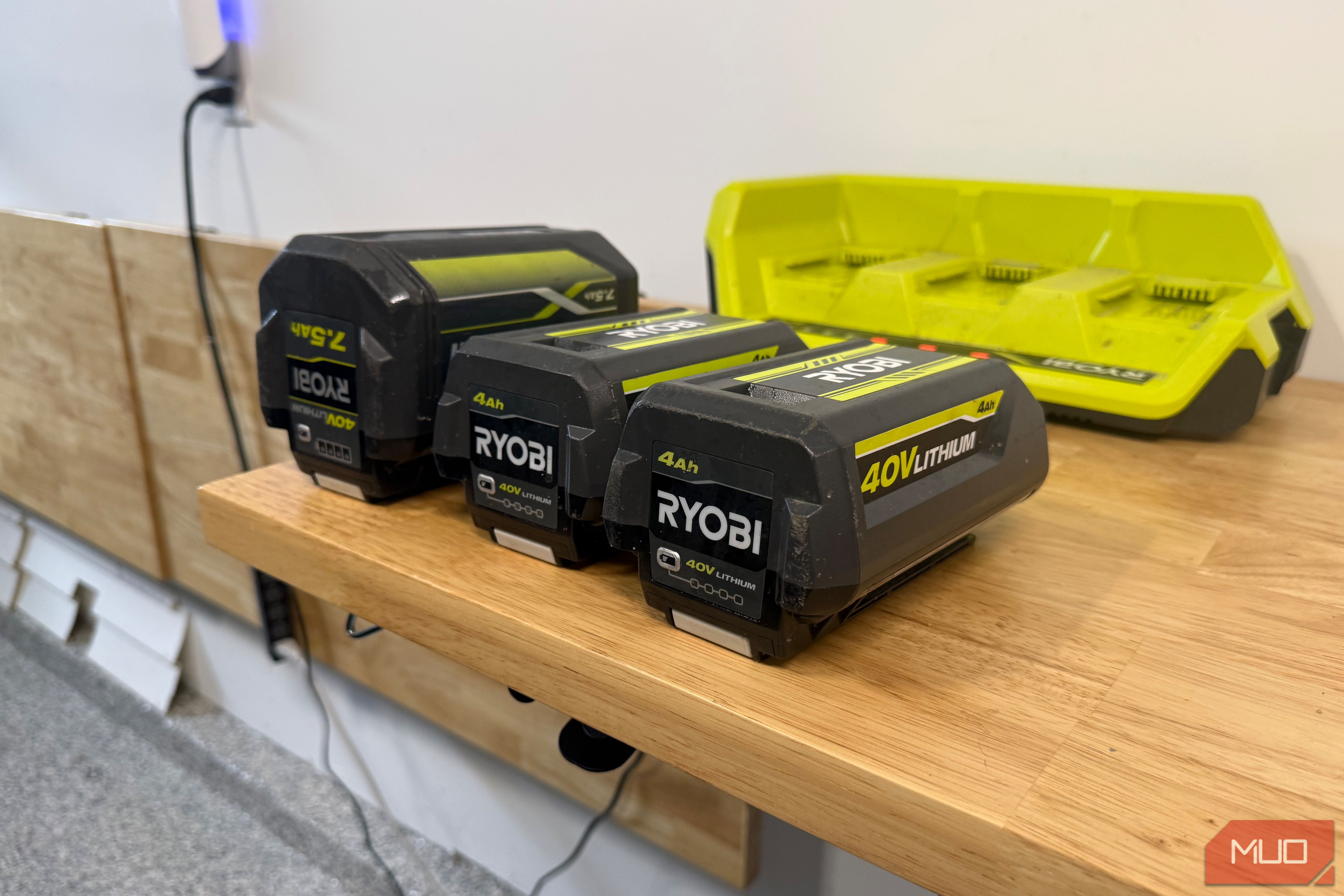
Ryobi hangs two 4.0Ah packs inches apart on the same rack, and color is the only obvious difference between them. The green one, model PBP005, runs about 129 for a battery that reads the same on its label. They share a capacity figure and a footprint, with roughly $30 sitting between them. Color does the real talking. Teal marks Ryobi’s IntelliCell design, built with higher-output cells that feed a brushless tool around 30% more power than the green version delivers. That extra output only surfaces on tools built to draw it. My brushless HP impact driver leans on a teal pack when it is sinking long lag screws, while a green pack rides my drill and work light with nobody noticing a shortfall. I sorted through which Ryobi packs are worth the money on their own, but the rule that matters here stays small: pay for IntelliCell only when a tool can actually pull on it.
DeWalt just renamed its entire battery lineup
The tool decides how much of the pack it will use
DeWalt spent 2026 tearing up its own naming scheme. PowerStack and PowerPack, the labels that once marked its strongest 20V MAX cells, are gone from the product pages. Everything now sorts into two names: plain 20V MAX for standard cells, and 20V MAX XR for the high-performance packs those retired labels used to cover, with a new tabless XR battery rolling out on top. The rebrand cleans up a cluttered shelf, but it also resets the labels shoppers had finally learned. The part that costs people money sits under those names. Some XR tools read the pack the instant it seats and cap their own output unless a qualifying battery is attached.
Clip a base pack to one of them and it holds back, whatever the tool’s rating says. DeWalt has published real figures for the difference, claiming numbers like 42% more power on a hammer drill and 77% on a circular saw with the right pack in play. The same DeWalt tool can reach a second power level, but only when the battery allows it. Check the model number on DeWalt’s site before trusting the box art, because kits pair one bare tool with wildly different packs.
Milwaukee broke the amp-hour rule everyone trusted
A 6.0Ah pack can now match a 12.0Ah pack
Milwaukee took the amp-hour shorthand and snapped it. For roughly a decade, a bigger M18 number meant a stronger pack, reliable enough to become the standard tip in every tool aisle. The Forge line ended that. Milwaukee now rates packs on a power scale running from PWR1 to PWR5, and capacity has come loose from that rating. Its Forge 6.0Ah sits on the same power rung as a High Output 12.0Ah, which means half the amp-hours can push the same load. It gets slipperier from there: two packs both stamped 6.0Ah can fall a full tier apart because the cells inside them are not the same.
Part of the confusion is that Milwaukee uses two sets of marks at once. The CP, XC, and HD codes describe a pack’s physical size and rough capacity. What tells you about power is the cell family printed alongside them, whether that reads REDLITHIUM, High Output, or Forge. A small pack can carry strong cells, which is how Milwaukee broke the shorthand buyers had trusted for years. Read the cell name, not just the amp-hours.
The rule I use before paying for any pack
Match the tier to the tool, then read the model number
The three brands play the same game, so one habit covers all of them. Before any pack goes in the cart, I decide what the tool needs from it. High-draw tools, the saws and grinders and impact wrenches that hold a motor under load, are the only ones that repay a premium pack. A tool that sips power gains nothing from IntelliCell, Forge, or an XR-grade battery, so paying for those cells on a caulk gun or a work light is money set on fire. Capacity works the same way. A bigger amp-hour pack buys runtime, not strength, so I size it to how long the job runs rather than how hard it pulls. Then I check the model number rather than the packaging, because kits love to pair a strong tool with a weak pack, or a premium tool with a base one. I also quit buying the small compact packs outright. They come bundled with kits for almost nothing, so I keep those freebies and leave the retail ones on the peg.
 Ryobi ONE+ 18V Battery
- Battery Type(s)
- Lithium-Ion
- What’s Included
- 2 Batteries Buy the battery your tools can actually use Ryobi, DeWalt, and Milwaukee arrived at the same place by different roads. The amp-hour number still sells the pack, but a second spec now decides what that pack does once it is working. That is good news once you know to look for it, because it means you can stop overpaying the moment you learn your own tools. Figure out which ones actually strain, buy premium cells and large capacity only for those, and let everything else run on the cheaper packs. The pattern is easy to beat once you can see it.