Summary
I found Devs the way I find most things worth watching now: by accident, scrolling Hulu at 11 at night, looking for something to put on while I did the dishes — looking for another Hulu diamond in the rough. The thumbnail showed a gold Buddha statue standing in a redwood forest next to a glass office building, and that combination alone was strange enough to stop me.
Devs came out in 2020, and if you missed it, you had company. It aired on FX and landed on Hulu the same week, which FX was still experimenting with in 2020, and it got buried almost immediately under bigger shows people were actually talking about. Eight episodes, one season, done. Alex Garland wrote, directed, and created every single one of them himself. That kind of one-man control over eight hours of television rarely happens.
Devs takes place inside one of TV’s most striking tech campuses
A gold cube in the redwoods that looks more like a monastery than an office
The setting is Amaya, a quantum computing company tucked into a stretch of redwoods, a shuttle ride outside San Francisco. Sonoya Mizuno plays Lily, an encryption engineer who has no idea what actually happens inside the company’s most secretive division. Her boyfriend Sergei does. Karl Glusman plays him, and early on, he shows off an algorithm that can predict how a single-celled organism will move. That’s enough to get him pulled into Devs itself — the team nobody at Amaya is allowed to talk about, not even to each other.
I keep coming back to the building, not the tech. Amaya’s most secure lab is a gold cube hanging over the trees. You get in one way — a narrow walkway — and Garland’s camera sits on it every time, long enough that I started dreading the crossing before any of the characters did. The place looks like a monastery got acquired by a tech company. Heads down, voices low, nobody laughing, three episodes running.
Nick Offerman’s role in Devs is nothing like Parks and Rec
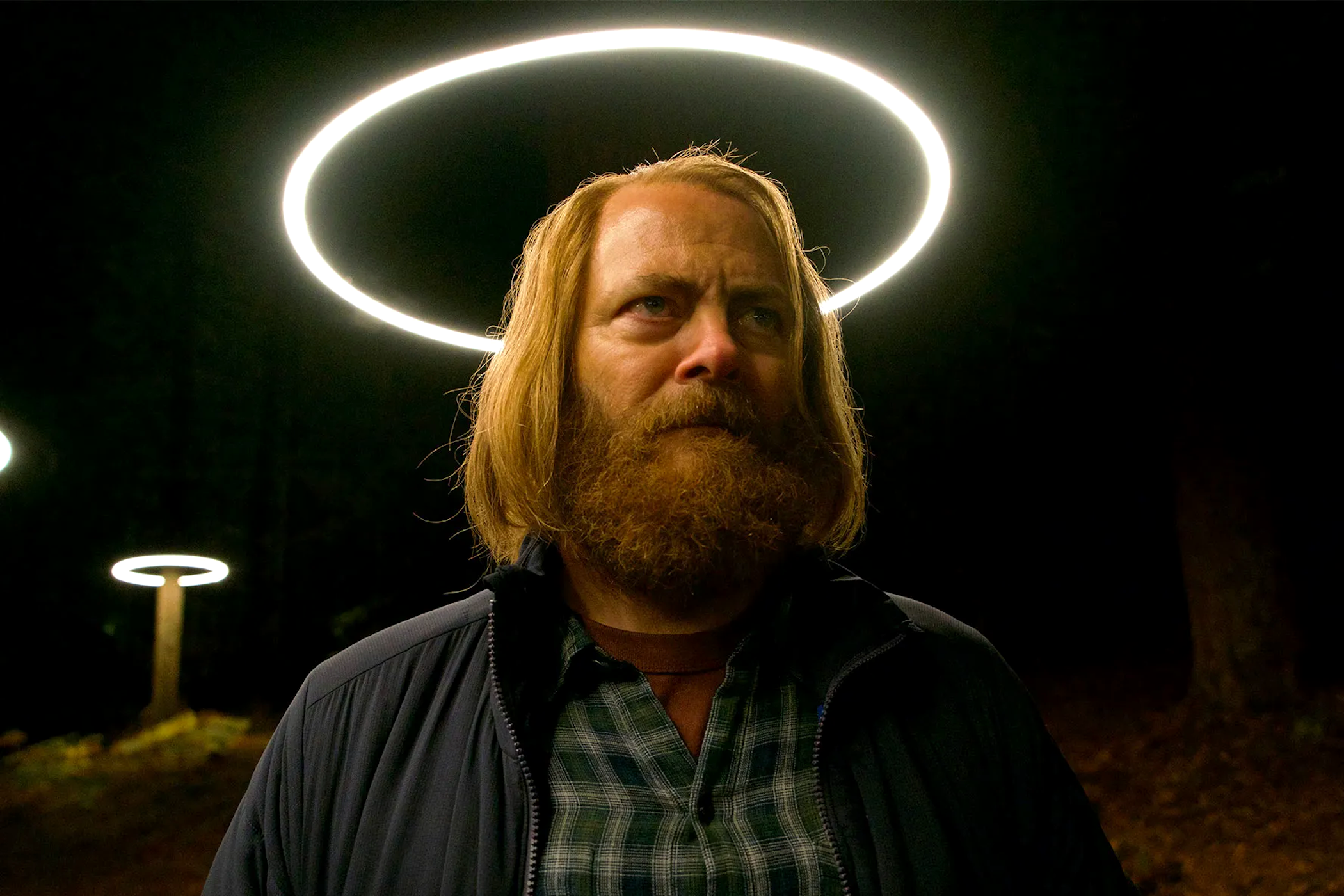
Forest is quiet, grieving, and far more unsettling than Ron Swanson ever was
Forest runs Amaya, and Nick Offerman plays him as a soft-spoken, grief-stricken figure who talks like a man reciting scripture. If your only reference point for Offerman is Ron Swanson barking about breakfast food and government bureaucracy, Forest will throw you off completely. There’s a quiet menace to him. You don’t clock it right away, but it’s there in how calmly he talks about things he should probably feel worse about. Alison Pill plays Katie, his second-in-command, and I still couldn’t tell you which of them actually calls the shots.
I went in expecting stunt casting. What I got instead was a performance that would have exposed a weaker actor. Offerman barely raises his voice for eight episodes and somehow makes that the scariest thing about him.
What the Devs division is actually building at Amaya
A machine built on determinism, and what it means if the future is already fixed
Without spoiling the mechanics of it, the division is working on something tied to the idea that the universe is fully deterministic, that if you had enough computing power, you could reconstruct any moment in the past or forecast any moment in the future with total accuracy. Garland has said the whole series grew out of him trying to wrap his head around quantum mechanics years before he wrote a single scene, and that origin shows. The show treats its science with a seriousness that most television doesn’t bother with, spending real time on what determinism would mean for free will if it turned out to be true.
Lily starts investigating after Sergei vanishes, and the show slowly widens out from a missing-person mystery into something closer to a philosophical thriller wearing the clothes of a workplace drama. A murder is tangled up in the plot, along with corporate paranoia and a rival hacker trying to steal what Amaya has built. None of it moves fast. Devs is patient in a way that will frustrate anyone hoping for a twist every ten minutes.
Why Devs never found the audience it deserved
Bad timing, slow pacing, and a finale that asks a lot of viewers
Timing didn’t help. Devs premiered in March 2020, the same month the world shut down, and a moody eight-episode meditation on fate and surveillance had no shot at cutting through everything else people were dealing with that spring. Pacing didn’t help either. You can’t half-watch this one while scrolling your phone — long stretches play out in near silence, and the dialogue sits closer to philosophy than to anything punchy or quotable. Plenty of viewers who grew up on shows that spell everything out within a few minutes probably bounced off it for exactly that reason.
I’ll admit the finale didn’t fully land for me on first watch. It commits hard to its ideas about determinism in a way that either clicks or doesn’t, and I needed a second viewing before I felt like I understood what Garland was actually arguing. That’s nothing to ask of an audience, and I understand why some viewers bounced off it.
Should you watch it in 2026?
If you liked the sci-fi horror Ex Machina or the somewhat strange Annihilation, Devs will scratch the same itch. No aliens, no robots — just a tech campus that operates like a cult organized around a math problem, which might be stranger than either. It’s still sitting on Hulu right now, not getting pushed by the algorithm, not coming up in anyone’s “shows to watch” roundup, just there. I stumbled onto it while doing dishes. You’ll probably have to stumble onto it too, because nothing about how Hulu treats it is going to point you there on purpose.
Oh, and those dishes? They didn’t get done until hours later.
- Directors
- Alex Garland
- Writers
- Alex Garland
- Main Genre
- Sci-Fi
- Seasons
- 1
- Story By
- Alex Garland
- Streaming Service(s)
- Hulu, Prime Video, AppleTV+