Summary
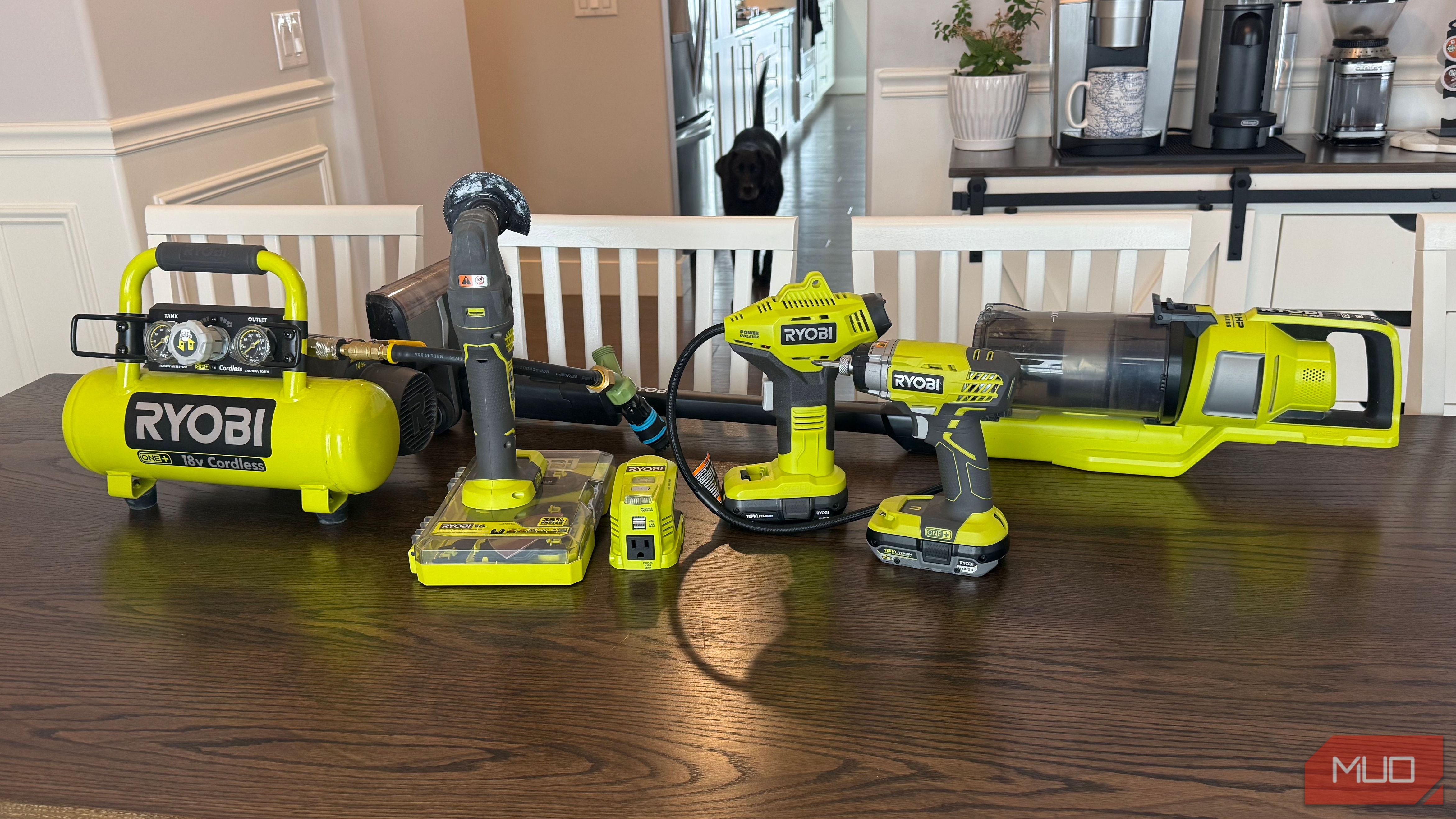
Walk the power tool aisle and every box leads with a big number. It’s printed large because it sells the tool, and it tends to skip the fine print that decides how the thing behaves in your hand. I’ve bought more than 20 Ryobi ONE+ tools over the years, and I’ve learned to read the line under the headline spec before I trust it. Some of these numbers mean less than they look like they do. A couple mean something else entirely. Once you know which figure to weigh and which to wave off, the aisle gets a lot less intimidating. Here are six power tool specs that don’t say what most people think. 18V and 20V describe the same battery One number is measured at rest, the other under load Every battery on my Ryobi bench reads 18V on the label. Clip a same-class DeWalt pack onto a DeWalt tool and the label says 20V MAX instead. Both are built from five lithium-ion cells wired in a row, and each cell runs at 3.6 volts under load but climbs to about 4 volts fully charged with nothing drawing on it. Five cells at 3.6 comes to 18. Five at 4 comes to 20. The 20V MAX number is what a meter reads off the charger, and the 18V number is what the pack gives you once a motor starts pulling. Makita, Milwaukee, and Bosch all label the same pack 18V. DeWalt picked the bigger resting figure, though its tools bury a second surprise in that badge beyond the voltage. Amp-hours measure runtime, not power A roomier pack buys you time between charges, nothing else This is the spec I watch people misread most. The amp-hour figure is a fuel-tank number. It tells you how much charge the pack stores, which decides how many holes you get before a trip to the charger. It has no bearing on force. My Ryobi drill sinks a 3-inch deck screw exactly the same with a 1.5Ah pack clipped on as it does with a 4.0Ah pack. All that changes is how often I swap. Power comes from the motor and the control board inside the tool, and the pack just feeds them current. The confusion is partly the industry’s doing. Milwaukee shuffled its amp-hour labels a while back, and the naming shoppers leaned on for a decade quit making sense. Buy the bigger pack for a longer session, not a stronger tool. Peak torque is a best-case lab number The headline figure isn’t measured the way you use the tool My Ryobi impact driver carries a rating of 1,800 in-lbs, and I can count on one hand the jobs that have asked for all of it. That headline figure is a peak measured on a bench in ideal conditions, not the twist you feel sinking a lag bolt into a stud. It’s also the spec brands test least consistently. One company’s maximum might be a brief stall reading, another’s a sustained figure, and no shared standard forces them to measure the same way. Impact drivers cloud it more, because the big number often reflects nut-busting force instead of the fastening torque you actually use. That’s why the tool I grab on most projects is so telling. On paper it’s a monster. In practice it rarely works that hard. No-load speed is the number with nothing attached That RPM reading assumes the bit never touches anything Speed ratings come with the same catch. My Ryobi drill lists a top no-load speed of 1,750 RPM, and the phrase no-load is doing quiet work in that sentence. The chuck spins that fast only when nothing is fighting it. Put a spade bit or a hole saw into framing lumber and the RPM drops well below the rated figure, because the motor trades speed for the torque it takes to keep cutting. The same holds for impacts per minute on an impact driver and strokes per minute on a reciprocating saw. Those are all free-running numbers. What matters on the job is how well a tool holds its speed once it meets resistance, and no box lists that. The listed weight usually leaves off the battery Tool-only weight skips the heaviest thing you’ll add Weight looks like the most honest spec on the sheet, and it’s quietly the most incomplete. Most listings quote the bare tool, meaning no battery attached. My Ryobi drill weighs 2.65 pounds that way. Clip on a 4.0Ah High Performance pack and it gains well over a pound, close to half its own bare weight again. That barely registers drilling at waist height. It registers plenty running a driver over your head to wire a ceiling box, or holding a tool at arm’s length for a stretch. When a listing gives a weight and doesn’t name the battery, that figure is the floor. Whatever pack keeps the tool useful is riding on top of it. Max PSI tells you the ceiling, not the fill speed The top number says nothing about how fast you get there My Ryobi tire inflator is rated to 150 PSI, which sounds like plenty until you notice what the figure leaves out. Maximum pressure is a ceiling. It’s the highest the pump can reach, not a promise about how fast it takes a tire from flat to 35 PSI, and no signal that it keeps a steady pace getting there. A compact unit like mine crawls through the last stretch near its rating, since shoving air against high back-pressure is slow going for a small motor. For car and bike tires that stop well short of the limit, it’s plenty quick. Judge it by that 150 alone and you’d expect it to fill a truck tire faster than it ever manages. Read the spec sheet like the fine print it is None of this means the numbers lie. Each one just answers a narrower question than the packaging implies, and the figure that matters depends on the job in front of you. For long runtime, amp-hours earn their keep and voltage class barely moves the needle. For overhead work, the lighter tool wins once you account for the battery riding under it. When you know what each spec actually measures, the aisle stops feeling like a shouting match and starts reading like a menu. You get to pick the tool that fits the work instead of the one with the boldest number on the box, and your money goes further for it.