Summary
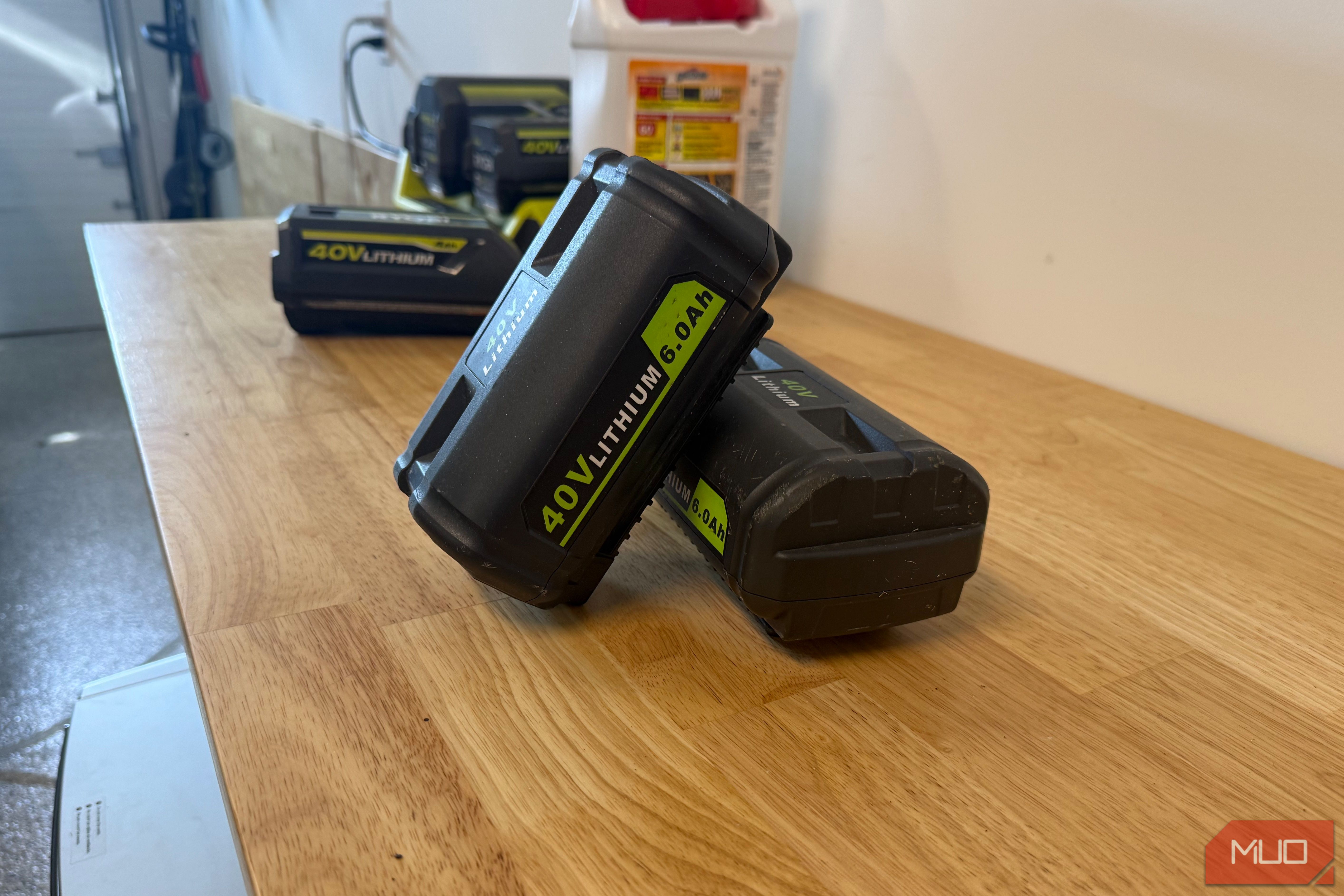
I built my whole workshop around Ryobi ONE+, so I own more 18V and 40V batteries than I can keep track of. Genuine packs add up fast, and when I found third-party versions on Amazon for half the price, I bought a few to see how they’d hold up. They ran fine at first. What pushed me to bag them all up and drive them to a battery recycler wasn’t performance. It was what those cheap packs leave out on the inside, plus the fire stories that made me stop trusting them on my bench. I only buy genuine Ryobi batteries now.
The math that pushed me toward the cheap ones
A real 4.0Ah pack can cost as much as the tool
Anyone with a ONE+ collection learns quickly that the batteries, not the tools, are the real expense. A genuine Ryobi 4.0Ah pack often runs close to the price of a bare tool, and filling out a full set means buying that pack again and again. Sellers noticed the gap a long time ago. Type “Ryobi 18V battery” or “Ryobi 40V battery” into Amazon and the results fill with off-brand packs wearing that same green shell, and plenty of them ring up around half of Ryobi’s price. So I bought a few. On paper they matched my real ones, down to the voltage and Ah rating printed on the label. Copying the sticker is the easy part.
They worked, until something felt off
Shorter runtime and more heat under load
For light jobs, the off-brand packs did the work. I ran them in a drill and my leaf blower and a work light without any drama. The trouble showed up under heavier load. Runtime came up short of my genuine packs, sometimes by a wide margin, and the cells seemed to run warmer to me after a hard stretch. I never put a thermometer on them, so treat that as an impression rather than a measurement. Even so, a battery that feels hot in your hand after a few cuts is one you start watching instead of trusting.
What a cheap pack leaves out on the inside
The protection circuitry is the part you can’t see
There’s real hardware under a Ryobi pack’s plastic shell, not just a bundle of cells. A battery management system rides along to keep the cells balanced, keep an eye on their temperature, and shut things down before a fault can snowball. That circuitry is proprietary, and it’s built to talk to Ryobi’s tools and chargers as one system. It’s the same electronics edge Ryobi leans on when it swaps premium cells into its High Performance packs to hand a brushless tool more power on demand.
Cheap packs are where the cost-cutting hides. You don’t know which cells are inside, whether the protection board is any good, or if there’s a real board at all. Some off-brand packs run the bare minimum of protection, and the worst counterfeits skip it. When a lithium-ion cell has nothing watching it, an internal short or an overcharge can tip into thermal runaway, the chain reaction behind the battery fires you’ve seen on the news.
The certification gap that finished it for me
A safety sticker isn’t the same as a tested pack
This was the part I couldn’t get past. Genuine power tool batteries go through safety testing from recognized labs such as UL and CSA, and that testing covers the battery, charger, and tool working together. Ryobi recommends using only Ryobi-branded ONE+ batteries in its tools, for exactly this reason. Off-brand packs rarely carry legitimate certification from a recognized lab, and counterfeit ones sometimes wear a fake UL mark to look the part. I had no way to verify what I had bought. Once I realized the safety mark on the label meant nothing I could confirm, keeping the packs around stopped feeling like a smart trade.
Why I recycled them instead of shoving them in a drawer
Lithium-ion doesn’t belong in the trash or a junk bin
I didn’t just stop using the off-brand packs. I got them out of the house. Lithium-ion batteries can’t go in household trash or recycling bin, and a questionable pack sitting in a drawer is a small fire risk you forget about until it stops being small. I dropped mine at a battery recycler near me. Call2Recycle runs free drop-off points at many hardware and home improvement stores, so finding one usually takes a quick search. Home Depot, where I buy most of my Ryobi gear, keeps a battery recycling bin near the entrance at a lot of its stores.
 Ryobi ONE+ 18V Battery
- Battery Type(s)
- Lithium-Ion
- What’s Included
- 2 Batteries What I clip onto my tools now I went back to genuine Ryobi packs, and I buy them with more intention than I used to. I match the pack to the tool, keep my High Performance batteries for anything that pulls hard, and I’m choosier about which Ryobi packs are worth the money. I also take better care of the ones I own, since a few simple habits go a long way toward stretching a pack’s life and softening the sting of full price. The cheap packs saved me a little money up front. Peace of mind on a garage full of tools was worth more than the discount.