Summary
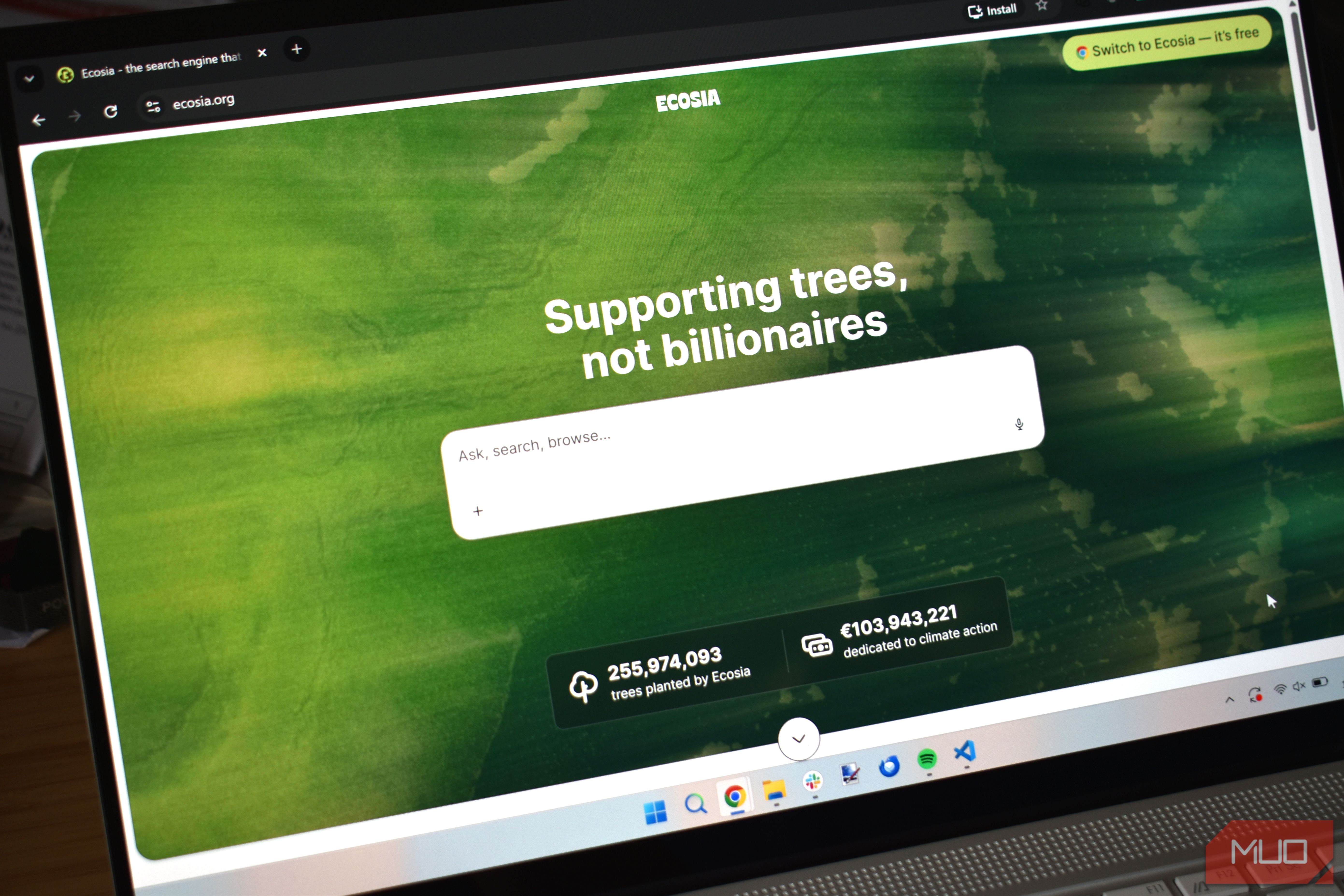
Google isn’t going anywhere anytime soon. That’s as close to a fact as the Earth orbiting the Sun. But that doesn’t mean you have to use Google for every online search. Sure, it’s probably the best, given its enormous reach, huge amount of infrastructure, and now, deep AI integration, but there are alternative search engines out there that you really should try. Some of them piggyback on Google to deliver similar results with new features, while others eschew Google entirely and are designed to search corners of the web you didn’t know existed. Either way, these Google Search alternatives can help show your search from a completely different perspective. Ecosia “The Greenest Way to Search” There are search engines other than Google that also contribute good to the world. Ecosia does its part from a slightly different angle. This search engine uses a modified Bing custom search — no second-rate APIs here. As you browse, 80 percent of Ecosia’s ad profits go to programs that plant trees in Burkina Faso, Madagascar, Indonesia, and Peru. Read through Ecosia’s FAQs; you’ll find them opening up about the project, depicting the success and the progress of their planting programs. Ecosia is an unfiltered search engine, but it does highlight websites that follow sustainable practices with a green leaf icon next to the result. What can we say? We’ve all got our favorites. Qwant You’re not just another advertising metric If you maintain a growing collection of private search engines, this unrestricted search engine is definitely one that you’ll want to check out. Qwant is a much more visual search engine than Google, which may appeal to you for one reason or another. Local storage on your machine saves your settings and data. You can register and log in to create visual boards by bookmarking the results that you like. If you cancel your account, the service deletes any personal data connected to your ID. The search engine also utilizes Microsoft Bing, which means that your privacy when browsing never has to come at the cost of the robustness of the unfiltered search that you enjoy. Mojeek Independent internet search in 2026 Mojeek delivers fast and unbiased search results, making it another good alternative when you’re looking for an unfiltered search engine. Besides being privacy-conscious, Mojeek crawls and builds its own giant web search index. For a few other search engines elsewhere, you might notice that the results are simply sourced from Google, and you’re seeing a highly similar list of information all over again. But with Mojeek, the results you obtain are generated by the company’s own algorithm. Now, that can lead to some situations where you don’t get the results you’re expecting, as I found when testing Mojeek against other search engines. But overall, having independent search engines alive in 2026 is worth a little search-pain. Boardreader A look into the internet of yesteryear Boardreader is an unbiased search engine that covers online forums and bulletin boards. If you search for a topic on Google, the top search results are mostly polished articles from mainstream magazines. However, the best places to get thoughts and opinions from real people are online communities, where enthusiasts and fans gather to delve deep into any topic. It reminds me of the older web, when information was more scattered and forums, BBS, and ICQ were how ideas were shared. So, if you want to get information through the grapevine and are curious what people are talking about, use Boardreader to dive into the rabbit hole of forum discussions. Kiddle Safe internet search for kids without all the toggles Kiddle is not a search engine that shows everything. In fact, it’s sort of the opposite of an unblocked search engine. It’s family-friendly and perfect for curious kids, since unfiltered search results aren’t age-appropriate. Even though there’s a SafeSearch option on Google, it’s insufficient. So, Kiddle is a search engine that’s a customized version of Google. Big thumbnails, images, and fonts make the kid-safe web, image, and video search easier to navigate. Kiddle is an awesome alternative if you’re trying to keep your kids away from NSFW sites, gambling platforms, and the rest of the black market underbelly of the web. If you’d like to directly provide learning resources for children, check out these best free online encyclopedias for kids. JustWatch Never miss a show ever again Online streaming has already replaced cable in many households. If you’re a cord-cutter and you want to discover where your favorite shows are hosted, JustWatch is exactly what you’ve been looking for. It’s a search engine new on each streaming platform. You can customize your preferences to narrow results by genre, IMDb or Rotten Tomatoes ratings, price, quality, or release year, and finally figure out exactly where the show is playing in the first place. In an era where shows and movies disappear all the time, JustWatch is a lifesaver. Thangs Search for your next 3D printed project Google Search still isn’t great for finding models designed for 3D printing. Thangs steps into that niche; this site is an online community of 3D designers. Its search engine stems from its members’ desire to share their work with one another. From here, you can get ideas for your own awesome 3D printing projects. Thangs claims to be a “geometric search engine” powered by AI. It can recognize 3D models, see how the parts can be assembled together, and then make accurate predictions about each object’s function, cost, materials, performance, compliance, and more. It’s one of the best sites for finding general 3D printing ideas, but you can also buy specific 3D models if you want, helping to keep other creators active. NASA Images Search space, one video and image at a time NASA Images brings you unfiltered search results depicting some of the most iconic achievements in space exploration of our lifetimes. Search through a treasure trove of more than 140,000 NASA images, videos, and audio files from across the agency’s many missions through history. Any science lover will fall in love with this one. This is a massive amount of content to explore from more than 60 different locations, all in one searchable index. Consensus AI-powered academic search summaries Consensus is an AI-powered search engine for academic research. It has an extensive library of research papers and provides answers using its own and OpenAI’s LLMs. Consensus provides a summary answer to your questions and lists all its sources. For yes/no questions, it shows a Consensus Meter that finds relevant studies and groups them by results. Like other search engines, Consensus has filters to narrow down your search. However, it focuses primarily on academic criteria like methodology, journal, citations, sample size, etc. Overall, this is a good search engine because it focuses on finding relevant papers and provides details to help you gauge their reliability (which is a tricky job for search engines). These alternative search engines don’t aim to replace Google; they aim to challenge the status quo. Think of these search engines without filters as “specialty” search tools. For general web searches, Google still has the rest beat. For niche and anonymous private searches, however, these niche search engines still reign supreme.