Summary
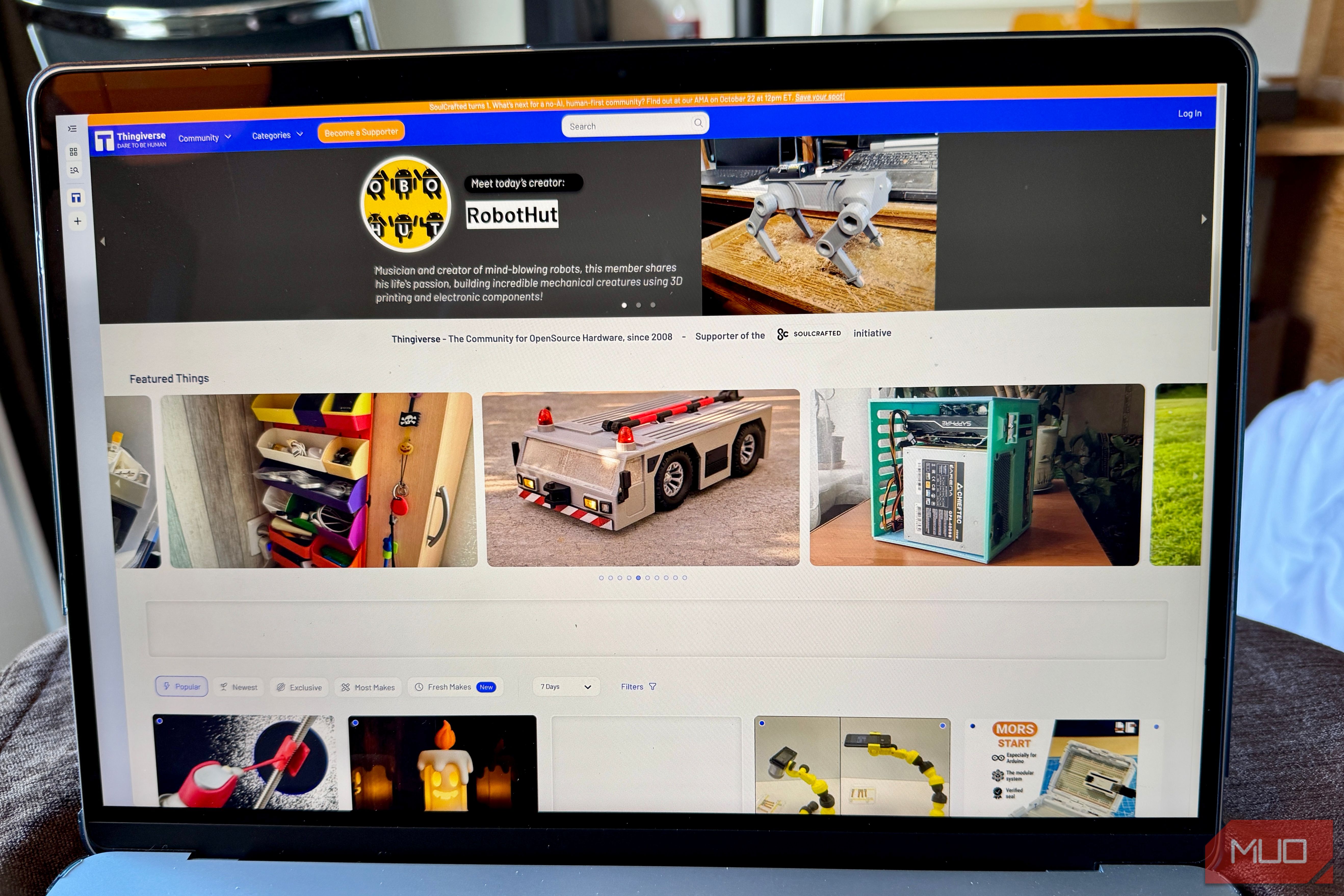
I still have a Thingiverse login. I can’t tell you the last time I actually searched it first. Somewhere between the dead thumbnails, the search results full of reposted junk, and the AI-generated files nobody asked for, I started going everywhere else — and in February, Thingiverse’s new owner basically admitted I was right to. On February 12, 2026, MyMiniFactory announced it had acquired Thingiverse, saying the platform needed saving from AI-generated models. It’s the third owner Thingiverse has had since 2013, and the clearest sign yet that the site makers grew up on isn’t the one they rely on now. “Every major content platform is now flooded with AI-generated material, and creators are paying the price,” said Romain Kidd in the press release. Here’s how Thingiverse got here, and where I actually go to find a model worth printing. Thingiverse used to be the only place you needed to check The rise, rot, and recent rescue of 3D printing’s default archive Founded by MakerBot in 2008, Thingiverse was the default, first-stop repository for STL files throughout most of the 2010s, and probably the sole reason “just Thingiverse it” became a common shorthand in maker circles. Back when I unboxed my Bambu Labs A1 Mini, it was naturally the first site I loaded up to set up the obligatory Benchy boats and early test prints. Even as modern competitors emerged, the sheer weight of its history kept it relevant; by the time of its 2026 sale, its massive library reached 8 million registered users and 2.5 million uploaded “things,” keeping its status as the largest/best file archive with raw volume. That massive scale, however, masks a decade of decay over three corporate handoffs. Stratasys acquired MakerBot and its repository in 2013, eventually passing the site to UltiMaker following a 2022 merger. Under this changing corporate oversight, basic platform maintenance seemed to stop: search functionality broke, model thumbnails routinely failed to load, and the famous Customizer tool produced garbled outputs. The technical neglect turned into a full-blown security crisis when a database backup exposed roughly 228,000 unique email addresses alongside usernames, IP addresses, dates of birth, and unsalted password hashes, convincing plenty of longtime makers to walk away from their accounts. The platform’s long decay reached an unexpected pivot point on February 12, 2026, when curator-vetted platform MyMiniFactory acquired Thingiverse. The CEO framed the buyout explicitly as a rescue mission to save the historical archive from being overrun by low-quality, AI-generated junk. Of course, it’s far too early to know whether this new ownership will reverse the overall decay, the takeover proves that even the industry’s biggest legacy platforms can no longer ignore the threat of AI-based synthetic content. Printables offers curation over raw volume Why Prusa’s platform leads in community trust Run by Prusa, the platform rebranded from PrusaPrinters.org to Printables in 2022 to make it clear that all makers, not just Prusa owners, were welcome. Its primary draw is quality control; regular themed contests keep functional, well-documented designs surfacing near the top of search results instead of getting buried. It offers direct plugin integration for PrusaSlicer and OrcaSlicer, allowing one-click file downloads straight into your slicer workspace. The trade-off, however, is catalog size: Printables maintains a smaller library than Thingiverse or MakerWorld, and its underlying contest culture skews heavily toward Prusa-branded visibility and exposure. MakerWorld is built for the Bambu ecosystem Rapid growth meets the reality of open-upload spam As Bambu Lab’s official platform, MakerWorld is engineered to make it easy to get the models directly into Bambu Studio. That makes it the fastest option for sending jobs straight to a P1S or A1 mini setup. This convenience fuels massive growth, but MakerWorld isn’t immune to quality control issues, either. Bambu Lab has had to take public action to curb spam and low-quality uploads, while a major overhaul of its point-incentive structure sparked creator backlash over slashed rewards, leading some designers to make their models private. Ultimately, MakerWorld demonstrates that AI-generated clutter is an inherent risk for any open-upload platform operating at a arger scale. Cults3D makes you pay for premium quality But paid marketplaces filter out abandoned files Founded in France in 2014, Cults3D has grown into a massive independent marketplace hosting over 15 million registered members and roughly 250,000 designers. Unlike free-only repositories, Cults features a heavy mix of paid models alongside free files. That financial reality acts as a natural quality filter: designers who charge 10 per download have a direct incentive to thoroughly test print their files, provide assembly guides, and answer user queries, avoiding the upload-and-abandon pattern typical of free repositories. Thangs is your meta-search solution Geometric indexing for targeted part hunting Thangs functions primarily as a specialized 3D search engine instead of a traditional digital store or file repository. It uses geometric and AI-driven spatial search to index models across multiple major platforms at once, including Thingiverse and Printables. This search format eliminates the hassle of running six identical query tabs across different websites when hunting down a specific part shape. It is built specifically for targeted queries for specific parts rather than general browsing for general inspiration. So is Thingiverse worth checking at all anymore? I don’t want to write the platform off completely, as MyMiniFactory’s stewardship could genuinely turn things around over the next year if its anti-slop curation takes root. But if I need a reliable print on my build plate by this weekend, Thingiverse is no longer my starting point. Given my everyday workflow on the P1S and A1 mini, MakerWorld is the first tab I open for native, pre-sliced convenience, closely followed by Printables whenever I want a thoroughly tested design with verified community prints. Today, Thingiverse functions strictly as a secondary backup option as a legacy vault to search when I can’t find what I’m looking for on a more modern platform.