Summary
A new phenomenon in the battery market is USB-C rechargeable AA batteries. USB-C is going everywhere and touching everything, and apparently that includes AA cells. AA batteries — and most non-LiPo batteries, really — have always required dedicated chargers. Suddenly, you can buy AA (and AAA) batteries you charge the same way you charge your phone.
When I first saw these, they looked like a scam. But curiosity wins, so I bought two packs just to settle my own questions — and yours too.
USB-C AA batteries are actually a thing
The sort of idea you expect to be nonsense
Yes. They arrived, and they look exactly like the photos. The price wasn’t outrageous either; I paid around $10 per pair. However, I couldn’t find a single reputable battery brand making these. Everything was off-brand. The “best” I found were Camelion and Powerology. Both are made in China — and both are clearly white-label versions of the same design.
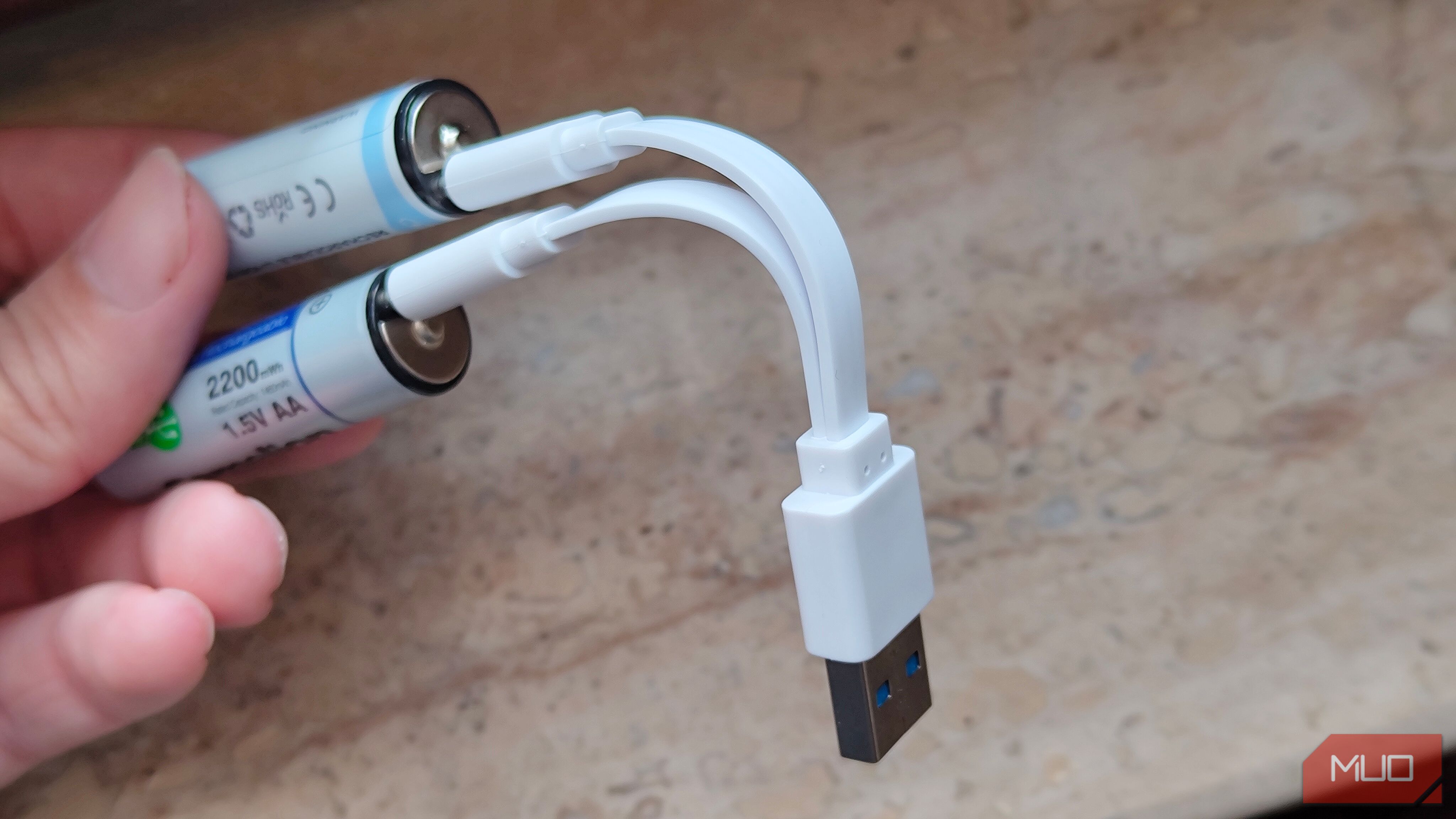
The packaging includes the batteries and a double-headed USB-C to USB-A cable. Camelion’s packaging was nicer; Powerology’s four-pack still included just one dual-headed cable, so you have to charge them sequentially. None of these are available on Amazon.
Oddly, both brands had identical LED behavior, identical port placement, identical construction.
The Camelion pack came with a tiny manual stating a 500 mA charging current and a 2 A max output. That 2 A claim is impressive for something pretending to be a 1.5 V AA, but I wanted to verify it myself.
The USB-C port sits on the positive terminal. Around that terminal is a blue LED ring that blinks while charging and stays solid when full. Oddly, both brands had identical LED behavior, identical port placement, identical construction. As I said: same OEM, different stickers.
The USB-C plugs in firmly, and the batteries are light enough that you can leave them dangling from a wall charger without the connector bending or sagging. The batteries also advertise to have over-everything protection, which includes over-charge protection — so it might be okay to leave them charging overnight.
 Nitecore NH2400 2400mAh USB-C Rechargeable AA Battery 4-Pack
- Battery Type(s)
- Li-ion AA
- What’s Included
- 4x batteries, 1x charging cable
- Brand
- Nitecore
- Voltage
- 1.5V
- Capacity
- 2400mAh The Li-ion truth of USB-C AA batteries Don’t try this at home This is where skepticism kicks in. A “2200 mWh” AA is suspicious. Even good NiMH AA cells hover around that number, and they’re physically denser. As I mentioned in my AA battery codes guide, I suspected these USB-C AAs would contain a tiny Li-ion cell and a buck converter to step the voltage down from 3.7 V to 1.5 V. The only way to confirm was a teardown. I tore down the battery. It was difficult, destructive, and not something you should ever do, but once the positive terminal popped off, the whole charade became obvious. The exterior is basically a metal sleeve. Inside is a green cylindrical Li-ion cell with a tiny PCB handling the voltage conversion. I couldn’t slide it out cleanly, so I peeled the metal casing. With the guts exposed, I realized I was both right and wrong. I was right that there’s a Li-ion cell paired with a buck converter, but wrong that the circuitry would take up most of the space. It’s actually quite efficient. The converter is tiny. Most of the internal volume is the Li-ion cell. So yes: electrically, this is a 3.7 V Li-ion battery pretending to be a 1.5 V AA, and the converter handles the rest. As long as it outputs a stable 1.5 V, that’s what matters to the device you put it in. One warning: while removing the converter board, I accidentally shorted the cell. It hissed, got very hot, and died. This alone proves the cell can output serious current. Don’t try this at home. But how do they perform? A headlamp doesn’t lie Capacity testing is tricky without a proper rig, but I improvised. I used a headlamp that draws around 1 A and requires 6 V. Four of these cells in series gave me 6.4 V. Once the lamp turned on, the voltage immediately settled to 5.5 V and stayed there for over 50 minutes. Eventually, the pack dropped to 4.5 V, then one battery died and the pack collapsed to 3 V, at which point I stopped. If you take the approximate average voltage under load and multiply by the current and time, the pack delivered roughly 5600 mWh. Divide by four and you get around 1400 mWh per cell — almost exactly what you’d expect after voltage conversion. The marketing isn’t entirely dishonest; it’s just framed in the most flattering way possible. These batteries advertise 2200 mWh — but that rating refers to the internal 3.7 V Li-ion cell. Once that energy is regulated down to a constant 1.5 V, you lose a noticeable chunk to conversion inefficiency. In practice, about 2.2 Wh of stored energy becomes roughly 1.4–1.5 Wh of usable output at 1.5 V. So the marketing isn’t entirely dishonest; it’s just framed in the most flattering way possible. For comparison, I repeated the test with a fresh set of alkaline AAs. Their voltage sagged immediately from 6.4 V to 4.4 V the moment I switched the lamp on, then steadily declined. Alkalines will run longer in total (they ran for almost 4 hours before the light went out), but their output voltage continuously falls, so performance slowly degrades. A USB-C lithium AA, on the other hand, keeps a perfectly flat 1.5 V until it hits its cutoff, then drops to zero instantly. In a flashlight, that means that alkalines run longer but dim over time, while USB-C lithium AAs stay bright and then suddenly die. They’re better than they look on paper Consistent voltage output makes them feel different I concede: these batteries are better than I expected. The internal converter does an excellent job maintaining a constant 1.5 V. The voltage stays flat until the protection circuit cuts off entirely to protect the Li-ion cell from over-discharge. Now, the trade-offs. Their voltage sag under heavy current is worse than NiMH. Their true capacity is lower than NiMH. And if you want maximum reliability or maximum runtime, NiMH is still superior. But these USB-C AAs fully charge in about an hour, don’t need a specialty charger, maintain a consistent output voltage, and work exactly as advertised once you understand the math behind the mWh numbers. In short: they’re not a scam — just a clever repackaging of lithium cells with a voltage regulator. The verdict is more nuanced than you’d think Who are these for? The truth is, these USB-C AA batteries occupy a strange but genuinely useful middle ground. They’re not here to dethrone NiMH, and they’re definitely not a replacement for alkalines in raw endurance. What they excel at is convenience. If you hate dedicated chargers, or you’re the type who always forgets where you put them, the ability to recharge an AA with the same USB-C cable you use for your phone is liberating. Travel, everyday carry, random household gadgets — these batteries make that whole category of “low-stakes, high-annoyance” charging problems disappear. What surprised me most wasn’t the charging, though. It was the voltage. These things hold a rock-solid 1.5 volts until the instant they die. If you’ve ever watched a flashlight fade into a sad yellow candle after ten minutes on alkalines, you’ll understand why that matters. Devices that behave erratically when voltage sags simply feel better with a regulated output. NiMH and alkalines both droop under load; these don’t. They run at full brightness or full performance consistently, and then they cut off sharply when the Li-ion protection circuit steps in. For some use cases, that behavior alone makes them superior. What surprised me most wasn’t the charging, though. It was the voltage. But if you’re chasing raw runtime, they’re not the answer. A good NiMH cell still outperforms them in actual usable watt-hours, and alkaline AAs last even longer in total — they just get dimmer and dimmer as the voltage drops. For any high-drain device where endurance and reliability come first, NiMH remains the gold standard. It’s safer, more predictable, and engineered to survive hundreds of cycles with stable performance. USB-C lithium AAs, on the other hand, are still mostly anonymous, white-label cells. These USB-C lithium AAs are not perfect, and they’re not universally better. But in the right devices, and for the right kind of user, they make far more sense than I ever expected when I first ordered them “just to see.” After using these batteries for a while, I’ve found that they make the most sense in high-drain devices. Because the batteries rely on a buck converter to maintain their output voltage, the converter draws a small amount of power even when the device itself isn’t being used. In other words, they slowly discharge just sitting on the shelf. That makes them a poor fit for low-power devices you only use occasionally, such as a TV remote. In those cases, the converter can end up consuming more energy over time than the device itself. You can still use these batteries in low-drain devices, but don’t expect alkaline-like longevity.