Summary
Full-color 3D printing has mostly stayed out of reach for creators and small studios. Industrial machines that can produce full-color models exist, but they typically cost tens of thousands of dollars and are built for factory floors, not desktops. Everyone else has made do with single-color printing, followed by hand painting, or basic UV printers that handle flat surfaces but not sculpted objects.
HeyGears is trying to close that gap with the G1X Series, which it describes as the first desktop printer to combine full-color 3D printing with UV printing on one machine. The company has spent more than a decade building professional and industrial 3D printing systems, and the G1X Series brings some of that engineering down to a size and workflow aimed at small studios, makerspaces, and serious hobbyists.
Here is what the HeyGears G1X Series actually does, how it works, and who is likely to get real use out of it.
What the HeyGears G1X Series is
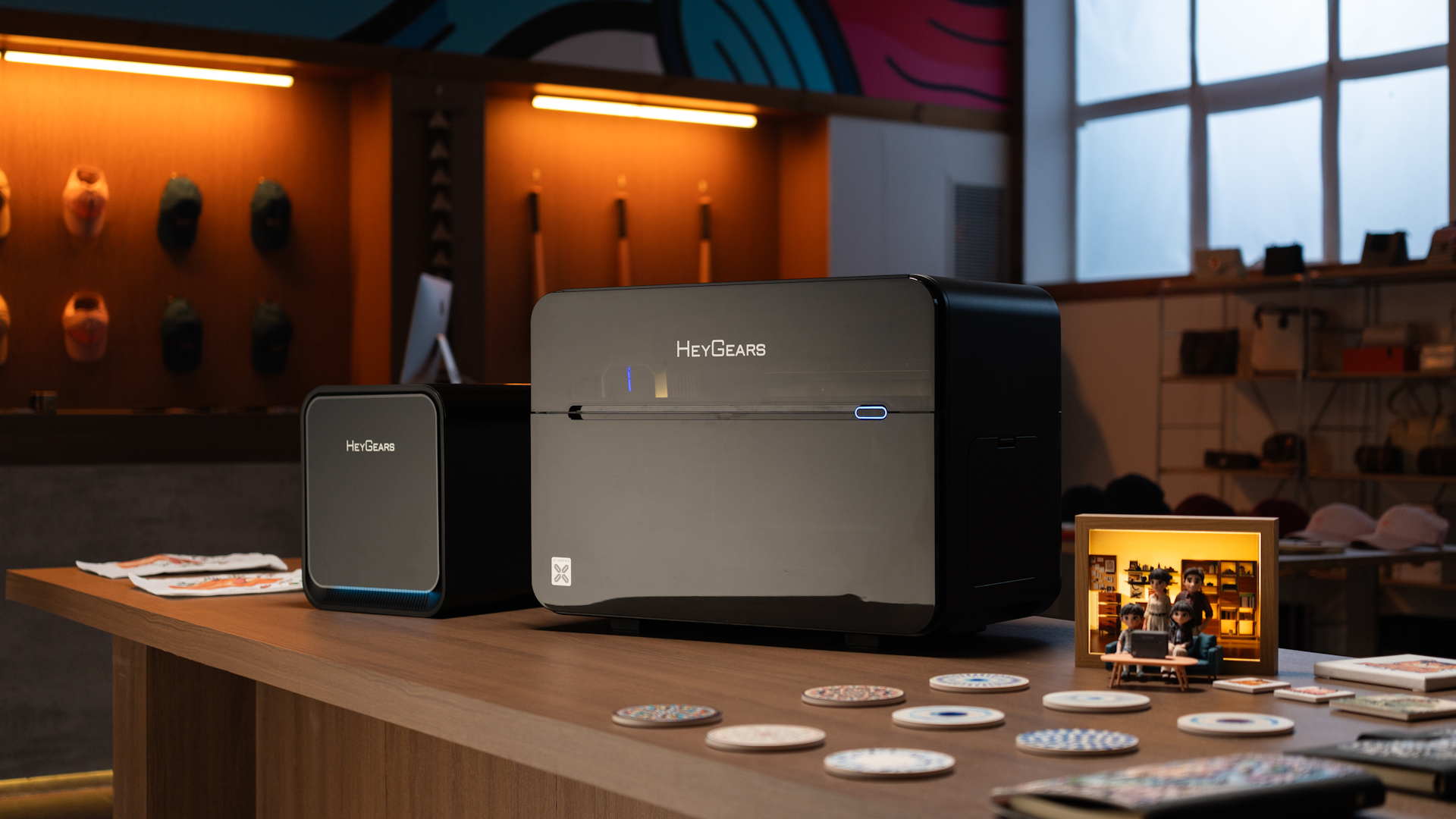
 HeyGears G1X Series 3-in-1 printer
- Build Volume
- 420 x 330 130mm
- Printing Speed
- Ultra-high-speed, high-speed-mode, wide gamut mode
- Materials Used
- 400+ substrates including wood, leather, glass, metal, ceramic and acrylic
- Brand
- HeyGears
- Multicolor
- 8-channel ink system (10 million + colors) The HeyGears G1X Series is a desktop printer that combines 3D printing with UV and textile printing in one machine. It uses an Epson i3200 industrial-grade printhead and an 8-channel ink system to produce full-color models with gradients and transparent effects, plus high-resolution UV prints across more than 400 materials. Built-in anti-clogging systems and automatic calibration are designed to keep long-term maintenance low. At its core, the HeyGears G1X Series is a 3-in-1 platform. It handles full-color 3D printing, 2D and 3D-texture UV printing, and fabric printing, using three separate material systems. Wide-gamut UV ink covers flat 2D printing and surface texture work across more than 400 compatible materials, including wood, leather, glass, metal, ceramics, and acrylic. UV 3D resin is used for full-color 3D models, producing gradients and transparent effects without any painting afterward. A water-based aqueous ink handles True DTF and DTG textile printing, so the same machine can also create printed apparel. Switching between these workflows on one machine is the real headline here, since desktop printers have generally specialized in doing just one of these things well. Full color without painting Full-color 3D printing is the most eye-catching of the three modes. The HeyGears G1X Series uses an eight-channel ink system alongside an Epson i3200 industrial-grade printhead, letting it lay down smooth color gradients and transparent sections within a single continuous print. That means a model can move from opaque to translucent, or shift through a gradient, without any manual post-processing. The maximum build volume is 420 x 330 x 130mm, and prints in this mode use water-soluble supports, which dissolve away rather than needing to be cut or sanded out by hand. It greatly simplifies the post-processing requirements and maintains the final surface quality of the print. UV printing with a wider color range In UV mode, the HeyGears G1X Series switches to 2D and 3D-texture printing. It is rated for more than 10 million colors at up to 1440 x 2400 DPI, using the same Epson i3200 printhead paired with HeyGears’ own wide-gamut ink set. That ink includes light cyan and light magenta channels alongside the usual CMYK, which is aimed at improving how accurately lighter tones and subtle color transitions render, an area where cheaper UV printers often struggle. HeyGears says the system carries G7 Colorspace’s highest level color certification, a standard used to benchmark print color accuracy. 3D-texture printing adds raised, tactile detail such as embossed or wood-carved effects, with a recommended texture height of around 5mm and support for texture builds up to 150mm. It is worth noting that this is surface relief rather than true volumetric 3D printing. Full-color 3D mode builds genuine three-dimensional objects, while 3D-texture mode adds dimensional detail to a surface. Three UV printing speed modes let users balance speed against color accuracy. Ultra-High-Speed mode uses four white ink channels for maximum throughput with up to 12 x faster speed; High-Speed mode uses two white and two varnish channels for a middle ground with at least 6x faster speed, and Wide-Gamut mode prioritizes color reproduction using the light cyan and light magenta inks and delivers at least 3x faster speed. Bringing textiles into the mix The HeyGears G1X Series also supports True DTF (Direct-to-Film) and DTG (Direct-to-Garment) printing through its dedicated water-based aqueous ink system. DTF prints a design onto transfer film that is then applied to fabric with heat, while DTG prints straight onto a garment. With both options on the same machine as the 3D and UV modes, a small studio could realistically produce custom apparel, tote bags, or caps alongside 3D models and UV-printed items, without a separate dedicated textile printer. Built with maintenance in mind Anyone who has owned an inkjet-style printer knows that clogged nozzles and dried ink are a constant risk, especially with white ink, which is prone to pigment settling. HeyGears has built what it calls a quad-layer anti-clogging system into the G1X Series. It includes a stirring mechanism to stop white ink pigment from settling, a printhead heater to keep ink at the right viscosity, automated cleaning cycles that run when the machine sits idle, and a sealed, moisturizing state for the printhead during extended inactivity to prevent drying. There are also three distinct cleaning modes. Jetting is a quick nozzle check that keeps things moist during regular printing. Regular Cleaning uses ink extraction and is meant for everyday maintenance. (HeyGears recommends leaving the printer powered on during normal use so this can run automatically.) Deep Cleaning uses cleaning fluid and is recommended when switching print modes or restarting after the printer has been off for a while. For alignment, the HeyGears G1X Series relies on a line-scan camera that reads substrate contours line by line, backed up by a top-mounted wide-angle camera and a LiDAR module that detects object position, height, and surface level. HeyGears says this combination reduces the distortion issues that can come with single-camera or LiDAR-only setups, letting the printer calibrate to a new substrate in seconds. No manual alignment required. AI modeling and modular expansion The HeyGears G1X pairs with HeyGears’ HeyVerse AI and Blueprint Studio software, which can generate printable models from text prompts or images, or convert flat 2D artwork into 3D-texture files in one step. That lowers the barrier for anyone without 3D modeling experience who still wants to produce custom color objects or textured surfaces. The system is also modular. HeyGears says it supports rotary, flatbed, roll-to-film, and resin station attachments for different production needs, along with a water-based aqueous ink option for printing on flexible textiles. In practice, that means the base machine can be expanded over time. Who the HeyGears G1X Series is actually for The HeyGears G1X Series is aimed squarely at creators, small studios, and businesses that need more than a single-color desktop 3D printer or a basic UV printer, but don’t have the budget or floor space for genuine industrial equipment. That could mean a prop maker who wants painted-looking miniatures straight off the printer, a small business producing custom phone cases and plaques, or a studio that wants to combine 3D models with printed textiles under one roof. It is less likely to appeal to anyone who only needs single-color functional 3D prints, since cheaper standard resin or FDM printers already do that job well. The G1X earns its keep specifically in the overlap between color, texture, and material versatility, which is attracting the attention of creators looking to skip manual painting and post-processing altogether. Brought to you by HeyGears.