Summary
Cordless power tools give you the flexibility to work whatever way you see it. Assuming your tool fits in whatever space you need, the cordless nature is likely one of the most appealing parts of the tool. Being able to keep it away from an outlet gives you so much greater use.
However, you need to power that tool somehow. It’s likely going to be a battery pack that needs charging. If you’re like many people around the world, the best place to store your power tools is in your garage. You have the most space there for your workbench and there’s nowhere else you can keep your inventory. While the space aspect of a garage is inviting, storing your cordless power tools there is damaging your batteries.
It’s understandable if you have a workbench in the garage
This isn’t the overarching problem
If you have a house, there are only a few places where you can realistically keep all of your tools. You might carve out a space in a bedroom, but you probably don’t want to waste the area in that room for that. You likely want a floor that’s easy to wipe up, so a carpeted room makes no sense. That usually leaves the basement, maybe a tool shed outside, or the garage.
Many people will choose the garage because you have a good amount of space, they don’t mind getting the outside dirty, and you can make loud noise and not disrupt as many people in the house. Plus, you can store both indoor and outdoor tools in the same place.
It doesn’t make sense to store your yard tools inside. You probably have shovels, rakes, pitchforks, and more in the garage or shed. So it makes sense to keep your lawnmower, leaf blower, hedge trimmer, and weed whacker all in the same place too.
For many of us, we power many of those power tools with lithium-ion batteries, which are obviously commonplace for cordless power tools these days. Which voltages you have depends on the size of the tool. Lithium-ion batteries are easy to use because you can charge them up, insert them, and you’re good to go. Many power tools have battery systems that let you use the same battery across many different tools. You can even use them on different devices as well.
Whether you decide to stick with the same manufacturer for indoor power tools as you do for outdoor ones is up to you. But with these battery systems, you can. However, keeping all of your batteries in the garage is not the smartest idea, which is where lumping all of your tools together in one place doesn’t make as much sense.
It isn’t smart to store your batteries in the garage
The lifespan of the batteries will shorten
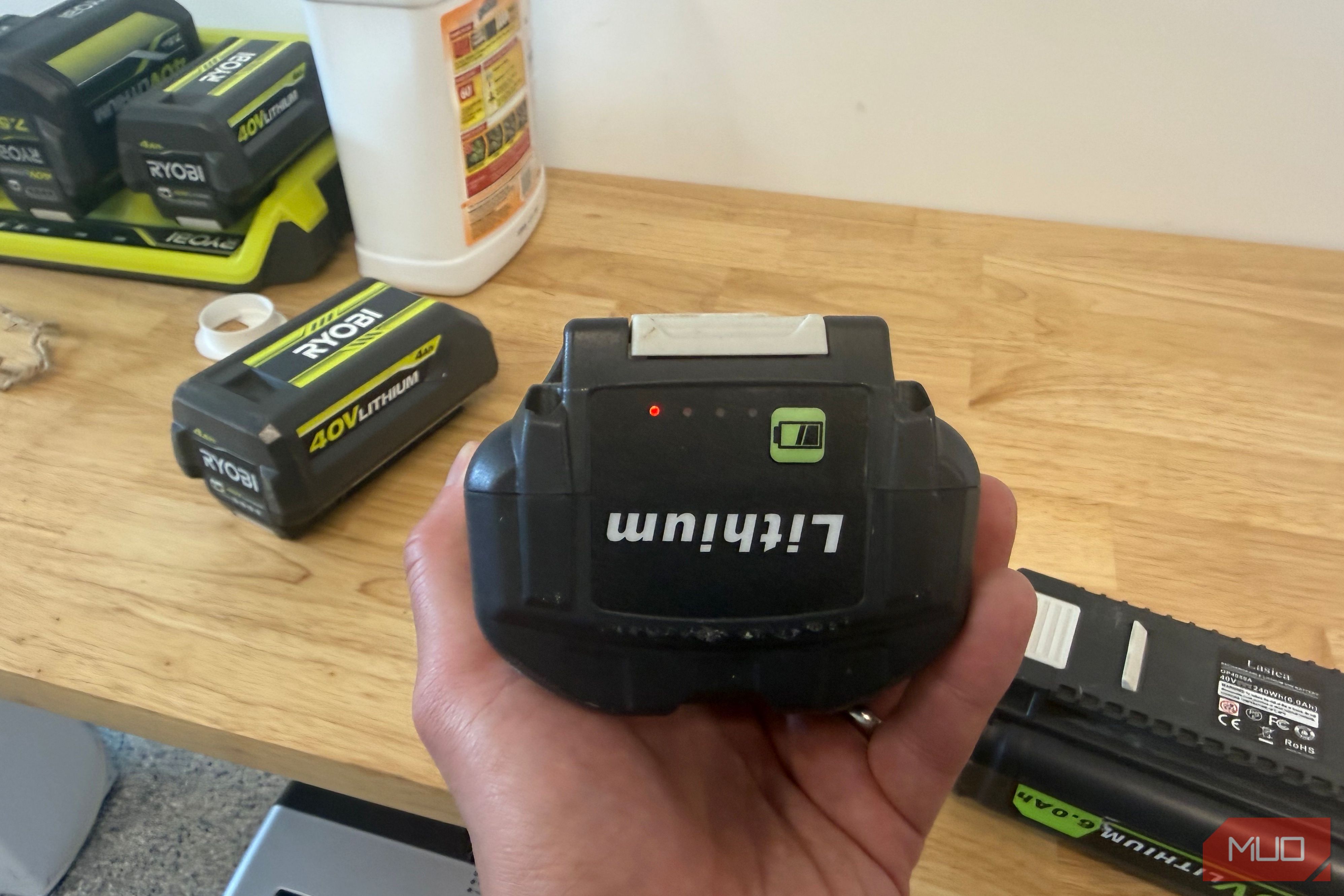
I have a set of Greenworks 80V battery chargers that I have been keeping in my garage for a while. It made sense to me to keep them outside because they are used with my string trimmer and my leaf blower. I can pop them into one and then swap them into the other. I have two batteries and two chargers, so I rarely have a dead battery.
However, it got incredibly hot in my garage over the summer. I would try not to have the charger plugged in all the time, but I started to hear about more lithium-ion battery fires and decided to read more into it. Temperatures over 104°F can cause thermal degradation of your lithium-ion batteries. Keeping them stored in anything over 100°F will accelerate the breakdown of your battery.
The same goes for the winter. If your garage gets incredibly cold during that time of year, your battery could potentially crack. It’s also not smart to charge a cold battery. At colder temperatures, the ions in the battery form a solid lithium metal coating known as dendrites. The coating and buildup will permanently damage the batteries and shorten the lifespans. Dendrites can damage the internal separators, leaving the batteries unsafe to charge, due to fire risks.
You might also have moisture in your garage, as you might live in a particularly humid climate. Dampness is also bad for your batteries, as the metal terminals could corrode, making them not as easy to charge within the charging unit. If internal components start to wear down, it could cause a short circuit.
If you have dampness in your basement, this will also be an issue for your batteries.
How to extend your battery life
It starts with storage space
If you’re investing in cordless power tools, you want to make them last. Whether you’re opting for Ryobi, Milwaukee, Porter-Cable, DeWalt, or another brand, these tools aren’t incredibly cheap.
Keeping the lithium-ion battery packs stored in a climate between 68°F and 77°F is the ideal temperature to prevent them from wearing down easily. A closet or utility space inside is ideal, as is a climate-controlled basement.
If you do have to store them in a basement, you should look into a storage closet that is climate-controlled. An insulated storage box will keep them from losing overall capacity.
At colder temperatures, the ions in the battery form a solid lithium metal coating known as dendrites. The coating and buildup will permanently damage the batteries and shorten the lifespans.
Extend the battery life by not charging your battery all the way to 100% after depleting it to 0%. If you keep it charged between 40% and 60%, you’ll guarantee you always have a battery to use and the capacity will last longer.
Forget about the garage when storing batteries
Give your batteries the best chance of lasting a long time by storing them in a more controlled climate. Your power tools are serious investments, as is wherever you set up your workbench. Even if it’s not going to be as convenient as keeping them near your garage workbench, you’ll be saving your batteries in the long run.
 Ryobi ONE+ 18V/40V Dual Platform Charger
- Color
- Green
- What’s Included
- Charger and power cable
- Voltage
- 40V and 18V