Summary
When the time comes to put on the elbow grease to write or learn something new, I often find myself getting distracted. I’ve tried every productivity trick in the book to beat procrastination. It still sticks to me like Velcro and refuses to let go. I thought of an anti-procrastination experiment to understand the root cause. I collected research from four experts who study procrastination and added it to Gemini Notebook (formerly NotebookLM). I wanted to see what happened when I queried my “advisory board of procrastination experts” for agreeing or disagreeing on the reasons behind my loafing. I gave Gemini Notebook a question I couldn’t answer Use experts who’ve studied it for years My research question was simple: Why do I struggle to start creative work even when I genuinely want to do it? Rather than rely on a chatbot’s summarized knowledge, I wanted to ground my research in the work of people who had spent years studying procrastination, motivation, and behavior change. I started with Fuschia Sirois and Timothy Pychyl, whose research explores the emotional side of procrastination. I added Piers Steel, who has studied the factors that influence procrastination. Then I included Peter Gollwitzer, whose research examines how specific plans help people turn intentions into actions. I searched for their research papers, accessible books, interviews, and lectures, then added them to one Gemini Notebook. This gave me a tight collection of sources to investigate a single problem instead of a pile of unrelated productivity advice. My goal was to keep each expert’s voice separate. With Gemini Notebook’s cited sources, I could also validate each claim. I asked every expert the same question The same prompt makes answers comparable Experts love to introduce new terminology even when they approach a field from the same angle. Gemini Notebook’s summarized and cross-checked response helps me understand each researcher’s position. It’s like taking in a bird’s-eye view of your research sources in the notebook. I used a simple overview prompt to compare their explanations, proposed solutions, and supporting evidence. Using only the sources in this notebook, explain how each researcher accounts for procrastination when someone wants to do creative work but struggles to begin. For each researcher:
- State their central explanation.
- Identify the mechanisms they believe contribute to procrastination.
- Describe the intervention their work supports.
- Cite the relevant sources.
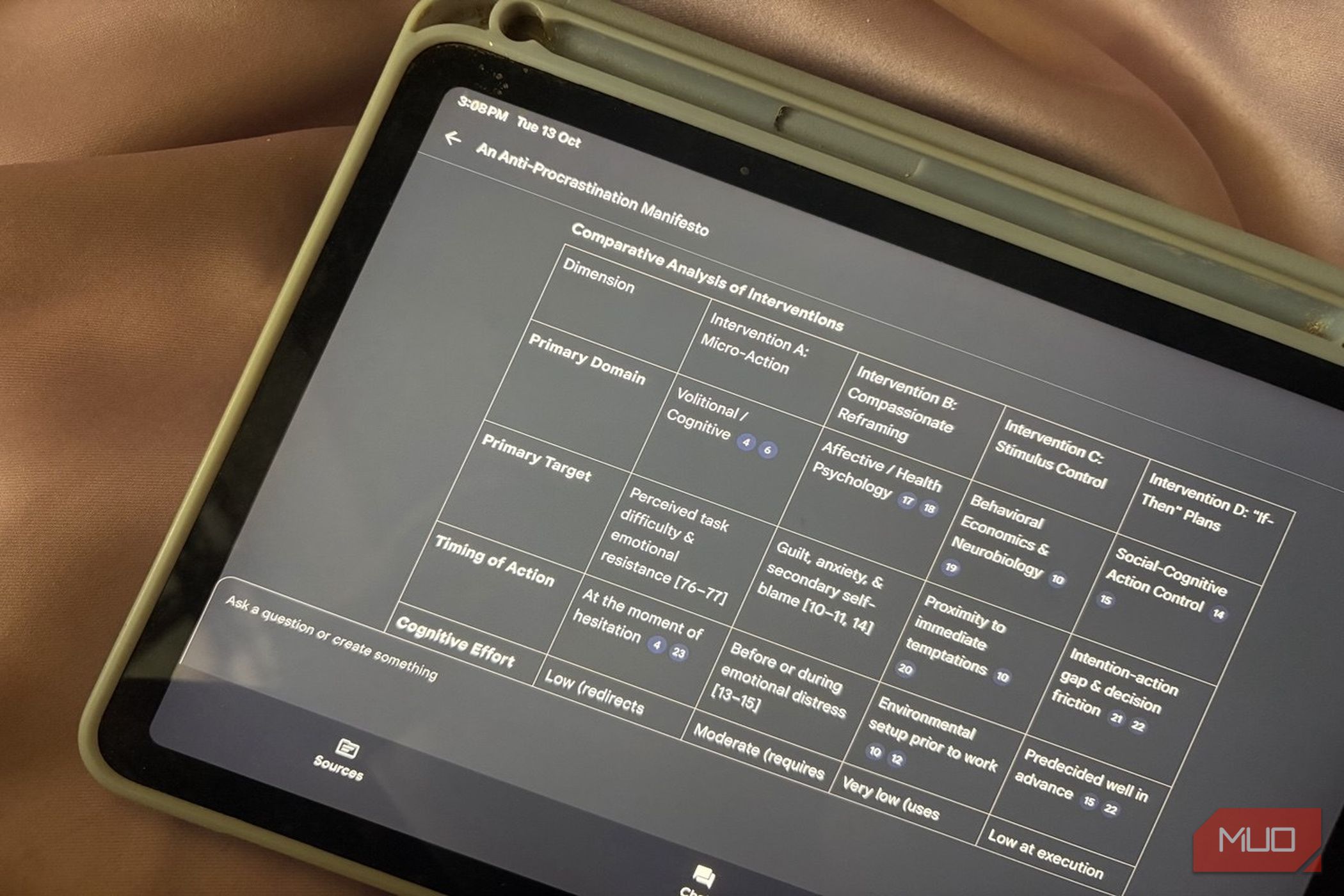
- Distinguish direct findings from theoretical interpretations. Do not assume that the researchers disagree. Identify where their explanations overlap and where they differ. This is just the first step. I didn’t want Gemini Notebook to jump straight to the answer I’m seeking. Once I know each position, I can then dig into the sources that interest me the most. I looked for disagreements, not just answers Search for disagreements, not consensus The four researchers followed different research paths to examine procrastination. Sirois and Pychyl emphasize how putting off a task can provide short-term emotional relief. Steel’s work examines factors such as task aversiveness, expectations of success, and the delay before rewards arrive. Gollwitzer’s research suggests that specific if-then plans can help people translate intentions into action. They explain different parts of the same problem, and they aren’t contradictory. Still, each suggests a different intervention that can cure different parts of my problem. For instance, my emotional response to an overwhelming task, the task itself, or simply the trigger to get started. This prompt looks at each… Compare the explanations of Fuschia Sirois, Timothy Pychyl, Piers Steel, and Peter Gollwitzer. Create a comparison table showing:
- What each explanation treats as the main barrier to action.
- What each explanation predicts will help.
- Where two or more approaches make different predictions.
- Which claims are supported by direct empirical evidence in the sources.
- Which differences are differences of emphasis rather than genuine contradictions. For every disagreement, cite the sources supporting both sides. If the evidence does not establish a disagreement, say so explicitly. Do not invent opposing positions. The last instruction is the tricky part. AI can make competing ideas sound more opposed than they really are. I wanted to separate real disagreements from different parallel. It also tells me that a single fix for my procrastination may not be enough. Gemini Notebook’s response to this also comes down to the quality and depth of the sources. I made the experts tackle my problem Test the expert theories on your own life Knowing why people procrastinate is useful. In the next step, I wanted to translate the research into practical suggestions I could actually try. My obstacle was specific: I had time available for a creative project, genuinely wanted to make progress, but found myself idling or binging instead of starting. I asked Gemini Notebook to examine my specific scenario through each researcher’s perspective. That way, I could compare each intervention rather than settle for a generic recommendation to be more disciplined. Consider this scenario: I have two hours available for a self-directed creative project. I genuinely want to make progress, but I remain in my chair reading or watching Netflix instead of starting. I have other responsibilities and cannot assume I will have uninterrupted time or high energy. For each research perspective:
- Explain the likely barrier without claiming to know my actual mental state.
- Recommend one small, testable intervention.
- Explain what observable result would support the recommendation.
- Identify what might make it ineffective.
- Cite the source material. Then compare the interventions. Which is the most defensible first experiment, given the evidence and the limited information available? Explain your uncertainty. Gemini Notebook can’t decide which expert was right. It can extract competing, evidence-linked explanations from the sources and identify what I could test with tweaks to my own productivity routine. I turned the research into an experiment A small test beats another elaborate plan The next and final step was to turn theory into practice. I’ve turned self-help theory into self-help action before with ChatGPT. Here, scientific theories could give me more than one path to pursue. For every recommended anti-procrastination exercise, I could track whether I started, how long it took, and how reluctant I felt beforehand. If I repeatedly failed to begin, I’d revisit the other explanations instead of assuming I needed more willpower. A two-week trial would give me enough hints to work with, although it wouldn’t prove that one theory was superior to the other. Maybe it would simply be a better fit for me. Based on the sources in this notebook, propose a two-week experiment to help me start creative work more consistently. Compare the proposed interventions, identify the strongest evidence supporting each, and recommend one small initial test. Include a simple way to record results and explain what the results cannot establish. Do not present a hypothesis as a proven conclusion. Cite the relevant sources and explain any important limitations. The value of this step is that it can be turned into a live experiment. I can use the notebook as a self-reflection journal to refine my next experiment rather than repeatedly searching for a better productivity system. Make your next obstacle a research project You can use the same approach for anything you’re stuck on. Find the cognitive link and get to work collecting the research behind it. Then question the evidence, identify where they disagree, and turn the comparison into a small experiment. My next project in Gemini Notebook is to ask: how much deliberate practice does it take to become good at something?