Summary
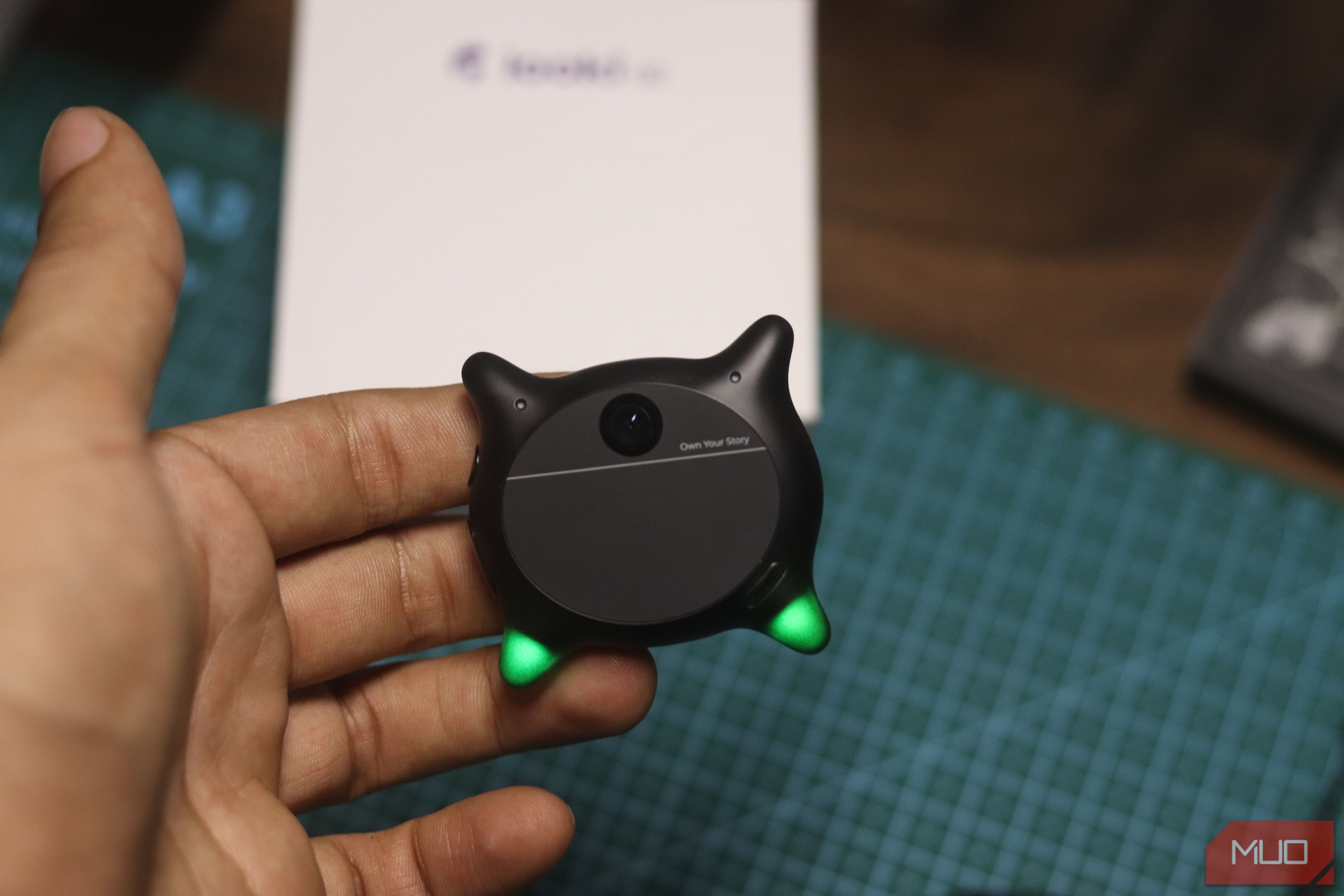
The world of AI-powered wearables has been constantly expanding, and the Looki L1 might be the strangest gadget I regularly use among it. It’s a tiny camera that clips to my clothes and quietly gathers fragments of a day. Looki describes it as a “life memory camera”, but the more you start wearing it, the more you realize it can do much more than that.
The problem however is the same as with any AI service. For the L1 to be useful, it has to send recordings of your day, however sensitive, to the cloud for processing. That habit is what initially kept me from using it, but the more I test it, the more I’m starting to like it, and that’s scary in a whole different way.
A chest-mounted archivist turned my errands into a sitcom
The raw footage is mediocre, the AI-made comics are the actual draw
Pulling out a phone turns a moment into an event. Unlock your phone, open the camera, point it at something, and you run the risk of missing whatever it is you wanted to capture. The L1 removes nearly all of that friction. I clip it on before I’m heading out, start adaptive recording, and get on with my day. Later, I can see the scattered moments that would otherwise have disappeared into the gap between something being worth remembering and worth taking out my phone for.
The L1 isn’t compelling because it shoots exceptional video. In fact, the 1080p camera on board is really not that good if you look at the raw footage. What the device does after capturing said footage is what makes it interesting. The Looki app can arrange recorded moments into a lifelog, recap, short vlog, or comic-style story, while its assistant can use available context to produce reminders and suggestions.
Those outputs make the device feel less like a chest-mounted action camera and more like an enthusiastic, occasionally confused archivist. It doesn’t get everything right, and often the generated summaries are far off what actually happened. But it gets close enough to jog my memory, and that’s the useful part.
I’ve really started liking the comics too. Seeing an ordinary errand or uneventful afternoon reframed as a dramatic sequence of illustrated panels is inherently funny. The generated frames do not need to be perfectly accurate to work, and they often aren’t. Sometimes, the odd interpretation is the joke, especially when the AI treats lunch or a simple break as if it were an important chapter in my personal mythology.
The recaps are also useful, but in a more subdued manner. At the end of a busy day, they give me a quick visual index of where I went and what I did. Context-aware nudges can also catch small things I might overlook, such as taking a break after working too long. The health reports are imperfect estimates, as the camera needs to be running for every meal you take, but they can still make me think about how long I sat at my desk or what I ate.
The fun part needs an unnerving amount of my life uploaded
Local-first capture is nice, until you want an actual recap
But the fun starts feeling uncomfortable really quickly. For these personalized results to exist, I have to give the system an unusually intimate view of my life. A wearable camera doesn’t only see the scenic parts of my evening run or bike ride. It can capture faces, conversations, computer screens, documents, addresses, routines, purchases, and the inside of places that were never meant to be in front of a camera.
Looki says recordings are stored on the device by default, and that you choose whether to sync them or enable cloud-processing features. It also says uploaded data is encrypted in transit and at rest, hosted on AWS, that the copy on the device is deleted 12 hours after an upload completes, and that your personal content isn’t used to train general-purpose AI models. Those are all sensible commitments, and local-first capture is better than silently uploading everything as soon as it is recorded.
But a promise isn’t the same as a technical guarantee I can independently verify. Content you save to your account stays there until you delete it or close the account, and the privacy policy gives no fixed retention period. It also says Looki may use de-identified or anonymized data for research and development. The same policy states that it collects uploaded messages, images, videos, audio clips, and files, and notes that some enabled features may automatically capture and upload limited, compressed data. The moment I want AI-generated recaps, searchable memories, health observations, or comics, some of the most revealing parts of my day must leave hardware I control and enter infrastructure I do not.
That massively changes the threat model. I am no longer only worried about losing the device. I am trusting the company’s security, retention practices, access controls, cloud providers, future policy decisions, and ability to respond to a breach. Encryption helps, but it doesn’t eliminate every risk once a service must process the data.
The Federal Trade Commission’s guidance for connected devices recommends encryption, restricted access, secure cloud systems, data minimization, and retaining personal information only as long as necessary. Those practices reduce exposure, but they cannot make an intimate cloud data set harmless.
Everyone near me signed up for this without being asked
A tiny light isn’t consent, and your cashier never read the privacy policy
There’s also a much bigger problem which a privacy policy between me and Looki cannot solve: everyone around me. I choose to wear the camera, but the stranger beside me in public, the friend I’m catching up with, and the cashier behind the counter did not choose to become part of my lifelog.
The L1 has a recording indicator, like most similar devices, and I can stop recording or point it away, but a small light isn’t the same as informed consent. Studies of wearable cameras point to bystander images and sensitive material on nearby screens as privacy risks, and in one small study, about 12 of 20 bystanders felt discomfort around camera glasses. Reactions vary, though. In the first study, bystanders rarely objected to lifeloggers, while the wearers themselves were less comfortable with always-on capture than with deliberate sharing. That means using the L1 responsibly requires active judgment but its whole appeal comes from not having to think about recording.
My scariest gadget is winning me over, which is the problem
Convenience turns extraordinary surveillance into an ordinary habit
I expected the Looki L1 to be an amusing experiment. Instead, I am beginning to appreciate the reminders, browse the recaps, and look forward to the ridiculous little comics. It takes the forgettable pieces of a day and turns them into something I can revisit. That is genuinely charming.
It is also why the device bothers me more now than when it was merely novelty. The better it becomes at understanding my routine, the more context I must surrender. The more useful its memory becomes, the easier it is to normalize wearing a camera around other people. And the more delightful those comic strips are, the less inclined I feel to ask what had to be captured, uploaded, and analyzed to create them.
I do not think the L1 is bad because it records my life. I think liking it can be bad because convenience has a way of turning extraordinary surveillance into an ordinary habit. My scariest gadget is winning me over, and that may be the most convincing warning it could give me.
 Looki L1
- Brand
- Looki
- Connectivity
- Wi-Fi, Bluetooth
- Battery
- 375mAh
- Weight
- 32 grams Looki L1 is a lightweight AI-powered wearable camera that passively captures moments throughout your day, then uses multimodal AI to organize them into searchable memories, summaries, and highlight reels.
- Price
- $249