Summary
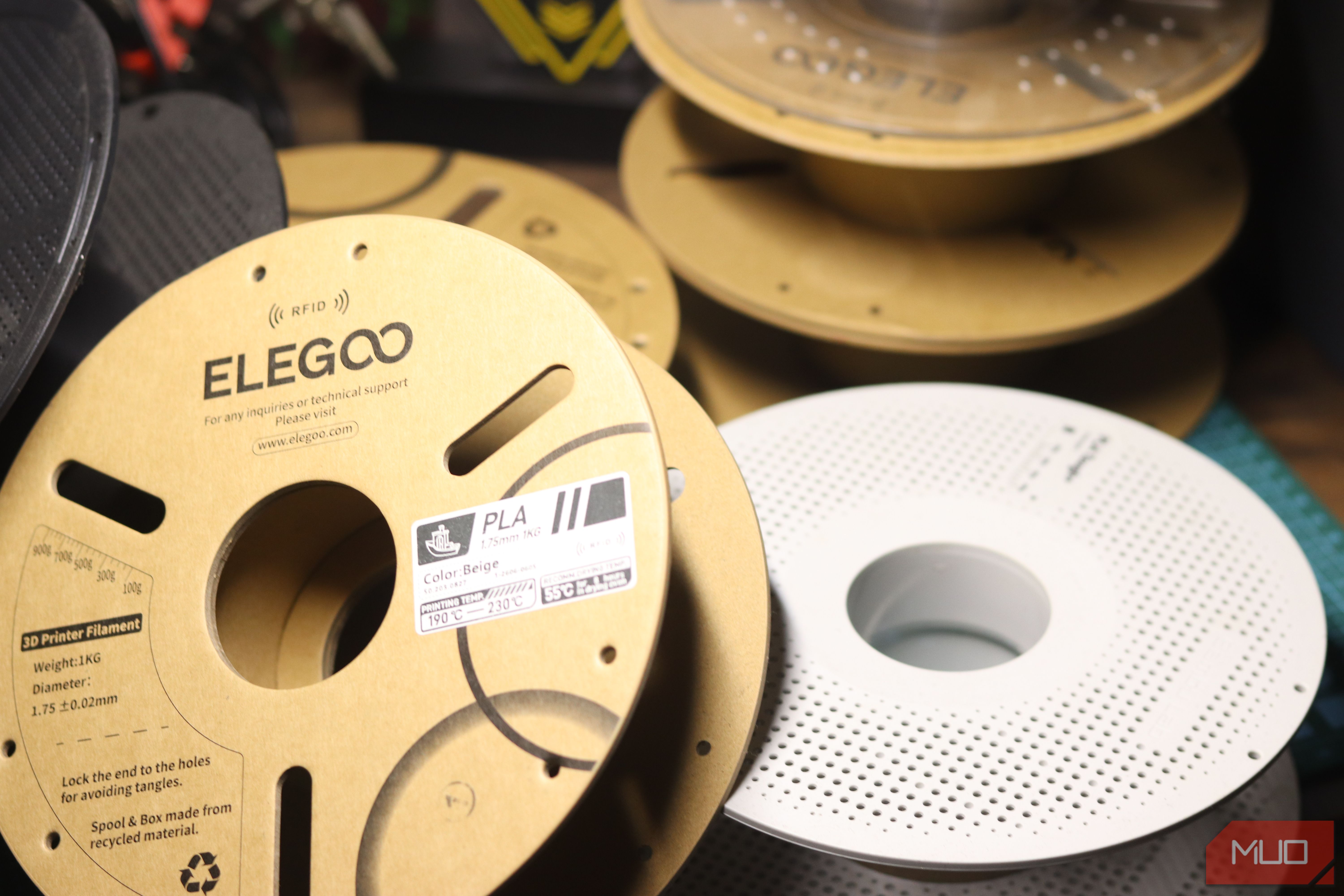
Finishing a roll of filament feels satisfying right up until you look at the empty spool. Regular printing can quickly turn one harmless-looking leftover into a wobbly plastic tower. Throwing them away is the easy bit, but most filament spools are already sturdy, symmetrical parts with a useful axle hole and plenty of life left in them. That makes simply tossing them in the garbage a little hard, especially considering I use my 3D printers to reduce waste. So if you’re letting your filament spools go to waste, you can instead reuse them, pass them on, return them, or recycle them properly. Check what your spool is made of before it hits the bin That little triangle is a resin code, not a recycling guarantee Start off by checking what you already have. Spools may be cardboard, polypropylene, ABS, polycarbonate, or a combination of materials. You’ll also likely find a printed materials label, manufacturer instructions, or a molded resin code, although a triangle-shaped resin mark doesn’t automatically make a plastic spool curbside recyclable. The EPA says the mark identifies the resin, while acceptance still depends on your local recycling program. A clean cardboard reel is usually easier to recycle than a bulky plastic one, although you may need to separate plastic hubs, fasteners, or reinforced edges. Polymaker, for example, says its cardboard spools are accepted by most paper mills. Keep any cardboard clean and dry, and confirm the rules with your local collector before dropping it in the bin. Buy refills and let the spool earn its keep Refills only work if core size and locking method actually match The easiest way to get your empty spools back into action is buying filament refills instead of entire spools. A ton of brands, such as Bambu Lab, Prusa, and Numakers, sell PLA refills designed for their existing spools, while Polymaker’s Panchroma PLA refills are built to fit several brands’ reusable spools. The only catch here is compatibility. Check the refill’s core diameter, width, and locking method first before assuming every coil fits every spool. Generally speaking, brands sell refills for their respective spools, but if you’re using one brand’s empty spool with another brand’s refill, things can go sideways. Leave the retaining straps in place until the refill is properly installed on the spool, as removing them too early can release a tightly wound coil and create a tangle that’s going to be very difficult to wrap up again. Turn an empty spool into storage that beats a tangled drawer Cable reels, parts carousels, and a lazy Susan with ambition An empty spool is essentially a compact cable reel, so give it the job it already resembles. You can wrap extension cords, Ethernet cables, hookup wires, LED strips, rope, ribbons, holiday lights, or just about anything that’s in the shape of a wire. A printed clip can hold the loose end, and you can even 3D print a simple crank and stand that can turn the spool into a dispenser. That said, avoid tight bends with delicate data cables, and never wind a powered extension cord so tightly that it starts trapping heat. Spools also make rather useful rotating organizers. You can 3D print wedge-shaped bins that fit between the flanges, add a lazy Susan bearing underneath, and you’ll get a carousel for holding nozzles, inserts, screws, or components. These inserts can also hold paint bottles, pens, or hand tools. There are tons of other projects that convert spools into drawers, yarn winders, and small-parts boxes, clearing clutter without creating yet another decoration. Build something fun, because not everything has to be useful Clocks, lamps, and cat toys, minus the high-voltage experiments If utility isn’t your goal, empty spools can come in handy as project frames. The circular sides can become wheels for a lightweight toy, the body of a clock, or the structure of a lamp. LED strips placed around the inner core can even create a 360-degree glow, and printed diffusers or decorative panels can hide the spool’s original branding. Stick with low-voltage LEDs, though, as the plastic or cardboard used in making spools can warp around intense heat. The spool can also become part of a cat toy, school craft, diorama, or tabletop scenery. Just make sure to sand down sharp molding seams, remove leftover filament ends, and supervise children or pets around small printed attachments. Pass spools along before you hoard a mountain of them Makerspaces, robotics clubs, and brand take-back programs want them If you’re at your wits’ end, you don’t need to invent a project for every empty spool. Ask a local makerspace, school robotics club, art teacher, electronics workshop, or online maker group whether they need spools for cable storage, crafts, or loose filament. Also check the brand’s website. Some manufacturers operate take-back programs, though eligibility may depend on brand, region, spool condition, and minimum quantity. Filament PM takes back clean, undamaged spools from customers in the Czech Republic and Slovakia in exchange for account credit on their next purchase, while 3D Innovators Official pays $0.50 in store credit per approved spool, but only for its own spools and only through an approved account. Make sure to save up a batch before shipping, and follow the program’s packaging rules, though. Recycle only as a last resort, and stop wishcycling A resin code won’t convince your local facility to accept it When reuse and return aren’t practical, it’s best to prepare the spool for the correct recycling stream. Separate cardboard from plastic where possible, remove unwanted labels or metal parts, and keep everything clean. For a large stockpile, contact a local plastics recycler directly. Sorted spools in volume may be more acceptable than a single bulky item. Most importantly, resist wishcycling. A resin code doesn’t guarantee that your curbside facility can sort or sell that shape and material, and the EPA warns that wishcycling can cause an entire batch of recyclables to get tossed. If disposal is the only local option you have, let that influence your next filament purchase. Cardboard spools and refill coils prevent the problem earlier, which is better than finding increasingly creative ways to put a growing pile of empty plastic spools to use.