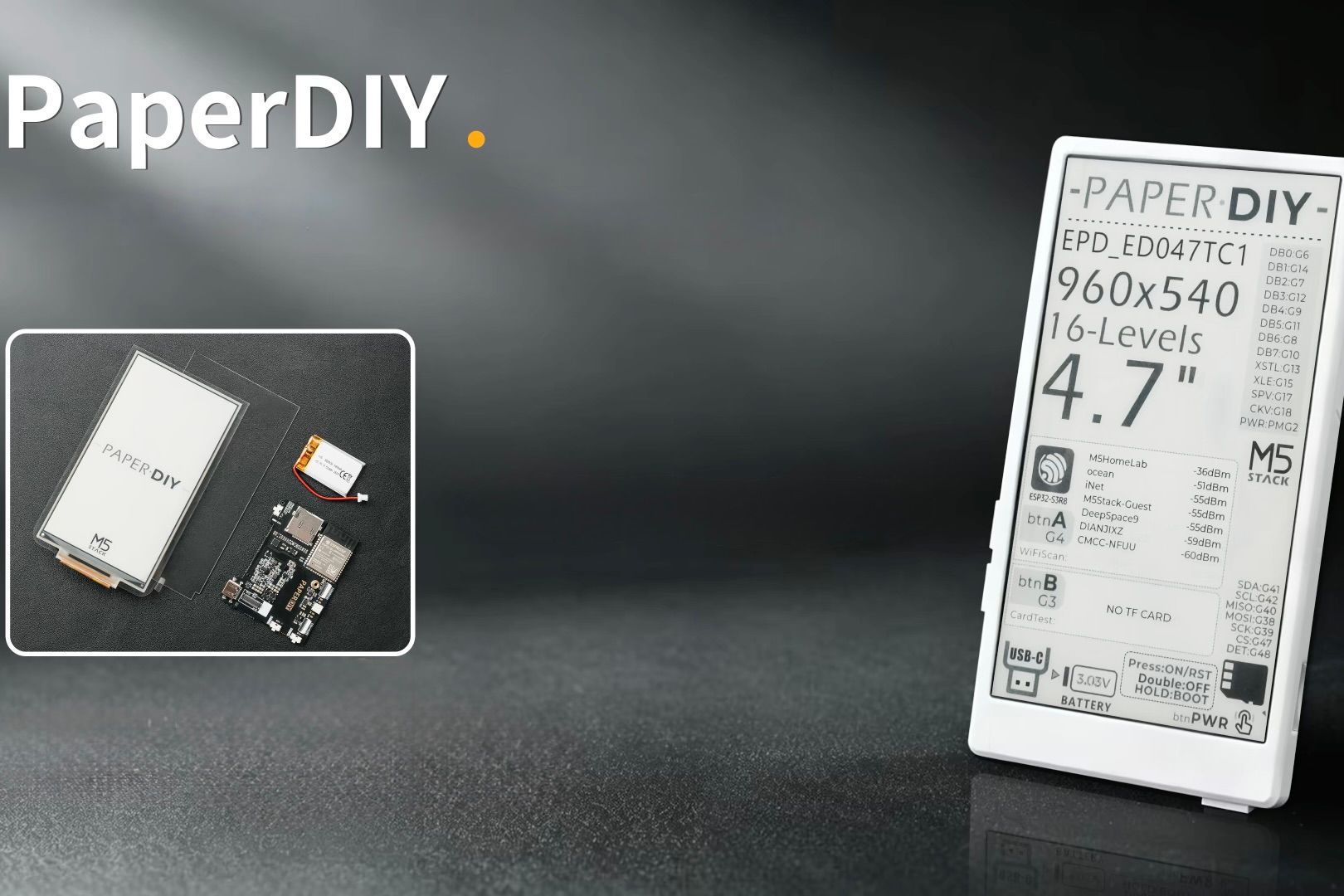
Summary
Summary
- M5Stack’s $25 PaperDIY kit combines a 4.7-inch grayscale e-paper display with an ESP32-S3 microcontroller.
- Built-in Wi-Fi and microSD support let you create calendars, weather stations, task boards, and other desk displays.
- The kit requires assembly, programming, and a custom enclosure, but M5Stack provides open-source firmware examples to help.
M5Stack has launched a new development board called the PaperDIY Assembly Kit. For 25 bucks, it combines an ESP32-S3 chip with a 3.7-inch e-paper screen. Besides the microcontroller and the display, it comes with a control board, acrylic pressure plate, and a small rechargeable battery.
Earlier this year, E-papers already proved to be a popular technology at IFA 2026. PaperDIY now makes the technology more accessible with an affordable price tag if you prefer building things yourself.
This could become a small calendar, task board, or weather station sitting on your desk
And the ESP32-S3 gives it a lot of bang for the buck

 Thanks to the battery and the ESP32-S3’s built-in Wi-Fi, you can finish your project and retrieve information from your PC without having to stay connected via cables. It features a 960 × 540 display with 16 levels of grayscale, which can be a minimalistic and less-distracting addition to your desk compared to a generic LCD tablet.
It’s important to mention that the display is not a touchscreen. Moreover, the $25 version does not give you the 3D-printed framing around the display. Instead, its exposed design lets you create or 3D-print a case suited to your project. Below you can find a list of PaperDIY’s specs and features:
|
Specification |
M5Stack PaperDIY |
|---|---|
|
Processor |
Dual-core ESP32-S3, up to 240MHz |
|
Display |
4.7-inch e-paper |
|
Resolution |
960 × 540 |
|
Color |
16-level grayscale |
|
Memory |
8MB PSRAM |
|
Storage |
16MB flash and microSD slot |
|
Connectivity |
2.4GHz Wi-Fi |
|
Battery |
140mAh |
|
Ports |
USB-C and two expansion interfaces |
|
Size |
115.3 × 62.5 × 5.5mm |
|
Weight |
26.4 grams |
Also, M5Stack has published the factory firmware source code, which is built with ESP-IDF. It includes working examples for monitoring battery voltage, scanning nearby Wi-Fi networks, reading and writing to a microSD card, detecting button presses, and shutting the device down with a long press.