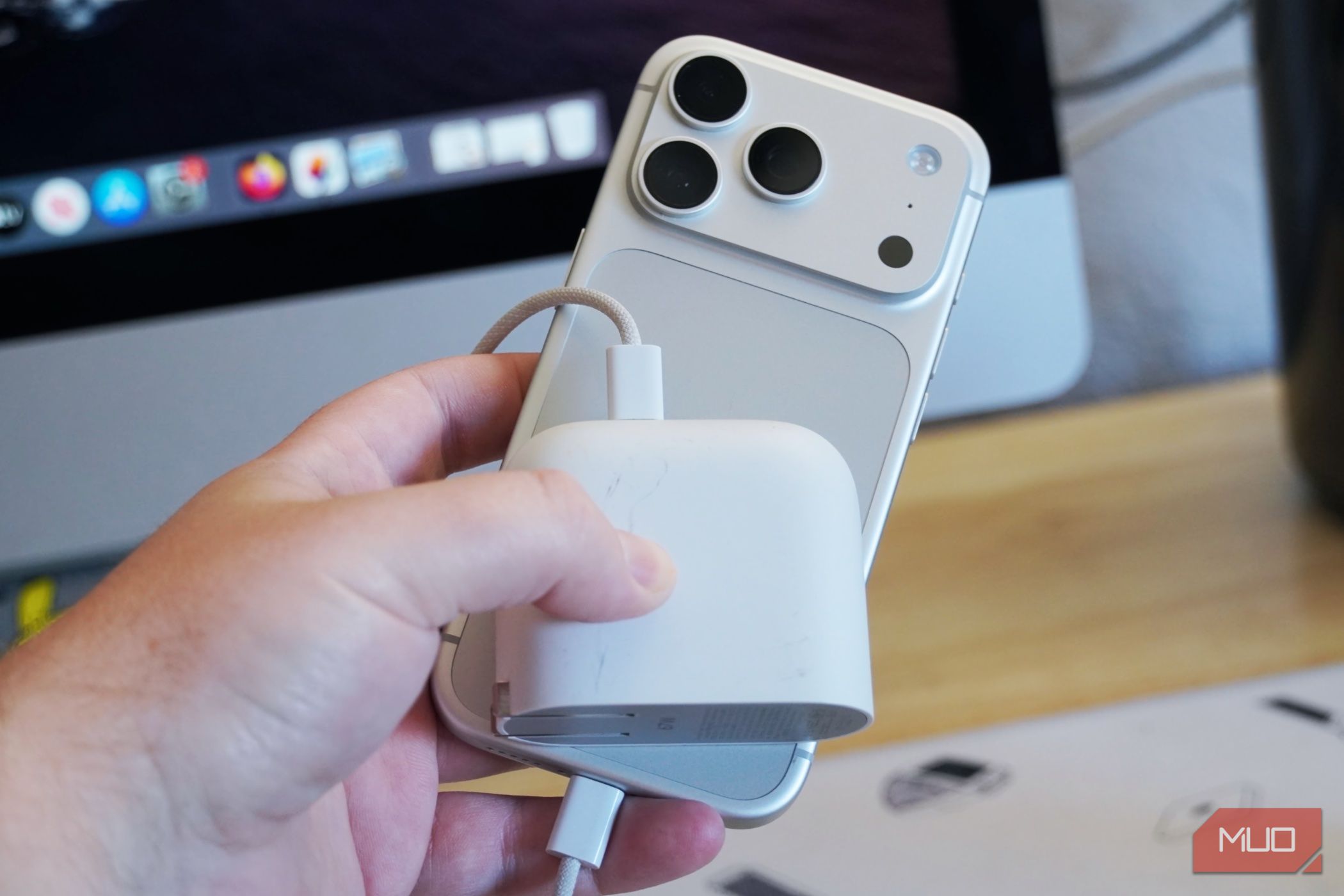
Summary
I used to religiously charge my phone overnight, and occasionally required midday top-ups to keep my phone’s battery going. Now, I don’t have to plan daily charges, because flagship phone batteries finally support fast charging across the iPhone, Pixel, and Galaxy lineups.
Most recently, I put my eSIMs in the iPhone 18 Pro and the Google Pixel 11 Pro Fold. Both phones support fast wired charging, but I quickly realized that I needed the right charger to unlock these new speeds. The iPhone 18 Pro’s fast charging and long battery life are two reasons I upgraded in the first place, and I almost missed out on the benefits because I forgot to check my chargers.
iPhone users need an AVS charger
My iPhone 18 Pro won’t charge fast enough without one
I spent a year with the iPhone Air, and while it was a blast, I wanted to try an iPhone with better battery life, faster charging, and a telephoto lens again. So, I switched to the iPhone 18 Pro. Check the tech specs page for the iPhone 18 Pro and iPhone 18 Pro Max, and you’ll see some pretty impressive charging speeds listed. They can charge up to 50% in 15 minutes with a 60W charger.
While the iPhone 18 Pro still charges slower than phones from Motorola and other Chinese brands, I’ll take an extra 50% of battery in exchange for a 15-minute charge. Apple specifies the wattage needed from the cable and power adapter to deliver those speeds, and wattage is the spec most people check. However, not just any 60W power adapter will work.
You need a power adapter with support for Adjustable Voltage Supply (AVS), too. I tried fast-charging my iPhone 18 Pro, and didn’t see the speeds I expected until I checked the fine print on the power adapter. If you don’t have one with AVS, be prepared for slower speeds.
AVS allows for a charger and a connected phone to work together in determining how much power should be delivered. The technology makes it possible for a charger to deliver voltages between 9V and 20V in tiny 100mV increments, which isn’t possible with basic chargers.
Instead, standard chargers without AVS or similar technology are locked into specific wattage and voltage levels. For example, a phone might ask for less than 15V but more than 9V of power — a regular power adapter can’t do that, but one with AVS can.
Without AVS, an old-school power adapter can’t give a modern iPhone the exact amount of voltage it needs at a particular stage of the charge cycle. The amount of voltage an iPhone can accept varies at any given time, based on factors like its state-of-charge and battery temperature.
A standard charger needs to step down to pre-set voltage levels more aggressively without AVS, and thus it can’t charge as fast.
Pixel and Galaxy users need a PPS charger
Alongside the iPhone 18 Pro, I’ve carried a Google Pixel 11 Pro Fold in my pocket. It charges fast, too — although not as fast as my iPhone. That’s not unexpected, as it’s a foldable. However, the Pixel 11 Pro Fold requires different charging tech than an iPhone to reach its peak speeds.
Google says the Pixel 11 Pro Fold can charge up to 50% in 30 minutes, and the traditional “Pro” Pixels charge a bit faster. Regardless of which model you choose, you’ll need a power adapter with Programmable Power Supply (PPS) support to actually enjoy those speeds. It’s a step beyond AVS, and this makes it a bit more rare on chargers.
AVS is required on certified USB PD 3.2 chargers, as long as they’re capable of power delivery speeds between 27W and 100W. It’s more common as a result, at least on newer USB Power Delivery chargers. PPS is an extra because it enables more precise adjustments than AVS. Voltage and current can be tweaked in 20mV and 50mA increments, and this is how Pixel phones (and some Galaxy phones) deliver fast wired charging speeds.
The tricky part is finding a charger that not only supports PPS, but also works within the voltage range required by phones like the Pixel 11 Pro Fold. Some PPS-equipped power adapters top out at 11V or 16V, whereas newer Pixel phones need a power adapter with PPS 20V or higher to charge at their fastest speeds.
The charger matters as much as the phone
Your phone’s peak speeds are irrelevant without the right charger
I learned the hard way that the charging speeds on your phone’s spec sheet won’t matter without the right charger. If you’re an iPhone user, you’re looking for a certified USB PD 3.2 power adapter with AVS. If you’re a Pixel user, you need a PPS power adapter that can reach at least 20V.
Don’t forget about the maximum wattage, either. Your phone demands a power adapter with AVS and/or PPS, but it also needs enough wattage to charge fast. The charging cable is another piece that is easily forgotten. The cable needs to match or beat the maximum wattage required by your phone, or better yet, your power adapter.
USB-C charging is pretty neat, because I can charge my earbuds, phone, tablet, and laptop with the same cable and power adapter. However, it also creates a complex landscape where chargers look the same but have vastly different features. If you’ve recently upgraded to a new flagship like I did, make sure your power adapters and cables are up to the charging task.
 Pixel Flex Dual Port 67W USB-C Fast Charger
- Output
- 2x USB-C
- Output Power
- 67W
- Color
- Snow (White)
- Smart Features
- USB PD: 3.2 PPS PD: 5V/3A, 9V/3A, 15V/4A, 20V/3.35A max 67W PPS: Up to 11V/3A, 16V/4A, 21V/3.35A max 67W AVS: 9-15V/4A, 15-20V/3.35A max 67W The Pixel Flex Dual 67W charger is a fast USB-C power adapter that can fast charge two high-end Pixel phones simultaneously. It also includes USB PD 3.2, PPS, and AVS support, allowing it to charge modern devices like the iPhone 17 or Pixel 10 Pro XL quickly.