Summary
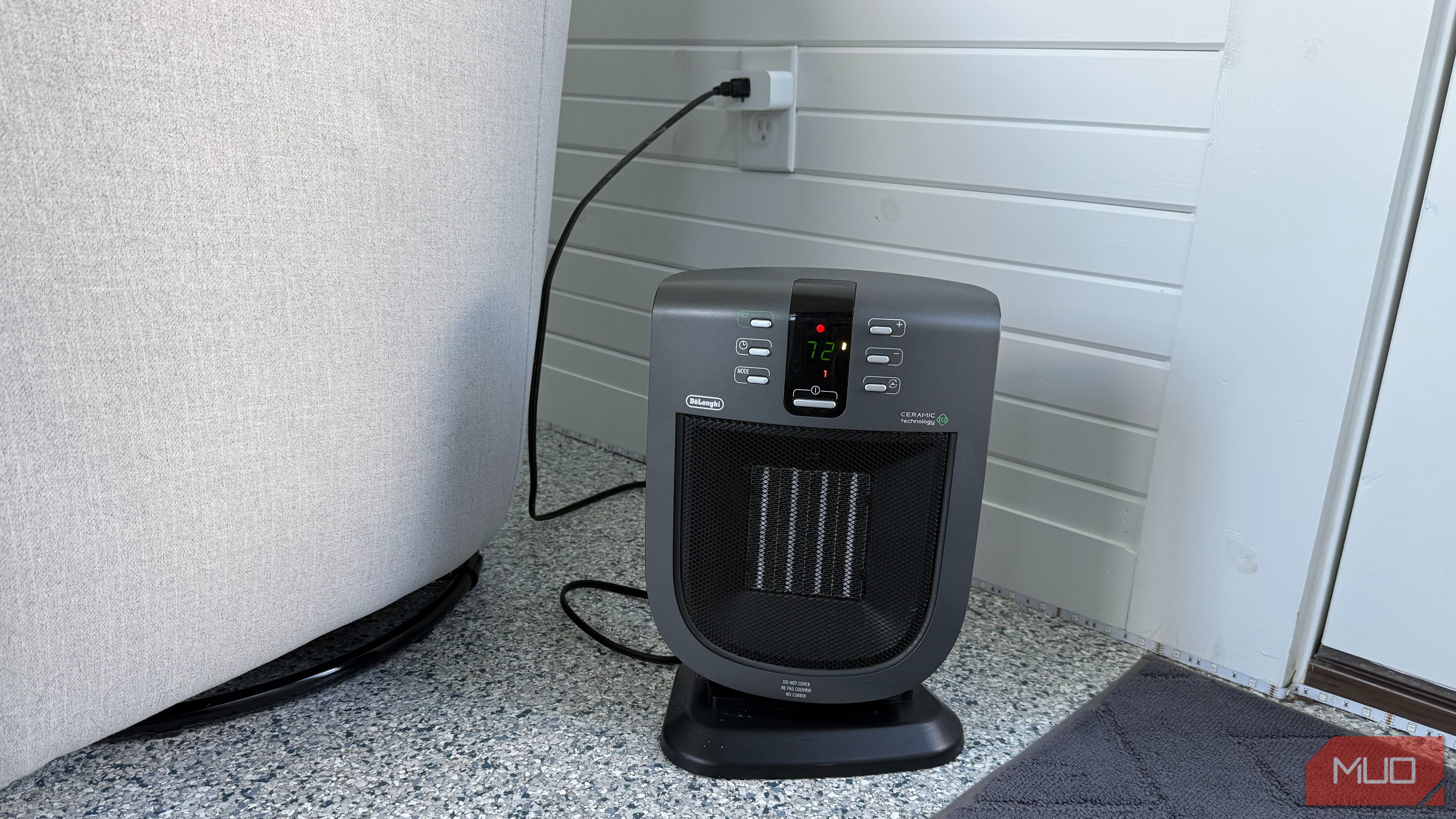
Every October, the same idea makes the rounds: plug a space heater into a cheap smart plug and have the room warm before you walk in. I understand the appeal. I’ve called a smart plug the most useful smart home device I own, and I keep an Amazon Smart Plug and a small Honeywell space heater in the house.
They never share an outlet. Twelve years in engineering taught me to read the fine print on anything that makes heat, and the fine print here is blunt. The wattage usually checks out. Trouble starts when an app, a schedule, or a voice command switches on a heater nobody is standing next to.
The math works, but the margin is thin
The label says 1500W fits, and technically it does
Plug-in heaters almost never exceed 1500W, and on a 120V outlet that draws 12.5A. The Amazon Smart Plug and most rivals are rated for 15A and 1800W, so on the box everything fits. That’s where most “is it safe” answers stop.
Duration is what the box leaves out. Code calls anything that runs three hours or longer a continuous load, and a continuous load shouldn’t push a circuit past 80% of its breaker rating. For the 15A circuit feeding most bedrooms, the math lands at 12A, which is 1,440W. A heater on high already sits past it before a TV or lamp on the same circuit adds anything.
Heat doesn’t spread evenly when that happens. The extra heat piles up wherever current crosses a joint. Here, that means the plug blades, the smart plug’s internal relay, and the outlet’s spring contacts, which loosen as a receptacle ages. Each one behaves like a small resistor running hot all evening. If you’ve ever pulled a heater cord from the wall and found the plug warm, you’ve felt it. Discoloration or a softened edge on the plug means that outlet is done hosting a heater.
The schedule is the dangerous part
Heater manuals and plug makers say the same thing
Load ratings get the attention, but the bigger risk is letting something other than your hand turn a heater on.
Heater manufacturers spell this out. Many manuals warn against using a timer, programmer, or remote-control device that switches the heater on automatically, since the heater could be covered or knocked out of position when it starts.
At least one US model warns that an external timer may accidentally disable its thermal cutout. Amazon’s safety sheet for its own smart plug goes further and says not to use it with equipment, heaters included, where unsupervised operation could be dangerous.
The fire data backs them up. From 2019 to 2023, US fire departments handled an estimated 38,881 home heating fires a year, according to NFPA, killing 432 people annually, with December through February the busiest stretch.
Older NFPA reports tie more than half of heating fire deaths to one cause: a heater placed too close to bedding, clothes, or furniture. A 6 PM schedule can’t tell that the dog dragged a blanket against the grille at 4 PM. You’d only notice that if you walked into the room to turn the heater on manually.
Smart heaters exist because of this exact problem
Look for built-in controls, then check the recall list
Heaters with Wi-Fi built in are the category actually designed for remote control. Since 2019, UL 1278, the safety standard for portable room heaters, has included requirements for connected models that accept wireless commands. Some brands lean conservative with it. Dyson blocks heating control in its US app entirely and leaves that job to the physical remote.
A smart label alone doesn’t settle the question. In 2024, Atomi recalled about 99,400 smart heaters that could turn on without user input. Govee followed in November, recalling about 512,000 units after testing showed they fell short of UL 1278 and their wireless controls posed an overheating and fire risk. Run the model number through CPSC.gov before you buy, and look for the UL or ETL mark on the heater’s actual label rather than trusting the listing photos.
What I run instead
A smart panel heater and off-only automations
When I want supplemental heat, I use a panel heater mounted high on a wall with its own smart controls, plugged straight into a wall outlet. No smart plug, no extension cord, no power strip. The heater’s thermostat and safety controls decide when it runs, which is how a connected heater is meant to work.
If you already own a regular heater and a smart plug, read the plug’s manual first. If it rules out heaters, as Amazon’s does, skip the pairing. If it doesn’t, give automation the off switch only. Turn the heater on by hand, then let a schedule cut power at bedtime, or set up a contact sensor routine that kills it when an exterior door stays open. When that automation fails, you’re left with an ordinary heater you switched on yourself.
Better still, fix the cold room at its source. A room that always needs a space heater usually points to a thermostat reading the wrong spot. I pair Echo devices with my Amazon Smart Thermostats as extra temperature sensors, and my motion sensor routine bumps a zone a couple of degrees when someone walks in. Neither one puts a 1500W load on a bedroom outlet.
 Amazon Smart Plug
- Brand
- Amazon
- Connectivity
- Wi-Fi (2.4GHz) Keep the on switch in your own hands I still like smart plugs for plenty of jobs. A lamp, a fan, or a strand of holiday lights can switch on remotely without much downside, since none of them can light a blanket on fire by switching on beside it. Space heaters can. Before the first cold snap, dig the heater’s manual out of the junk drawer (or look it up online), check what your plug’s instructions allow, and look at what else shares that circuit. Then decide which job automation gets. Let it shut the heater off, or replace the pairing with a heater built for remote control. Either choice keeps the room warm without leaving the riskiest decision to a schedule.