Summary
The latest Samsung Galaxy and Google Pixel smartphones offer decent battery life, but there’s still a pretty big difference between them that you might not realize. They both include large batteries in their newest phones, rated to last for more than a day per charge. Battery saver modes can extend that by limiting features. There are lots of other ways you can extend battery life on your Android phone, like dimming brightness, turning off location services and automatic Wi-Fi connection, and limiting apps that run in the background. But this one key difference isn’t something you have as much control over. And it’s hidden in the fine print.
Some Samsung Galaxy phones are rated to last for up to 2,000 charge cycles, while all the latest Google Pixel phones are about half that at just 1,000 before you reach 80%. This is a huge difference that matters in terms of longevity of the phones, or at least their batteries, perhaps even more so than software and security support duration.
Examining the fine print
How many times can you charge them?
In the fine print found on Google’s support page, accessed from a Google Pixel 11 Pro, the company notes that Pixel 3 through Pixel 8 Pro and the original Pixel Fold phones are rated to retain up to 80% of their battery capacity for about 800 charge cycles. Pixel 8a and later models increase this to 1,000 cycles.
Some Samsung phones claim to offer double the number of cycles. Though this isn’t directly advertised, the figure is a requirement of disclosure for devices sold in Europe due to EU regulations. The Samsung Galaxy phones rated for up to 2,000 charge cycles include the Samsung Galaxy S25, S25 Ultra, S25 FE, Galaxy S25 Edge, Galaxy S25 Plus, Galaxy A56, Galaxy A36, Galaxy Z Flip 7, Galaxy Z Fold 7, along with the Samsung Galaxy XCover 7 and XCover7 Pro, both rugged phones for field and enterprise use. It’s also worth noting that the Samsung Galaxy Z Flip 7 FE is rated at 1,700 battery cycles.
Interestingly, most Samsung phones, including the newest Galaxy S26 series models, are rated at up to 1,200 cycles. So, this bump in cycles is limited to only a selection of devices. But it’s still a significant difference worth noting that can inform the longevity of the battery that you’ll be pleased to know if you have one of these phones, especially if you’re a heavy user of battery-draining features like gaming who recharges frequently.
What battery cycles mean
Calculating lifespan
Charge cycle of a phone refers to a full cycle of the phone reaching 0% and being charged back up to 100%. Since most of us don’t let the battery fully drain (nor should you), you likely participate in half or three-quarter charge cycles most of the time, giving your phone’s battery a boost whenever it gets to 20%, or potentially even once it hits 50%. Assuming you charge your phone to a half cycle every day, that’s one full charge cycle every two days. At 1,000 charge cycles, this means the battery should theoretically last 5.5 years. With 2,000 cycles, that could hit up to 11 years, well beyond software support for any phone.
You want to factor in battery size and life as well. This varies from one device to the next, but the Google Pixel 11 Pro, for example, has a 4,850mAh battery that is rated to last up to 30+ hours with general use. By comparison, the Samsung Galaxy S25 Ultra has a larger 5,000mAh battery but you get up to the same 31 hours of use with video playback. This means the Samsung Galaxy S25 Ultra that’s rated for 2,000 cycles should last longer if you were to charge both at the same frequency. The same can be said for the Samsung Galaxy S26 Ultra, which is rated at 1,200 charge cycles with the same rated battery life. If you charged it at the same frequency, the battery should theoretically last about 6.5 years.
Check battery health
Stay on top of things and maximize life
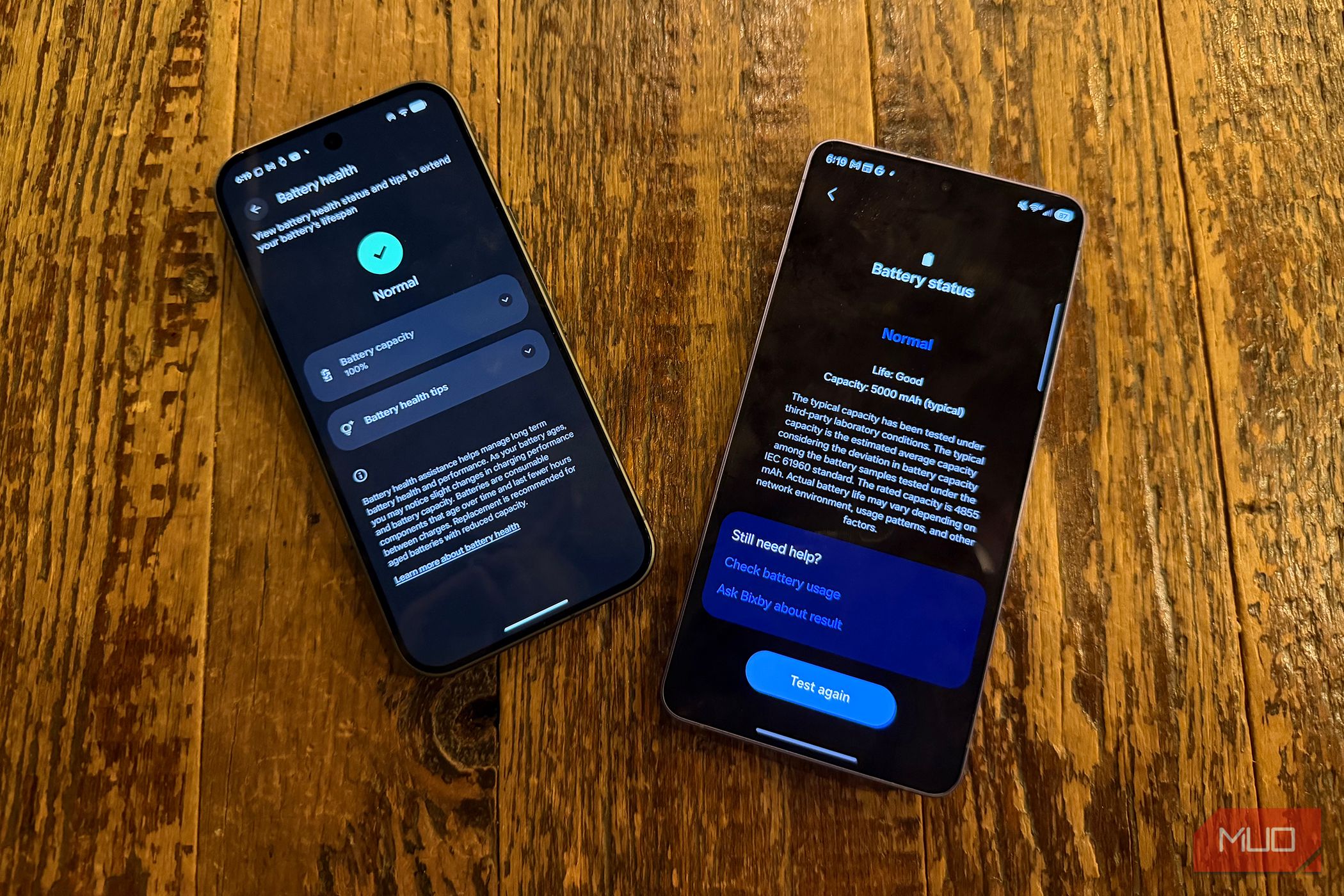
Want to check your phone’s battery health? With a Google Pixel phone, go to Settings, About phone, Battery information to see the exact cycle count. On Pixel 8a and later phones, you can also go to Settings, Battery & charging, Battery health to see its health with the battery capacity as a percentage and a descriptor like “Normal” or “Reduced.” If it says “Reduced,” this means the battery capacity is under the 80% threshold, and it’s time for a replacement.
With a Samsung Galaxy phone, go to Settings, Battery, Battery information. Note that health percentage and cycle counts are only available in newer models running One UI 7 and Android 15 or higher, and only in select regions. Alternatively, check the pre-installed Samsung Members app. Open the app once updated to One UI 9, go to the Support tab, and under Phone diagnostics, select Phone checkup, one of which is for battery status. Select the icon once the check has completed, and you’ll see the status with a word descriptor like Normal, but no exact cycle count.
The number of charge cycles for a phone can’t be extended, and it’s just an estimation. But there are things you can do to preserve as much battery life as you can, as noted above. The general rule-of-thumb suggests charging your phone to 80% and trying not to let it drop to below 20%. Some people still wish to charge their phones to 100%, and I’m one of them. While 20-80% is the sweet spot, a full cycle isn’t counted until it gets to 100% anyway, so go ahead and do that if you need to maximize usage.
Cycle count is important for lifespan
Most people focus on the size of the battery and the rated battery life per charge, as well as the duration of software and security support to inform the potential longevity of a phone. But most of us don’t pay attention to the number of charge cycles. This figure is important, though, especially when there’s such a huge discrepancy, like there is between Google Pixel and some Samsung Galaxy models. Both brands offer seven years of software and security support, but based on this metric, a Google Pixel phone’s battery might need to be replaced sooner than a Samsung Galaxy phone that’s rated for more charge cycles.
This might be a moot point, since most of us will upgrade our phones before five years anyway and certainly before 11 years. Removable batteries are more replaceable in most phones as well, whether you want to use a DIY kit or take it to an authorized repair center. Nonetheless, when you’re considering the longevity of your phone, factor in charging cycles as well as battery life per charge and software and security support. It matters.
 Samsung Galaxy S25
- SoC
- Qualcomm Snapdragon 8 Elite
- Display
- 6.2-inch FHD+ Dynamic AMOLED 2X Display, 120Hz Adaptive Refresh Rate
- RAM
- 12GB
- Storage
- 128, 256GB
- Battery
- 4,000mAh
- Ports
- USB-C The Samsung Galaxy S25 is one of a few Samsung Galaxy phones that has a battery rated for up to 2,000 charging cycles. This is twice as long as the latest Google Pixel phones and could mean that theoretically, the battery could last for up to 11 years based on this metric. It’s an important consideration alongside battery size, charging time, and use per charge when it comes to overall battery health.